Have you ever had an appliance stop working and had no idea why? Or wondered if a wire is broken, a fuse has blown, or a battery is still good?
A multimeter gives you the answer in seconds. It is the one tool every homeowner, student, and technician should keep in their toolkit. Whether you are fixing a car, troubleshooting a circuit, or checking a battery, a multimeter tells you what the electricity is doing.
In this guide, you will learn what a multimeter is, what each of its parts does, how it works, and how to read one. I also cover the parts of an older analog multitester, since many schools and workshops still use them. Everything is explained in simple language so complete beginners can follow along.
What Is a Multimeter?
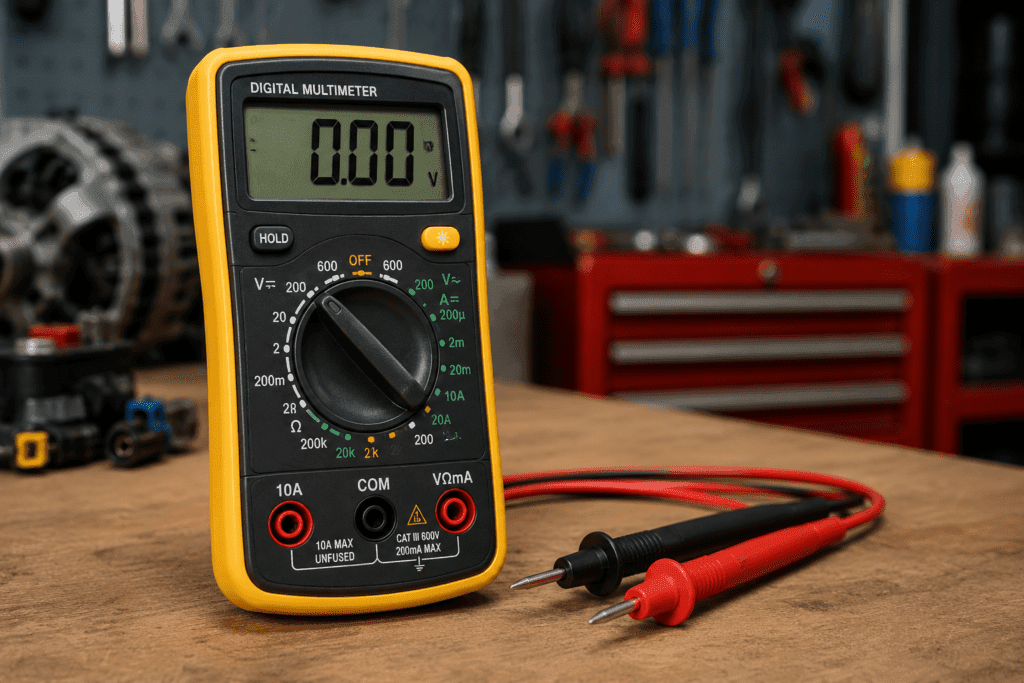
A multimeter is a handheld electrical testing tool that measures voltage, current, and resistance in a single device. Electricians, engineers, students, and DIY users rely on it to find and fix problems in circuits, appliances, and wiring.
The name “multimeter” comes from its ability to take multiple measurements. Before multimeters, technicians needed three separate tools: a voltmeter, an ammeter, and an ohmmeter. A multimeter combines all three into one affordable, portable device.
You will find multimeters in homes, workshops, cars, factories, and electronics labs. When a device stops working and you want to know why, a multimeter is usually the first tool you reach for.
💡 Tip: Ready to use one? My guide on How to Use a Multimeter walks you through every setting step by step.
What Can a Multimeter Measure?
A multimeter measures several electrical properties. Here is what each one means in simple terms.
Voltage (V): Voltage is the force that pushes electricity through a circuit. You measure it to check whether a battery is charged, an outlet is live, or a component is getting the right supply.
Current (A): Current is the flow of electricity through a wire or component, measured in amperes (amps). Measuring it tells you whether a circuit is drawing too much power.
Resistance (Ω): Resistance is how much a component slows the flow of electricity, measured in ohms. Testing it tells you whether a component is damaged.
Continuity: Continuity testing checks for a complete, unbroken path between two points. The meter beeps when it finds one. It is the quickest check for wires, fuses, and switches.
Extra functions on advanced multimeters:
- Capacitance (how much charge a capacitor stores)
- Frequency (how fast an AC signal cycles)
- Temperature (with a thermocouple probe)
- Diode test (checks semiconductor health)
💡 Tip: New to continuity testing? Read my guide on How to Test Continuity with a Multimeter.
Multimeter Parts and Their Functions (Labeled Diagram)
Knowing the parts of a multimeter helps you use it correctly and safely. Every digital multimeter has the same core parts.
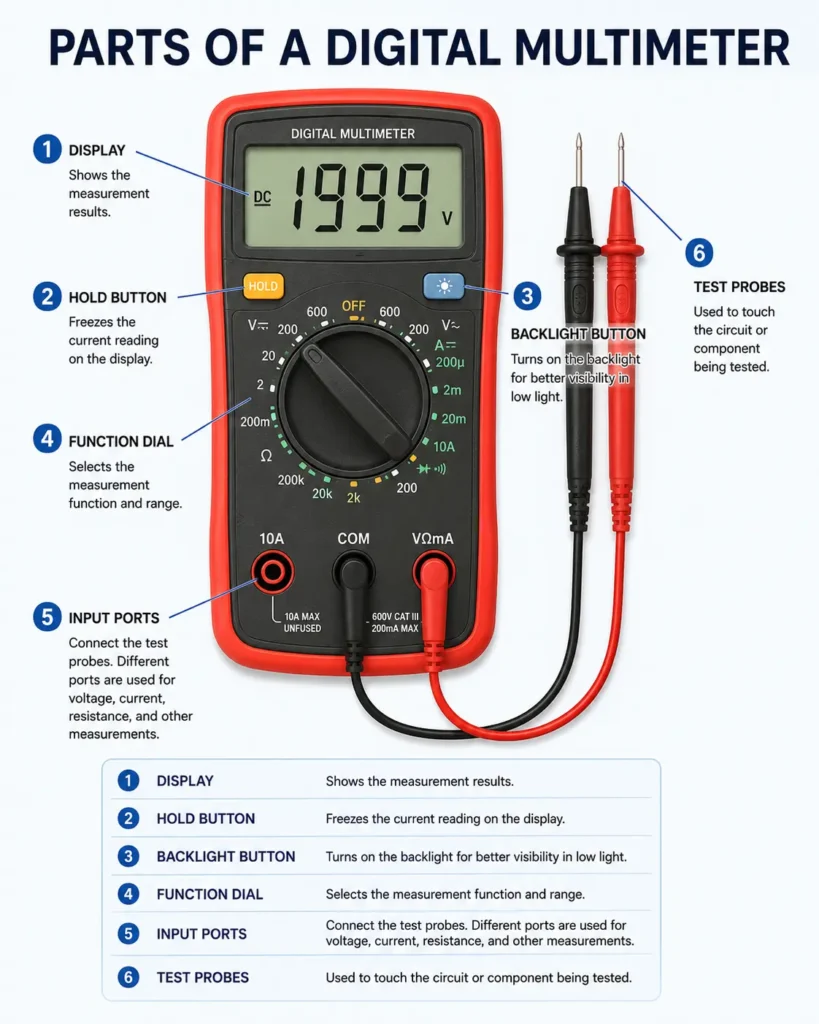
Display
The display is the screen on the front of the meter. It shows the reading, the unit (V, A, or Ω), and status icons such as AUTO, HOLD, and low battery.
Meter makers describe screens in counts, not digits. A 4,000-count meter like the Klein MM400 shows up to 3,999 on each range. More counts means finer readings. Many meters also add a backlight for dark spaces.
Selection Dial (Rotary Knob)
The selection dial is the large knob in the center of the meter. You turn it to choose what to measure. Each position has a symbol, such as DC voltage, AC voltage, resistance, or continuity. My Multimeter Symbols Guide explains every one.
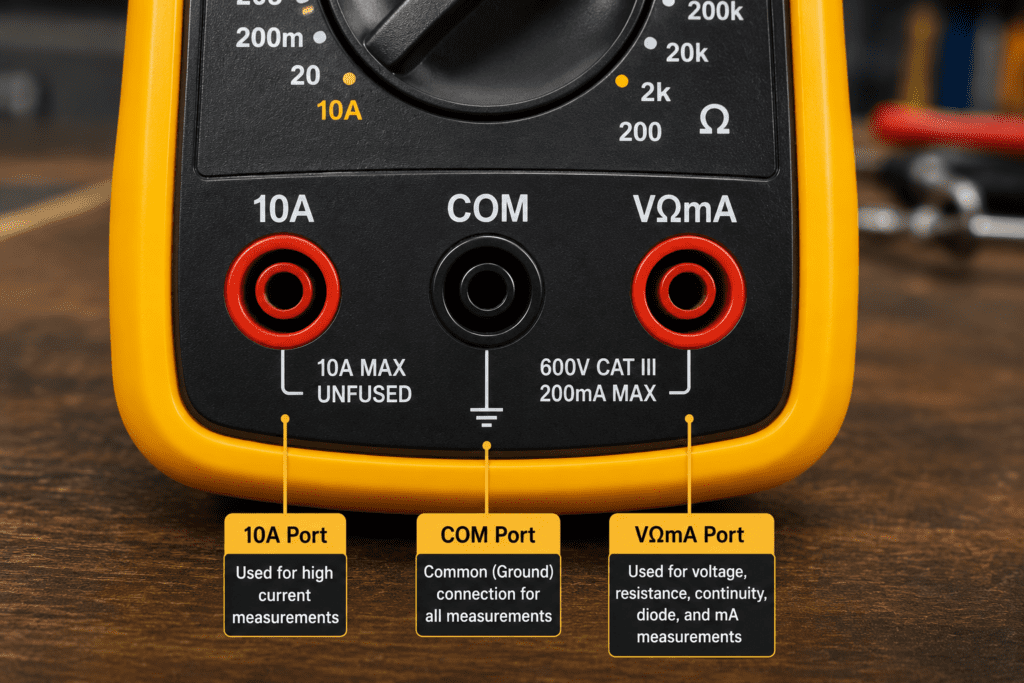
Ports (Input Jacks)
Most multimeters have three or four ports for the test leads.
| Port label | What it is for |
|---|---|
| COM | Common port. The black lead always goes here. |
| VΩ (or VΩmA) | Voltage, resistance, and continuity. On three-port meters, also small currents. |
| mA or µA | Small currents, up to the limit printed beside the jack (often 200mA to 400mA) |
| 10A | Large currents, up to 10 amps |
⚠️ Safety note: Never measure voltage with the red lead in an amps jack. The amps input acts like a short circuit, and it will blow the fuse or damage the meter.
Test Leads (Probes)
Test leads are the two insulated wires that connect the meter to the circuit. The red lead goes in the port for your test. The black lead always goes in COM. Each lead ends in a pointed metal probe tip.
Always hold the probes by their insulated handles, behind the finger guards. Never touch the metal tips while testing a live circuit.
Function and Control Buttons
Buttons near the dial change how the meter works:
- SELECT or FUNC: switches between settings that share one dial position, such as AC and DC voltage.
- HOLD: freezes the reading on the screen.
- RANGE: switches from auto-ranging to manual ranges.
- MIN/MAX: records the lowest and highest readings.
- REL: subtracts a stored reading, such as test lead resistance.
- Backlight: lights the screen.
Battery Compartment
The battery powers the display and the measuring circuit. When the low-battery icon appears, replace it soon, because a weak battery can cause wrong readings.
Internal Fuses
Fuses inside the case protect the current inputs (the mA and 10A jacks) from overload. They do not protect the voltage input. The Klein MM400, for example, uses a 500mA/600V fuse and a 10A/600V fast-blow fuse.
If your meter reads current as zero but still measures volts, a blown fuse is the likely cause.
Holster (Protective Boot)
The holster is the rubber cover around the meter. It absorbs drops and bumps. Many holsters also include a tilt stand and clips for storing the leads.
Parts of an Analog Multimeter (Multitester)
An analog multimeter, often called a multitester, uses a moving needle instead of a screen. Its parts work differently, and two of them need adjusting before every test.
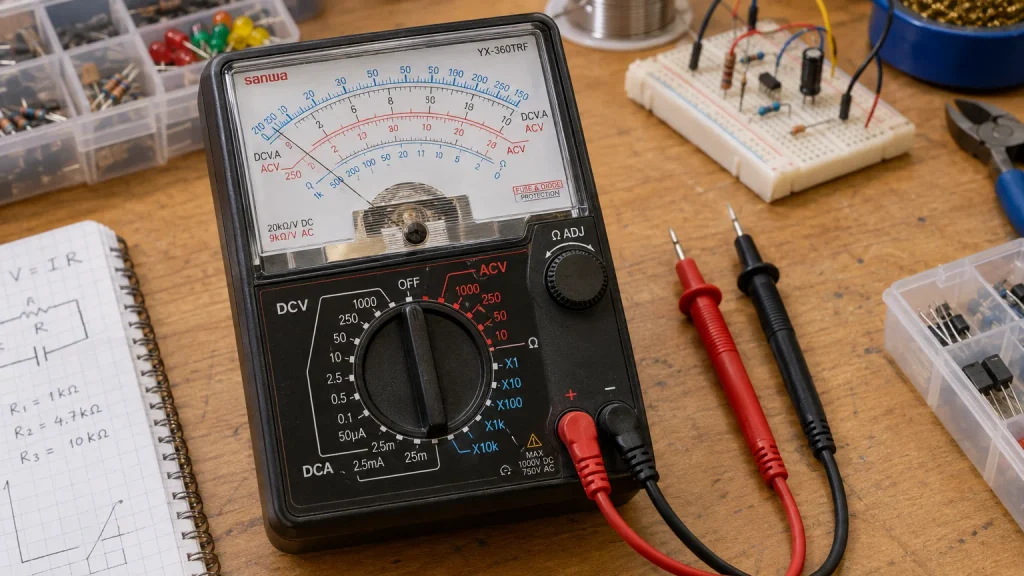
them great for spotting trends like a slowly charging capacitor or a
fluctuating signal.
| Part | What it does |
|---|---|
| Needle pointer | Swings across the scale to show the reading |
| Scale | Printed arcs for volts, amps, and ohms. The ohms scale reads from right to left. |
| Mirror strip | Line the needle up with its reflection, so you read the scale straight on |
| Zero adjustment screw | Sets the needle exactly on zero before you measure, with the leads disconnected |
| Zero-ohm adjustment knob | With the probes touching, turn it until the needle reads 0Ω. Repeat each time you change the ohms range. |
| Range selector switch | Picks the function and range, such as 10V, 50V, or 250V DC, or ×1, ×10, or ×1k for ohms |
| Terminals | The + and COM jacks for the test leads |
| Test probes | The red and black leads that touch the circuit |
| Internal battery | Powers the ohms ranges only. Volts and current readings need no battery. |
For more on reading a needle meter, see my analog voltmeter guide.
Which Multimeter Parts Can You Replace?
Some parts wear out or fail with normal use. Most of them are easy to replace yourself.
| Part | Can you replace it? | What to know |
|---|---|---|
| Test leads | Yes, and it is the easiest upgrade | Match or exceed your meter’s CAT and current ratings. See my Multimeter Test Leads guide. |
| Fuses | Yes | Use the exact current rating, voltage rating, size, and type printed in the manual |
| Batteries | Yes | The battery type is printed on the battery door or in the manual |
| Holster or case | Yes | Measure your meter first. My multimeter case guide shows how. |
| Display, dial, or jacks | Rarely | These need the maker’s repair service. On a budget meter, a new meter often makes more sense. |
⚠️ Safety warning: Never replace a fuse with a higher-rated fuse, a cheaper glass fuse, or a piece of wire. The fuse is a safety part. It is what stops a mistake from turning into a fire or an injury.
Types of Multimeters
There are two main types of multimeters. Each has its own strengths.
Digital Multimeters (DMM)
A digital multimeter shows readings as numbers on an LCD screen. It is the most common type today, for beginners and professionals alike.
Why most people choose a digital multimeter:
- Numbers are clear and easy to read
- More accurate than analog models
- Auto-ranging models pick the correct range for you
- Compact and affordable
Analog Multimeters
An analog multimeter uses a moving needle on a printed scale. The needle swings left or right with the reading.
When an analog multimeter is useful:
- Watching a reading that changes fast, because the needle movement is easy to follow
- Low-cost testing when high precision is not needed
- Classroom training, where reading a scale teaches the basics
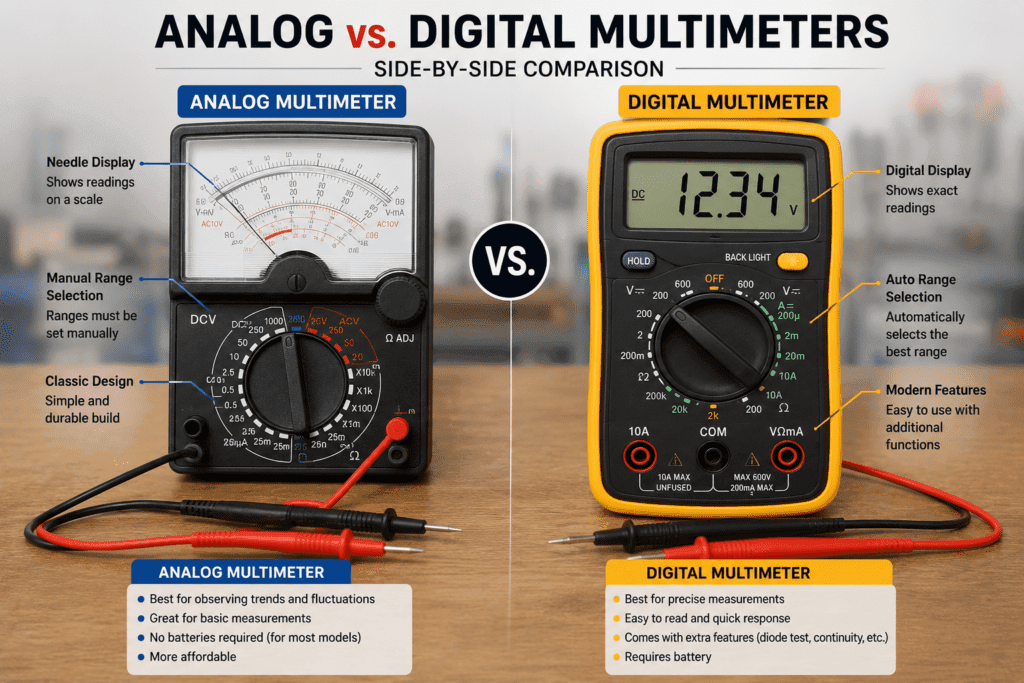
Digital vs Analog Multimeter: Which One Should You Choose?
| Feature | Digital multimeter | Analog multimeter |
|---|---|---|
| Display | Numbers on an LCD screen | Needle on a printed scale |
| Accuracy | High | Lower |
| Ease of use | Very easy for beginners | Takes practice to read |
| Setup before testing | None | Zero the needle; zero the ohms range |
| Price | Affordable to expensive | Usually cheaper |
| Best for | Most everyday tasks | Watching fast-changing signals |
| Auto-ranging | Available on most models | Not available |
For most beginners, a digital multimeter is the right choice. It is easier to read, more accurate, and sold at every hardware store. My guide to the best multimeter for beginners compares the top picks.
How Does a Multimeter Work?
A multimeter works differently for each setting. Here is a simple breakdown.
Voltage measurement: The meter connects across a component, in parallel, and reads the difference in electrical pressure between two points. A digital meter has a very high input resistance, usually 10MΩ, so it barely disturbs the circuit.
Current measurement: The meter must connect in series. You break the circuit and put the meter in the gap, so the current flows through it. The meter then measures how much current passes.
Resistance measurement: The meter sends a small known current through the component from its own battery. It measures the voltage that results and calculates the resistance with Ohm’s law.
Continuity testing: The meter sends a tiny current between the probes. If it flows freely through a very low resistance, the meter beeps. No beep means the path is broken.
💡 Tip: Ohm’s law (V = I × R) is the idea behind every multimeter reading. Voltage equals current multiplied by resistance. Try it in the free Ohm’s law calculator.
How to Read a Multimeter
Reading a multimeter display is simple once you know what the numbers and units mean.
Reading Voltage
The display shows a number followed by V. For example:
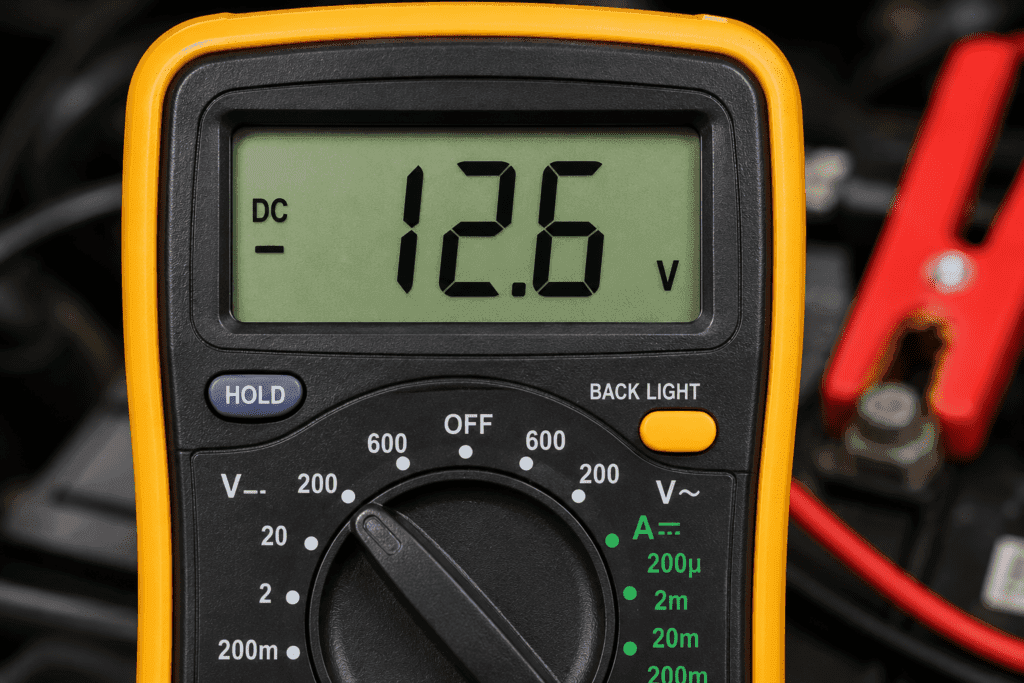
- 12.6V on the DC setting means 12.6 volts DC, a well-charged car battery
- 120V on the AC setting means 120 volts AC, a typical US wall outlet
Reading Resistance
The display shows a number followed by Ω, kΩ, or MΩ:
- Ω = ohms
- kΩ = kilohms (1,000 ohms)
- MΩ = megohms (1,000,000 ohms)
Reading Current
The display shows a number followed by A, mA, or µA:
- A = amperes
- mA = milliamps (one thousandth of an amp)
- µA = microamps (one millionth of an amp)
What Does OL Mean on a Multimeter?
OL means overload. The value is higher than the range the meter is set to.
- In voltage or current mode: switch to a higher range. If the highest range still shows OL, the value is beyond what your meter can measure safely.
- In resistance or continuity mode: OL can mean the range is too low, or that the path is open, such as a broken wire or a blown fuse. On a manual-ranging meter, try a higher range first. If OL stays on the highest range, the path is open.
With the probes touching nothing, the resistance setting shows OL. That is normal.
Multimeter Uses: Real World Examples
A multimeter is useful in more situations than most people expect. Here are the most common ones.
Testing a car battery: Turn the engine off and wait at least 15 minutes. Set the meter to DC volts and touch the probes to the battery terminals. A healthy 12V battery reads 12.6V or higher. My guide on How to Test a Car Battery with a Multimeter has the full voltage chart.
Checking a household fuse: Remove the fuse from the circuit first. Set the meter to continuity and touch one probe to each end. A beep means the fuse is good. No beep means it has blown.
Testing a wall outlet: Set the meter to AC volts and insert the probes into the outlet slots, holding them by the handles. A working US outlet reads between 114V and 126V. See my guide on how to test an outlet for the full method.
Finding a broken wire: With the power off, set the meter to continuity and touch the probes to each end of the wire. A beep means the wire is intact. No beep means there is a break inside.
Checking a resistor: Set the meter to resistance and touch the probes to each end of the resistor. Compare the reading with its color code. My guide on How to Measure Resistance with a Multimeter explains tolerance.
FAQ
What is a multimeter used for?
A multimeter measures voltage, current, and resistance in electrical circuits. It helps you find problems in appliances, cars, wiring, and electronics. It is the most common electrical test tool for technicians, engineers, and DIY users.
How does a multimeter work?
It depends on the setting. For voltage, the meter reads the difference between two points. For resistance, it sends a small current from its battery and calculates ohms with Ohm’s law. For continuity, it beeps when current flows freely between the probes.
What are the parts of a multimeter?
The main parts of a digital multimeter are the display, the selection dial, the input ports, and the test leads. Most also have function buttons, a battery compartment, internal fuses that protect the current inputs, and a rubber holster.
What are the parts of a multitester?
An analog multitester has a needle pointer, a printed scale with a mirror strip, a zero adjustment screw, a zero-ohm adjustment knob, a range selector switch, two terminals, and test probes. An internal battery powers its ohms ranges.
What is the difference between a digital and an analog multimeter?
A digital multimeter shows readings as numbers on a screen and is more accurate and easier to read. An analog multimeter uses a moving needle on a printed scale. Digital meters suit most everyday tasks, while analog meters make fast-changing readings easy to follow.
How do I read a multimeter display?
The display shows a number followed by a unit: V for voltage, Ω or kΩ for resistance, and A or mA for current. OL means the reading is beyond the selected range. In resistance mode, OL on the highest range means the path is open.
Can a beginner use a multimeter?
Yes. A digital multimeter is very beginner-friendly. Turn the dial to what you want to measure, plug the leads into the right ports, and read the screen. Start with the power off whenever you can, and follow basic safety steps.
Conclusion
A multimeter is one of the most useful tools you can own for anything electrical.
It measures voltage, current, and resistance, tests continuity, and helps you find problems in everything from car batteries to household appliances. Once you know the multimeter parts and their functions, from the dial and ports to the fuses inside, you can set it up correctly every time.
For most beginners, a digital multimeter is the best choice. It is accurate, affordable, and easy to read. To keep it accurate, check it against a known voltage now and then, as shown in my guide on how to calibrate a multimeter.
Now that you know what a multimeter is and how it works, the next step is using one. My guide on How to Use a Multimeter gives step-by-step instructions for every measurement. When you have a reading, my free multimeter tools help you work out what it means.