You touch the probes together, and the meter reads 1.8Ω instead of nearly zero. Or the reading jumps every time the cable moves. Most people blame the meter. Usually, the test leads are the problem.
Test leads are the only part of your multimeter that touches the circuit. Worn or cheap multimeter test leads give you wrong readings. In the wrong place, they can also cause a shock or an arc flash.
This guide explains every type of probe and clip, how to read the safety ratings, how to choose a kit, and how to check your own leads in two minutes.
Quick answer: Good multimeter test leads have a CAT rating at least as high as your meter, shrouded 4mm banana plugs, and flexible silicone cable. For CAT III and CAT IV work, the probe tips need caps that limit exposed metal to 4mm. Shorted together, a good pair reads 0.5Ω or less. For most electricians, the Fluke TL175 at $50.99 is the safe default. For electronics, a Probe Master 8000 series kit adds sharp gold-plated tips and screw-on accessories.
💡 How I chose these recommendations: They are based on manufacturer specifications, US retailer listings, and published test data, not on hands-on lab testing. Prices were checked on 3 October 2026 and change often.
What Are Multimeter Test Leads?
Multimeter test leads are the insulated wires that connect your meter’s input jacks to the circuit you are testing, with a plug on one end and a probe or clip on the other.
Three words get mixed up in store listings, so here is the difference:
- Lead: The cable itself, from the plug to the probe handle.
- Probe: The handle and metal tip you hold against a test point.
- Clip: An attachment that grips a wire or terminal so you do not have to hold it.
Many listings say “multimeter probes” when they mean a full test lead set. When you shop, check the photos to see exactly which parts are included.
DMM Leads and DVOM Test Leads
DMM leads and digital multimeter test leads mean the same thing. DVOM is the term car repair manuals use, short for digital volt-ohm meter. DVOM test leads use the same 4mm plugs as any other meter. Automotive kits simply add back-probe pins and larger clips.
Red, Black, and COM
The black lead always goes in the COM jack. The red lead moves between the VΩ jack and the current jacks, depending on the test. If you are new to meters, start with my How to Use a Multimeter guide.
Parts of a Multimeter Test Lead
Every test lead has the same five parts. Each one can fail in its own way, so it helps to know what to look at.
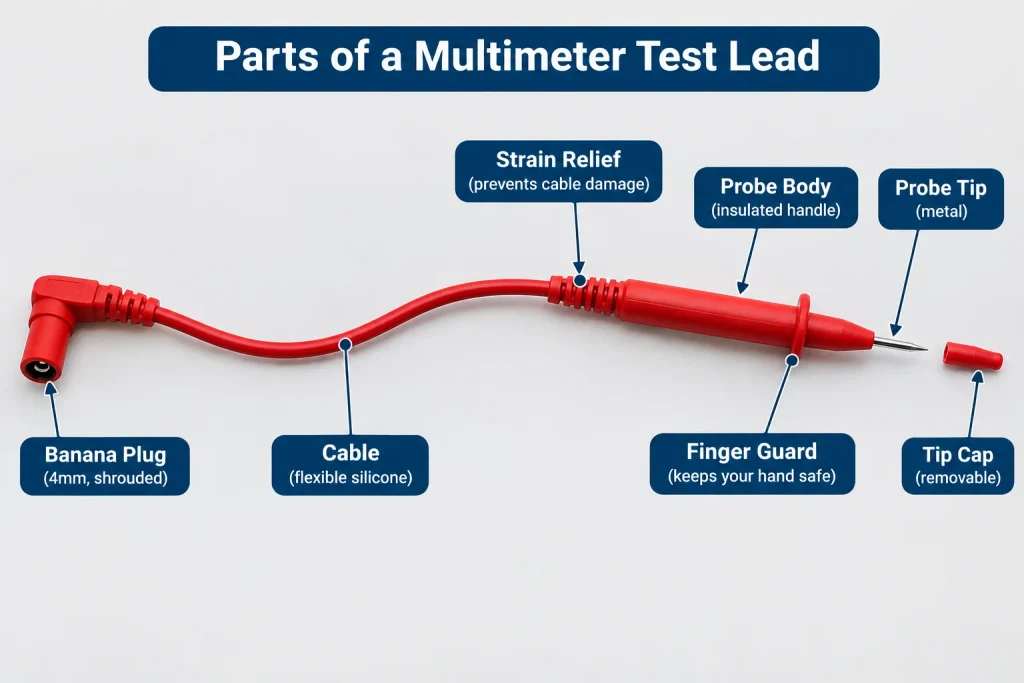
connects to your meter to the probe tip that touches the circuit. Always
keep your fingers behind the finger guard.
| Part | What it does | What to check |
|---|---|---|
| Meter plug | Connects to the meter. Most use a 4mm banana plug inside a plastic shroud. | The shroud slides fully into the jack, with no metal showing. |
| Cable | Carries the signal. Usually 18 AWG copper inside silicone or PVC. | No cuts, burns, or kinks. Some leads have a colored inner layer that shows through when the outer layer is damaged. |
| Strain relief | The flexible boot where the cable meets the plug and probe. | No cracks or exposed wire where the cable bends most. |
| Probe body and finger guard | The insulated handle, with a raised ridge that keeps your fingers away from the tip. | No cracked plastic. Your fingers stay behind the guard. |
| Tip and cap | The metal contact point. A removable cap reduces exposed metal for high-energy work. | The tip is straight and clean. The cap is present for CAT III and CAT IV work. |
What the Tip Is Made Of Matters
Most leads included with a meter use PVC cable and nickel-plated tips. Upgraded leads often use gold-plated or beryllium copper tips, which resist oxidation and make better contact.
In one published US comparison, every gold-tipped probe read 0.1Ω when shorted. The best nickel-plated probes read 0.2Ω, and most read higher. Gold is softer, though, so gold tips wear faster on hard terminals.
Test Lead Safety: CAT Ratings and Tip Shrouds
Your meter and your test leads each carry their own safety rating. The whole setup is only as safe as its lowest-rated part. Fluke’s own probe instructions say not to exceed the CAT rating of the lowest-rated component.
So a CAT III 1000V meter with CAT II 600V leads is a CAT II 600V system. The meter’s rating does not carry over to cheaper leads.
What Each CAT Rating Covers
| Rating | Where it applies | Home examples |
|---|---|---|
| CAT II | Circuits connected directly to outlets and similar points | Wall outlets, plug-in appliances |
| CAT III | The building’s distribution wiring | Breaker panels, fixed wiring, hardwired motors |
| CAT IV | The source of the building’s supply | Service entrance, utility meter, outdoor service drop |
For home users, I recommend CAT III leads at minimum. My Multimeter Buying Guide explains CAT ratings in more depth.
Why Tip Caps Matter: The 4mm Rule
The test lead safety standard, IEC 61010-031, was updated to limit bare metal at the probe tip. Probes used in CAT III and CAT IV environments may expose no more than 4mm of metal. Older probes with 19mm of bare tip must be capped for that work. The long tip is still allowed for CAT II measurements.
The reason is simple. A long bare tip can slip and touch two conductors at once. In a breaker panel, that short circuit can start an arc flash.
The Fluke TL175 solves this with a twisting shroud. Twist it one way for a 19mm tip, and the other way for a 4mm tip. The rating for the tip length in use is printed where you can see it.
⚠️ Safety warning: Do not plug a shrouded alligator clip onto an unshrouded banana tip in a live panel. Fluke warns that this combination leaves accessible metal without suitable insulation.
Check the Current Rating Too
Test leads also have a current limit. The Fluke TL175 is rated for 10A, which matches the 10A jack on most meters. Small clip leads are often rated much lower. Pomona’s popular minigrabber lead set is rated for only 30V AC, 60V DC, and 5A.
Use low-voltage clip leads for electronics only. Never use them on outlets or panels.
Types of Multimeter Test Probes and Attachments
The standard probes in the box handle most jobs. For everything else, there is a probe or clip built for it.
Standard Test Probes
These are the pointed probes that come with your meter. They work for outlets, batteries, fuses, and most wiring checks. For panel work, fit the tip caps first.
Multimeter Needle Probes
Needle probes have thin, very sharp tips. They reach IC pins, small surface-mount pads, and test points packed close together. A sharp point can also push through the clear coating some circuit boards have.
Keep them capped when stored. A needle tip can slip and short two neighboring pins, so steady your hand on the board. If you work on electronics, pair them with the best multimeter for electronics repair.
Micro Test Probes and Grabbers
Micro grabbers have a spring-loaded hook that pulls out of a plastic body. Release the plunger and the hook grips a component leg or a thin wire. They free both hands on a crowded board.
Most micro clip leads are low-voltage parts. The Pomona minigrabber set mentioned above is rated for only 30V AC and 60V DC. Keep them away from mains wiring.
Multimeter Test Leads with Alligator Clips
Alligator clips grip a wire or battery terminal so you can read the meter with both hands free. Screw-on clips are better than push-on clips, because they cannot pull off mid-test.
For mains work, use clips with their own CAT rating. Fluke’s AC175 clips have a flexible boot that pushes back as you clip on, keeping metal covered.
Hands-Free Multimeter Probes
“Hands-free” usually means one of four setups:
- Clips on both leads: alligator clips for large conductors, micro grabbers for small parts.
- Insulated test hooks: a hook that hangs on a conductor, with your fingers well away from bare metal.
- A magnetic meter hanger: it holds the meter on a steel panel at eye level.
- A one-handed probe: some probes have a test button on the handle, so one hand holds both the probe and the trigger.
A good habit: clip the black lead to ground first, then probe with the red lead only.
DVOM Test Leads and Back-Probe Pins
Back-probe pins are thin metal pins that slide into the back of a car connector, alongside the wire. They touch the terminal while the connector stays plugged in, so you can read a live sensor signal. Most automotive kits include them. My best automotive multimeter guide covers meters built for this work.
Insulation-Piercing Probes
These clips push a small pin through the wire’s insulation to reach the copper. Use them only when you cannot reach a connector. Seal the hole afterward with liquid electrical tape, or moisture can creep in and corrode the wire.
Interchangeable Tip Kits (Multi-Pin Kits)
Some lead sets accept screw-on tips. One pair of leads can then switch between hooks, clips, spade lugs, extender pins, and needle tips. The Probe Master 8000 series master kit includes sprung hooks, alligator clips, spade lugs, 4-inch extender tips, and pincer hooks.
Which Probe Should I Use?
| Job | Best probe or clip | Why |
|---|---|---|
| Wall outlet or breaker panel | Standard probes with 4mm caps | Meets the CAT III tip rule |
| Circuit board or IC pins | Needle probes or micro grabbers | Reaches tight points without shorting neighbors |
| Battery or long voltage reading | Alligator clips | Holds steady while you watch the screen |
| Car connector or sensor | Back-probe pins | Reads the signal without unplugging |
| Wire with no reachable connector | Insulation-piercing probe | Reaches copper; seal the hole after |
| Screw terminals | Spade lugs or test hooks | Stays put on the screw |
Silicone vs PVC Multimeter Cables
Multimeter cables come in two common jackets: silicone and PVC. Most leads included with a meter use PVC. Most upgrade leads use silicone.
| Feature | Silicone | PVC |
|---|---|---|
| Flexibility | Very soft; lies flat without coiling | Stiffer; holds the shape it was stored in |
| Cold weather | Stays flexible in the cold | Gets stiff in the cold |
| Heat | Higher melting point; survives a brush with a soldering iron | Melts more easily |
| Toughness | Softer surface can cut on sharp edges | Tougher surface against scrapes |
| Price | Higher | Lower |
If you work outdoors in winter or at a soldering bench, silicone is worth the extra cost. If your leads get dragged across sharp metal all day, a tough PVC set may last longer.
Wire Gauge and Length
Most quality test cables use 18 AWG copper. Thicker wire has less resistance and handles current better. Standard leads are about 1 meter long; Klein’s replacement set, for example, is 41 inches.
Longer leads help with panels and car engine bays. Probe Master sells its 8000 series in lengths from 24 to 120 inches. A longer cable adds a little resistance, which only matters for low-ohm readings.
💡 Tip: Look for a two-color jacket. On leads like the Fluke TL175, a white inner layer shows through when the black outer layer is damaged. That tells you to replace them before the copper is exposed.
What a Good Multimeter Test Leads Kit Includes
A multimeter test leads kit bundles a pair of leads with swappable tips and clips. The right kit depends on what you test.
| Use | Must-have pieces | Nice to have |
|---|---|---|
| Home electrical | CAT III 1000V / CAT IV 600V probes with 4mm caps, CAT-rated alligator clips | Insulated test hooks, magnetic meter hanger |
| Electronics | Needle probes with gold or beryllium copper tips, micro grabbers, silicone leads | Spade lugs, extender pins, tip covers |
| Automotive (DVOM) | Back-probe pins, large alligator clips, leads about 5 feet long | Insulation-piercing probe, magnetic hanger |
How to Judge a Kit
Ignore the piece count. A “25-piece” kit counts every tip and clip separately. Ten useful pieces beat 25 that sit in the bag.
Check the rating on every piece. The leads may be CAT III 1000V while the clips are unrated. The lowest-rated piece sets the limit for that setup.
Prefer screw-on tips. Threaded tips stay in place. Push-on tips can loosen and add resistance.
Check the resistance after you buy. In the US comparison mentioned earlier, one budget 23-piece kit included probes that read 1.1Ω and 2.2Ω. Both are well above Fluke’s 0.5Ω limit for good leads. The test section below shows how to check yours.
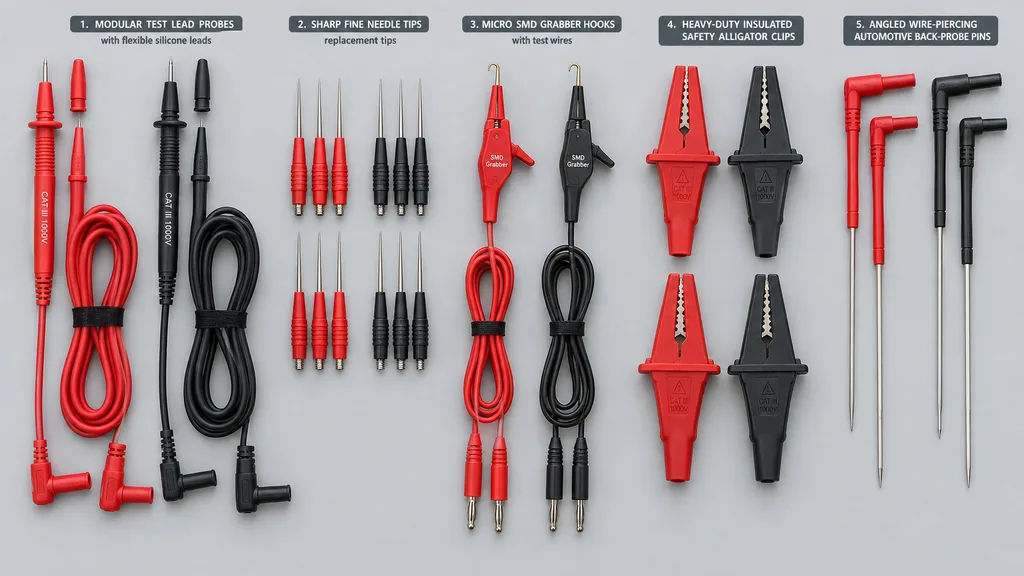
tips for tight spots, grabbers and alligator clips for hands-free
testing, and back-probe pins for car connectors.
Best Multimeter Test Lead Sets
These four sets cover electrical work, electronics, budget replacement, and hands-free bench testing. Prices are from US manufacturer and retailer listings on 3 October 2026.
| Category | Test lead set | Price | Rating | Best for |
|---|---|---|---|---|
| Best overall | Fluke TL175 TwistGuard | $50.99 | CAT III 1000V, CAT IV 600V, 10A | Electricians and home panel work |
| Best kit | Probe Master 8000 series master kit | $74.90 | CAT III 1000V, CAT IV 600V, 10A | Electronics and general bench work |
| Best budget | Klein Tools 69410 | About $20 to $30 | CAT III 1000V, CAT IV 600V | Replacing worn stock leads |
| Best hands-free (low voltage) | Pomona 3782-36-02 minigrabber set | $22.29 | 30V AC, 60V DC, 5A | Circuit boards and components |
Fluke TL175 TwistGuard: Best Overall Test Lead Set
The TL175 is the safe default for anyone who works on outlets and panels.
- Adjustable tip: twist between 19mm and 4mm of exposed metal
- Rated CAT II 1000V, CAT III 1000V, CAT IV 600V, 10A
- Silicone cable with a white wear-indicator layer
- Strain relief tested beyond 30,000 bends
- Fits any meter with standard 4mm shrouded jacks
Known limitations: No clips come in the box. Fluke’s matching AC175 alligator clip set costs another $52.99. The tips are standard size, so they are not ideal for fine circuit board work.
Probe Master 8000 Series Master Kit: Best Test Lead Kit
Probe Master makes these leads in El Cajon, California. They are a common upgrade among electronics technicians.
- Sharp gold-plated tips and 18 AWG silicone leads
- Lengths from 24 to 120 inches
- Includes sprung hooks, alligator clips, spade lugs, tip insulators, 4-inch extender tips, pincer hooks, and a case
- Rated CAT III 1000V, CAT IV 600V, 10A
Known limitations: The bare tip is 0.88 inches long, so fit the tip insulators before panel work. One US reviewer found the screw-on accessories long and awkward on small parts. Gold plating also wears faster than nickel. Choose the meter plug carefully; the 8043SK version has the shrouded right-angle plug that fits Fluke meters.
Klein Tools 69410: Best Budget Replacement Leads
This is a simple, safe swap for the thin leads that came with a budget meter.
- Rated CAT III 1000V, CAT IV 600V
- 41-inch leads with right-angle plugs
- Removable alligator clips that screw onto the tips
Known limitations: The cable is not silicone, so it is stiffer in cold weather. There are no needle tips or micro grabbers.
Pomona 3782-36-02 Minigrabber Set: Best Hands-Free Leads for Electronics
These 36-inch leads end in spring-hook grabbers that hold a component leg while you work.
- 20 AWG wire, red and black
- Stackable banana plugs
- Rated 30V AC, 60V DC, 5A
Known limitations: Use them for low-voltage electronics only. They are not rated for outlets or panels, and the banana plugs are not shrouded.
Replacement Multimeter Leads: What Must Match
Most multimeters accept standard 4mm banana plugs, so most replacement multimeter leads fit. “Most” is not “all,” though. Check these five points before you buy.
| What to match | Why it matters |
|---|---|
| Plug type | Most meters take 4mm banana plugs. Meters with recessed jacks need shrouded plugs. A few older or compact meters use 2mm or pin plugs. |
| Plug angle | Right-angle plugs reduce strain where the cable leaves the meter. Many also fit the lead storage slots on Klein and Fluke meters. |
| CAT rating | Equal to or higher than your meter. Lower-rated leads lower the safety of the whole setup. |
| Current rating | At least as high as your meter’s amp jack, usually 10A. |
| Length and tips | Long leads for panels and cars; fine tips for electronics. |
Signs It Is Time to Replace Your Leads
- The inner wear-indicator color shows through the outer jacket.
- The insulation is cracked, melted, or cut, or any metal is exposed.
- Shorted together, the leads read more than 0.5Ω.
- The reading jumps when you bend the cable near the plug or probe.
- A tip is bent or loose, or a plug feels loose in the jack.
If you see any of these, stop using the leads. Do not tape over damaged insulation and keep working on live circuits.
How to Test Your Multimeter Test Leads
This check takes about two minutes. Do it when you buy new leads, and any time a reading looks strange.
Step 1: Inspect the Leads
Look along each cable, both plugs, and both probe tips. Check for cuts, melted spots, cracks at the strain reliefs, and any visible wear-indicator color.
Step 2: Short the Probes Together
Set the meter to its lowest ohms range. Plug both leads in and touch the tips firmly together. Fluke says good leads read 0.5Ω or less.
Meters with a REL (relative) button can store this lead resistance and subtract it from later readings. That helps with low-ohm measurements.
Step 3: Test Each Lead on Its Own
Fluke’s support team suggests this method. Plug one lead into the VΩ jack. Touch its tip to the metal inside the COM jack. It should read between 0.0 and 0.5Ω. Repeat with the other lead, because one can be good while the other is bad.
Step 4: Do the Flex Test
Keep the tip in place and bend the cable near the plug, then near the probe. A few digits may flicker and settle. If the reading jumps high and stays there, the wire is broken inside.
Do Not Trust the Beep Alone
Continuity beepers often sound at surprisingly high resistance. On the Innova 3320, for example, the beeper sounds at 120Ω or less. A worn lead can beep and still add error, so read the ohms value. My guide on How to Test Continuity with a Multimeter explains the beeper in more detail.
Test Lead Results
| Reading (probes shorted) | What it means | What to do |
|---|---|---|
| 0.0 to 0.5Ω, steady when flexed | Leads are good | Keep using them |
| 0.6 to 2Ω | Dirty or oxidized tips, or a worn lead | Clean the tips with isopropyl alcohol and retest. Replace if still high. |
| Jumps when the cable bends | Broken strands inside the cable | Replace the lead |
| OL (overload) | Open circuit: broken wire or loose plug | Replace the lead |
Real World Example: Why 0.6Ω Matters
Say you check a heating element that should read 10.0Ω. Your leads add 0.6Ω, so the meter shows 10.6Ω. That is a 6% error from the leads alone. On a 1Ω part, the same leads would make it read 60% high. For more on low-ohm readings, see How to Measure Resistance with a Multimeter.
Common Test Lead Mistakes
Using leads rated lower than the meter. A CAT III meter with CAT II leads is a CAT II setup. Check the rating printed on the probe body, not just the meter.
Working in a panel without tip caps. The long 19mm tip is for CAT II work only. Fit the caps, or twist the shroud down to 4mm, before you open a breaker panel.
Using low-voltage clip leads on mains. Many micro grabber and clip leads carry low-voltage ratings, such as 30V AC. They belong on circuit boards, not outlets.
Ignoring lead resistance on low-ohm readings. Half an ohm does not matter on a 10kΩ resistor. It matters a lot on a 1Ω speaker coil or heating element. Use the REL button or subtract the shorted-lead reading.
Pulling leads out by the cable. Grip the plug, not the wire. Yanking the cable strains the joint inside the plug, a common failure point.
Taping over damaged insulation. Tape hides the damage but does not restore the safety rating. Replace the leads instead.
FAQ
What are test leads on a multimeter?
Test leads are the insulated wires that connect a multimeter to the circuit. Each lead has a plug for the meter on one end and a probe or clip on the other. The black lead goes in COM, and the red lead goes in the jack for the test you are running.
Are multimeter leads universal?
Mostly, but not fully. Most meters accept standard 4mm banana plugs, so most replacement leads fit. Meters with recessed jacks need shrouded plugs, and a few use 2mm or pin plugs. Always match the CAT and current ratings too.
Do test leads affect multimeter readings?
Yes. Every lead adds a small resistance, and good leads add 0.5Ω or less in total. Worn leads, dirty tips, or broken strands add more, which shows up most on low-ohm readings. A broken lead can also make voltage readings jump or drop out.
What CAT rating should my test leads have?
Your leads should match or exceed your meter’s rating, because the lowest-rated part sets the limit. For home use, choose CAT III leads at minimum. For panel work, the probe tips must expose no more than 4mm of metal.
How do I know if my multimeter leads are bad?
Short the probes together on the lowest ohms range. A reading above 0.5Ω, a reading that jumps when you bend the cable, or OL means the leads are bad. Also replace leads with cracked insulation or a visible wear indicator.
Are silicone test leads better than PVC?
For most people, yes. Silicone stays flexible in the cold, lies flat, and handles heat better. PVC is cheaper and has a tougher surface, so it can last longer where leads drag over sharp metal.
Conclusion
Good multimeter test leads come down to three things.
- Rating: Match or exceed your meter’s CAT and current ratings, and use 4mm tip caps for panel work.
- Fit for the job: Standard probes for outlets, needle probes and micro grabbers for electronics, clips for hands-free work, and back-probe pins for cars.
- Condition: Shorted together, good leads read 0.5Ω or less and stay steady when you bend the cable.
If you only buy one upgrade, buy a CAT-rated silicone set with screw-on clips. Then check it every few months with the two-minute test above.
Ready to use your new leads? My Multimeter Symbols Guide explains every jack and dial marking, so each lead always goes in the right place.