
You touch the metal case of an appliance and feel a tingle. Or you have just moved into an older home full of three-prong outlets, and you are not sure any of them are actually grounded.
A third hole in the outlet does not prove there is a ground behind it. The only way to know is to test. Here is how to check for ground using a multimeter at an outlet, on a ground wire, and on an appliance, plus the one fault a simple test can miss.
Quick answer: To test for ground with a multimeter, set it to AC volts and measure an outlet three ways: hot to neutral, hot to ground, and neutral to ground. A grounded outlet reads about 120V on the first two and close to 0V on the third. If hot to ground reads 0V, the outlet has no working ground. To test a ground wire itself, turn off the power and check its continuity from end to end.
What a Good Ground Does
The ground wire is a safety path that carries fault current back to the electrical panel, so the breaker trips if a hot wire touches metal.
Here is how it protects you. A loose hot wire touches the metal case of an appliance. Current flows through the ground wire instead of through you. That large current trips the breaker within moments.
In a home, the ground wire is green or bare copper. It is not the same as the neutral wire. The neutral carries current every time a light is on. The ground carries current only during a fault.
Safety and Tools
⚠️ Safety warning: If you feel a tingle from an appliance or fixture, unplug it or turn off its breaker and stop using it until it is repaired. A tingle means current is reaching metal it should not.
Method 1 is a live test at 120V. Use a meter rated CAT III, hold the probes only behind the finger guards, and keep your other hand away. Methods 2 and 3 are done with the power off or the device unplugged. Before any power-off test, prove the circuit is dead with the live-dead-live method: test a known live outlet, test your circuit, then test the known live outlet again.
What you need:
- Digital multimeter with AC voltage and continuity or ohms, rated CAT III
- Non-contact voltage tester
- Screwdriver
- A long spare wire or extension lead, for testing a ground wire between two rooms
- A plug-in load such as a hair dryer, for the bootleg ground check
Need help choosing a tester? See my guide to the best voltage tester.
Method 1: Test an Outlet for Ground (Power On)
This is the quickest way to check for ground using a multimeter. You take three voltage readings and compare them.
On a standard US outlet, the short slot is hot, the tall slot is neutral, and the round hole is ground.
Step 1: Set Up the Meter
Plug the black lead into COM and the red lead into VΩ. Turn the dial to AC volts (V~). Check the meter on an outlet you know works.
Step 2: Hot to Neutral
Put the red probe in the short slot and the black probe in the tall slot. A working outlet reads 114V to 126V. Write the number down.
Step 3: Hot to Ground
Keep the red probe in the short slot and move the black probe to the round hole. If the outlet is grounded, this reading is close to the Step 2 reading, usually within a few volts.
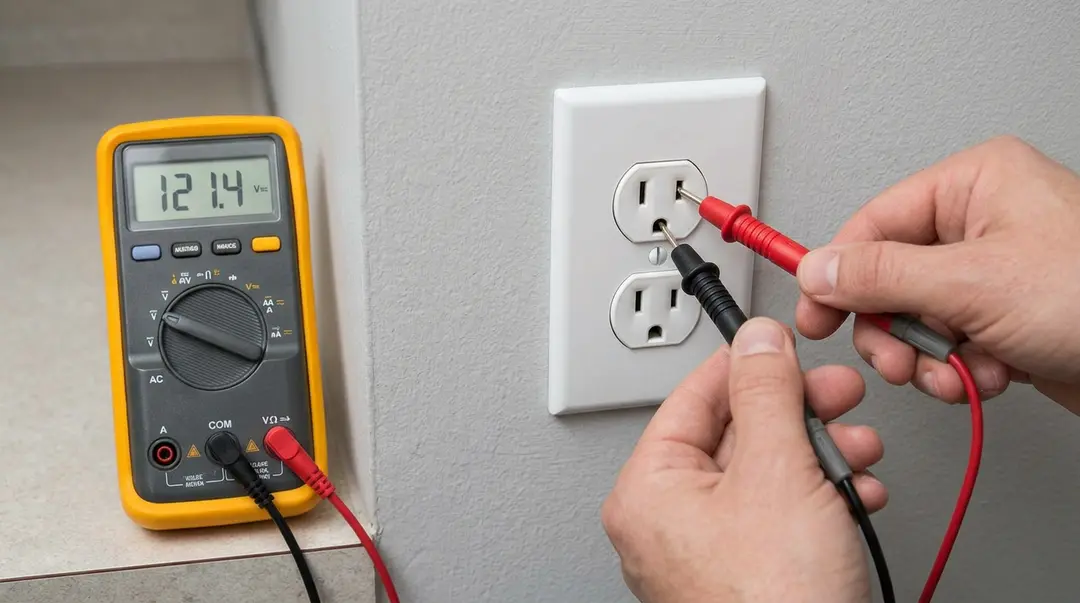
neutral. If it reads near 0V, the outlet’s ground isn’t connected.
Step 4: Neutral to Ground
Put one probe in the tall slot and the other in the round hole. With nothing running on the circuit, this should read close to 0V, usually under 2V.
Outlet Ground Test Results
| Hot to neutral | Hot to ground | Neutral to ground | What it means | What to do |
|---|---|---|---|---|
| About 120V | About 120V | Near 0V | A ground path is present | Good. In an older home, also do the bootleg ground check below. |
| About 120V | 0V | 0V | Open ground: nothing is connected to the ground hole | Do not use it for appliances that need a ground. Have an electrician repair it. |
| About 120V | Near 0V | About 120V | Reversed polarity: hot and neutral are swapped | Have it rewired before use. |
| About 120V | A partial reading, such as 40V | A partial reading | Poor ground connection, or ghost voltage | Retest in LoZ mode if your meter has it. If it stays, call an electrician. |
| About 120V | About 120V | Several volts, nothing running | Loose or overloaded neutral | Call an electrician. |
| 0V | 0V | 0V | No power | Check the breaker and any GFCI outlet upstream. |
An ungrounded three-prong outlet can be made safer without new wiring. An electrician can fit a GFCI outlet and label it “No Equipment Ground,” which US electrical code allows. For the full outlet test, including polarity and GFCIs, see my guide on How to Test an Outlet with a Multimeter.
Method 2: Test a Ground Wire for Continuity (Power Off)
Checking grounding with a multimeter this way tells you whether a ground wire is actually connected along its whole length. Use it when a box has a ground wire but you are not sure where it goes, or when Method 1 showed a weak ground.
Step 1: Turn Off the Power and Prove It Dead
Turn off the breaker and use the live-dead-live method on every wire in the box. Continuity mode must only be used on dead circuits.
Step 2: Find a Known Good Ground
You need a reference point that you know is grounded, such as the ground hole of an outlet that passed Method 1, or a grounded metal box. Run a long spare wire from that point to the box you are testing.
Step 3: Set Up the Meter
Turn the dial to continuity or the lowest ohms range. Touch the probes together and note the reading. That is your test lead resistance, usually a few tenths of an ohm.
Step 4: Measure
Touch one probe to the ground wire in the box you are testing. Touch the other probe to the end of your spare wire.
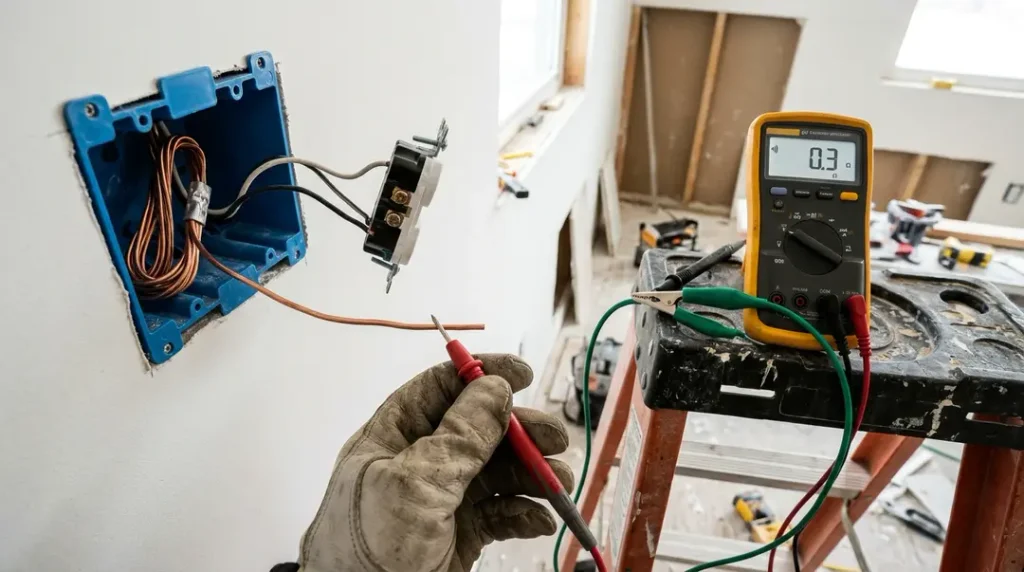
run it to the far end of the wire. A reading near 0 Ω confirms the
wire is unbroken.
Ground Wire Continuity Results
| Reading (minus lead resistance) | What it means | What to do |
|---|---|---|
| Under 1Ω | The ground wire is connected | Good |
| Several ohms | Loose, corroded, or damaged connection somewhere along the run | Check and tighten the ground connections in each box |
| OL | The ground wire is broken or not connected | Find the break, or call an electrician |
Why under 1Ω? Standard 14 AWG copper house wire has about 2.5Ω of resistance per 1,000 feet. A 50-foot run is only about 0.13Ω. A reading of several ohms means a bad connection, not just a long wire.
For more on reading continuity, see my guide on How to Test Continuity with a Multimeter.
Method 3: Test an Appliance or Tool Ground (Unplugged)
An appliance with a three-prong plug grounds its metal case through the round pin. If that path breaks inside the cord or the case, a fault could make the case live. This test finds the break.
- Unplug the appliance. This test is always done with it unplugged.
- Set the meter to continuity or the lowest ohms range.
- Touch one probe to the round ground pin on the plug.
- Touch the other probe to bare metal on the case, such as an unpainted screw or bracket.
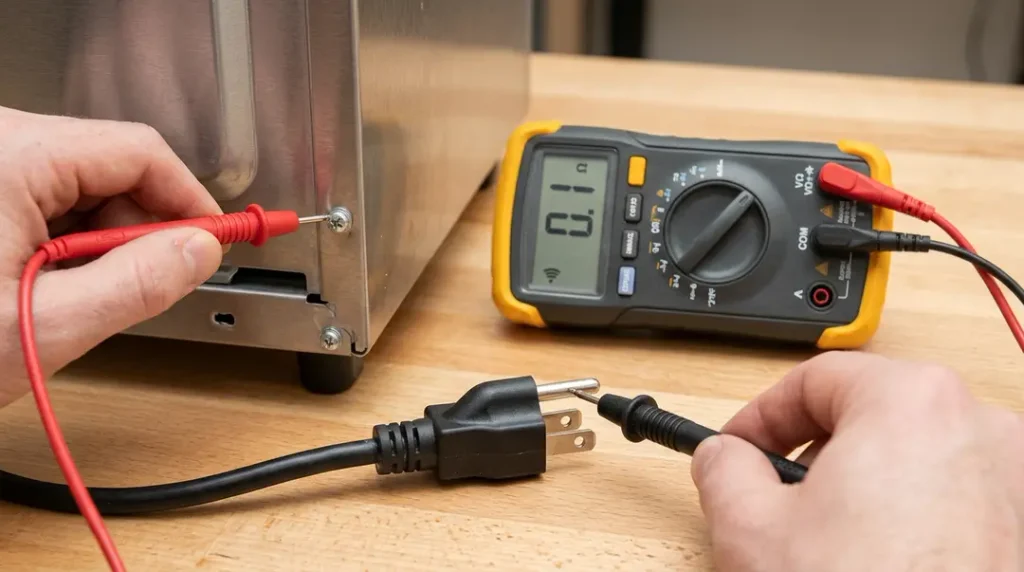
ground pin to bare metal means the case is grounded. OL means the
ground is broken, so repair it before use.
| Reading | What it means | What to do |
|---|---|---|
| Close to 0Ω, under 1Ω | The ground path is intact | Good |
| Several ohms | Loose or corroded ground connection | Have it repaired before use |
| OL | The ground path is broken | Do not use it until it is repaired |
Then, with the appliance’s own switch ON, check from each flat pin to the case. Both should read OL. A low reading means a hot or neutral part is touching the case, and the appliance is unsafe.
A multimeter tests at a low voltage, so it can miss insulation that only breaks down at full voltage. For that, use an insulation resistance tester.
Two-prong tools have nothing to test. Double-insulated tools carry a symbol of a square inside a square. They are designed to be safe without a ground wire.
Testing a Car Ground
In a car, ground means the battery negative terminal and the metal body and engine connected to it. A bad car ground causes dim lights, slow cranking, and odd electrical faults.
The best test is a voltage drop test under load: measure between the ground point and the battery negative while the circuit runs. Under 0.2V is healthy, and above 0.5V means a poor ground. My Car Electrical Diagnostic guide walks through the full test.
What a Multimeter Cannot Tell You About Ground
A multimeter is the right tool for most ground checks, but it has limits. Knowing them keeps a passing reading from giving you false confidence.
Bootleg Grounds
A bootleg ground is a short jumper wire from the neutral screw to the ground screw on an outlet. It is often found in older homes where three-prong outlets were fitted without a real ground wire.
It is dangerous because it passes the basic tests. Hot to ground reads about 120V, and neutral to ground reads 0V, exactly like a good outlet. Simple three-light plug-in testers cannot detect it either. If the neutral wire ever comes loose upstream, the metal case of anything plugged in can become live.
Two ways to catch one:
- The load check. Plug a hair dryer into one half of the outlet and run it on high. Measure neutral to ground at the other half. On correct wiring, the reading rises a little, often to about a volt, because the neutral wire is carrying current. On a bootleg ground, it stays at 0.0V, because neutral and ground are joined right at the outlet.
- Look. Turn off the power, prove it dead, and pull the outlet. A jumper from the silver screw to the green screw is a bootleg ground.
If you find one, have an electrician remove it. A GFCI outlet labeled “No Equipment Ground” is a code-allowed fix when no ground wire is available.
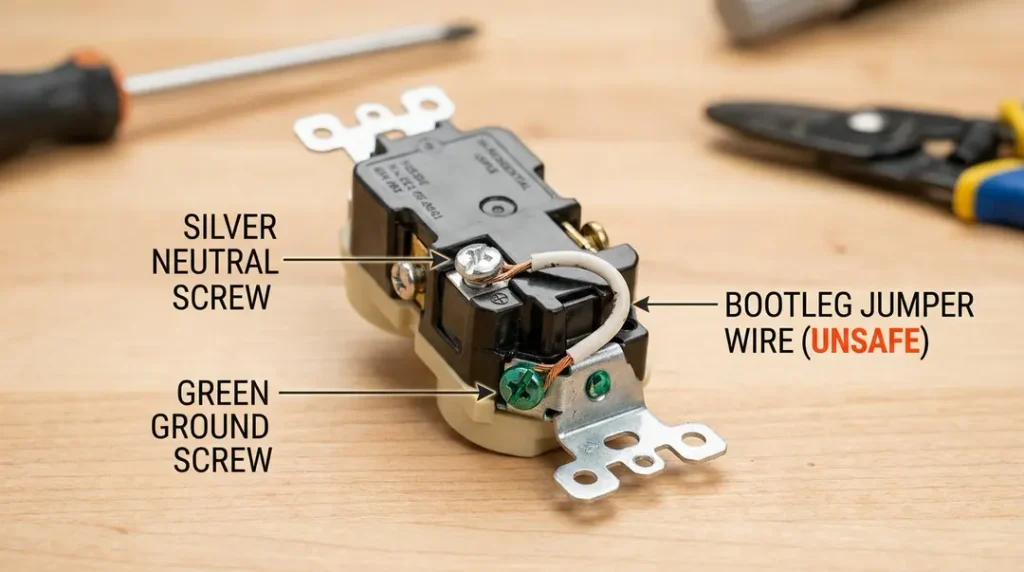
correct wiring. If neutral to ground reads exactly 0V while the circuit
is under heavy load, open the box and check.
Ground Rod Resistance
Your home’s grounding system ends at a ground rod or other electrode in the earth. Its resistance to earth needs a dedicated earth ground resistance tester. A multimeter cannot measure it, and IBM’s own equipment installation guide warns against using one for grounding resistance.
Fault Current Capacity
A continuity test uses a tiny current. It proves the ground path exists, not that it can carry the large current of a real fault. Electricians use a loop impedance tester or a plug-in circuit analyzer for that.
Common Mistakes When Checking Ground
Assuming a three-prong outlet is grounded. The third hole proves nothing. Test it.
Trusting a three-light tester alone. It cannot detect a bootleg ground. Use a multimeter and the load check.
Using continuity or ohms mode on a live circuit. It gives false readings and can damage the meter. Turn the power off first.
Using a water pipe as a known ground. Plastic sections in the plumbing can break the metal path. Use a ground that passed Method 1 instead.
Mistaking ghost voltage for a real reading. A floating ground wire can show tens of volts on a high-impedance meter. Retest in LoZ mode before you decide.
FAQ
How do you test for ground with a multimeter?
Set the meter to AC volts and take three readings at the outlet: hot to neutral, hot to ground, and neutral to ground. A grounded outlet reads about 120V on the first two and close to 0V on the third. To test a ground wire itself, turn off the power and check its continuity to a known good ground.
What should a ground read on a multimeter?
At a US outlet, hot to ground should read about the same as hot to neutral, between 114V and 126V. Neutral to ground should read close to 0V with nothing running. On a continuity test, a good ground wire reads under 1Ω.
How do I know if my outlet is grounded?
Measure from the short hot slot to the round ground hole. About 120V means a ground path is present, and 0V means the outlet has no working ground. In an older home, also run the load check, because a bootleg ground gives the same reading as a real one.
Can you test ground without power?
Yes. With the power off, use continuity mode to test a ground wire to a known good ground, or to test an unplugged appliance from its round plug pin to its metal case. A good ground reads under 1Ω.
Why does my multimeter show voltage between neutral and ground?
A small reading, about a volt, is normal while appliances are running, because the neutral carries current. Several volts with nothing running points to a loose neutral. A reading near 120V means the hot and neutral wires are reversed.
Can a multimeter detect a bootleg ground?
Not with the basic readings, because a bootleg ground reads the same as a real one. Run a hair dryer on one half of the outlet and measure neutral to ground on the other half. If it stays at 0.0V, neutral and ground are probably joined at the outlet. Pulling the outlet and looking for the jumper confirms it.
Conclusion
Testing for ground with a multimeter takes a few minutes and can uncover a hidden shock hazard.
- At an outlet: hot to ground should match hot to neutral, and neutral to ground should read close to 0V.
- On a wire or appliance: with the power off, a good ground reads under 1Ω to a known ground.
- Know the limits: a bootleg ground passes the basic test, so run the load check in older homes. Ground rods need a dedicated earth ground tester.
Ready to check the rest of the outlet? My guide on how to measure AC voltage covers every household voltage test, from outlets to 240V appliances.