You are about to touch a wire, and you genuinely do not know if it is live. This is exactly the moment a voltage tester exists for: a quick, reliable way to confirm whether electrical power is present before you commit to any repair.
This guide covers what a voltage tester actually is, the real difference between it and other electrical testers, how to use one safely, and how to choose the right electrical tester kit for your specific work.
What Is a Voltage Tester?
A voltage tester is a handheld device that detects the presence of electrical voltage in a wire, outlet, or component, either by direct contact or without touching the conductor at all.
Voltage Tester vs Multimeter vs Electrical Tester
These terms get used loosely, so here is the real distinction. A voltage tester tells you a simple yes or no, voltage is present or it is not, sometimes with a rough range indication. A multimeter is a far more capable voltage meter, giving you an exact numeric voltage reading along with current, resistance, and continuity measurements. “Electrical tester” is really an umbrella term covering both, plus circuit testers, outlet testers, and continuity testers.
For a quick safety check before touching a wire, a simple voltage tester is faster and safer to use. For diagnosing an actual electrical problem, a multimeter gives you the precise information you actually need.
💡 See our How to Use a Multimeter guide if you need the exact voltage value rather than a simple yes or no check.
How a Voltage Detector Electric Device Actually Works
A non-contact voltage detector electric device works by sensing the electromagnetic field that alternating current naturally produces around a wire. The tip of the tester contains a sensor tuned to pick up this field from a short distance, triggering an audible beep, a visual light, or both once it detects voltage nearby.
A contact voltage tester works differently, requiring the probe tip to physically touch the conductor, completing a small internal circuit that lights an indicator or produces a reading when voltage is present.
Voltage Tester vs Current Tester: Don’t Confuse These Two
This mix-up happens constantly, and understanding the difference matters for choosing the right tool.
What a Voltage Tester Detects
A voltage tester answers the question “is there electrical potential present here?” It tells you whether a wire is live, whether an outlet has power, or whether a circuit is energized.
What a Current Tester (Ammeter) Measures Instead
A current tester, more accurately called an ammeter, answers a completely different question: “how much current is actually flowing through this wire right now?” This requires either breaking the circuit to measure in series, or using a clamp-style current tester that senses the current through its magnetic field.
💡 See our Amp Meter Guide for the complete breakdown of current testers and our Clamp Meter Guide for the safest way to measure current without breaking a circuit.
Why the Terms Get Mixed Up Online
Both tools are commonly called “testers” and both are used for electrical safety work, which is exactly why search results and product listings often blur the line between an electric current tester and a voltage tester. They are not interchangeable, a voltage tester cannot tell you how many amps are flowing, and a current tester generally cannot confirm whether a dead-looking wire is actually safe to touch the way a voltage tester can.
Types of Voltage Testers
Non-Contact Voltage Tester Pen (Volt Pen)
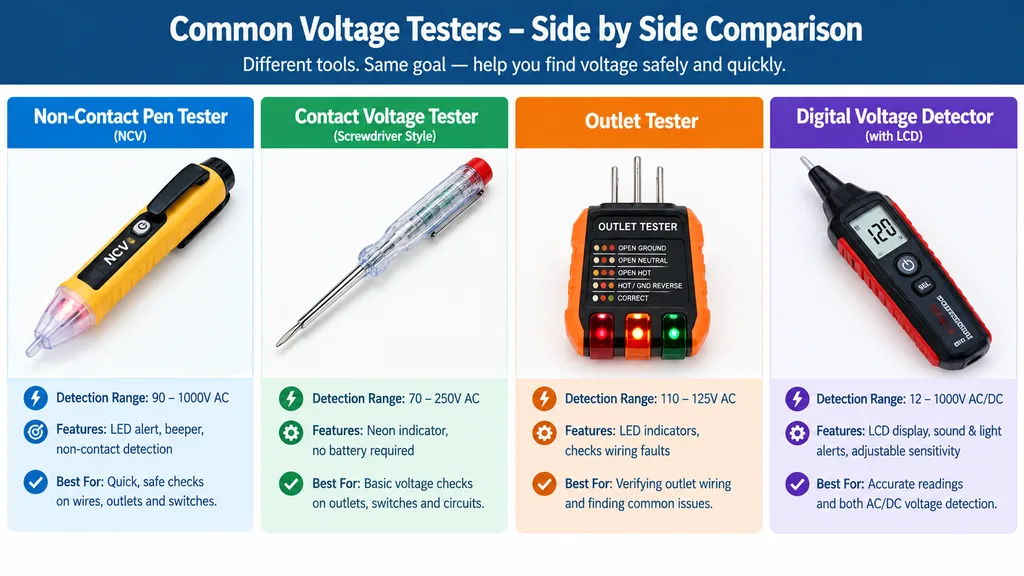
A volt pen is the most common style: a pocket-sized non-contact voltage tester pen that detects live wires without touching them. Simply hovering the tip near an insulated wire or outlet slot triggers an alert if voltage is present.
Contact Voltage Tester
A contact voltage tester requires you to touch the probe tip directly to the conductor or terminal. These are generally more reliable for a definitive reading than non-contact models because they respond to actual electrical contact rather than a nearby field.
Outlet Tester (Circuit Tester)
An outlet tester, sometimes called a circuit tester, plugs directly into a standard wall outlet. A pattern of small indicator lights tells you not just whether the outlet has power, but whether it is wired correctly, flagging common problems like an open ground or reversed polarity.
Digital Voltage Detector with LCD Display
A digital voltage detector adds an actual numeric readout to the detection function, giving you an approximate voltage value rather than just a simple presence indicator. This bridges the gap between a basic tester unit and a full multimeter.
Multimeter as a Voltage Meter
Every standard multimeter functions as a highly capable voltage meter, giving you an exact reading down to a tenth of a volt, far beyond what any dedicated voltage tester provides.
Does a Voltage Tester Work on a Car? (AC vs DC Testing)
Why Standard Voltage Testers Only Detect AC
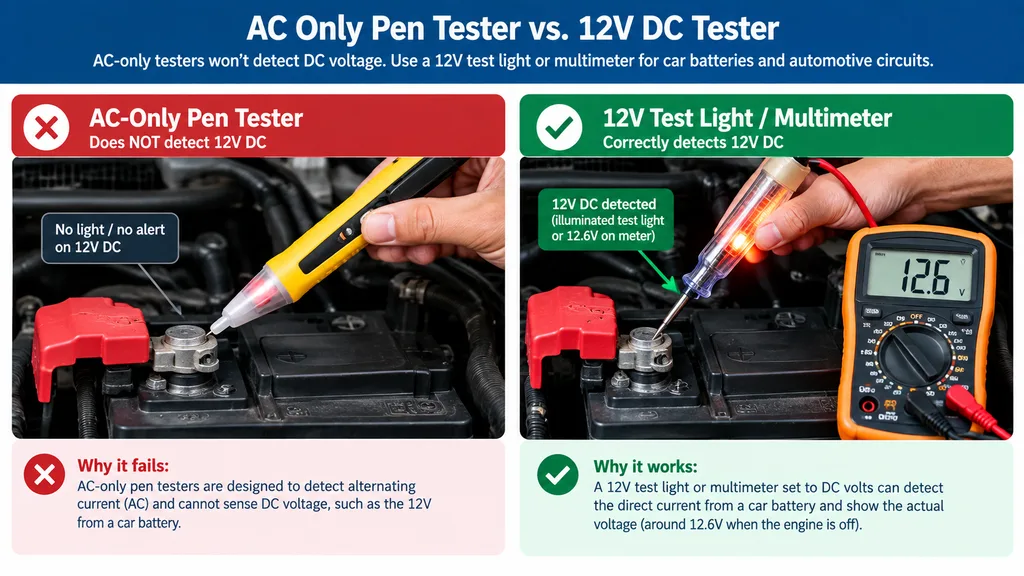
This is genuinely important for your automotive projects, and it is a limitation most product listings never explain clearly. A standard non-contact voltage tester pen detects the electromagnetic field that alternating current produces as it constantly changes direction. A steady, unchanging DC current, the kind found in every car’s electrical system, does not produce this same changing field, which means a standard AC voltage tester will not reliably detect it.
12 Volt Testers for Automotive DC Circuits
For automotive work, you need a tool specifically designed for DC, either a dedicated 12-volt tester (often a simple contact-based test light) or a standard multimeter set to DC voltage mode.
When You Need a Multimeter Instead
Any time you need an exact voltage reading on a car battery, alternator output, or automotive circuit, reach for a multimeter rather than a voltage tester. See our How to Test a Car Battery with a Multimeter guide for the full process.
How to Use a Voltage Tester Pen Safely
The Live-Dead-Live Test
This is the single most important habit for using any voltage tester, and it is a simple three-step verification. First, test your tester on a circuit or outlet you know is definitely live, confirming the tester actually alerts correctly. Second, test the circuit you actually want to check. Third, immediately retest your tool on that same known-live source again to confirm it is still working correctly and did not fail silently between the first and second checks.
⚠️ Never trust a “no voltage” reading without bracketing it this way. A voltage tester with a dead battery, a damaged sensor, or a simple malfunction can silently fail to alert on a genuinely live wire, and the only way to catch that is by verifying the tool against a known-live source immediately before and after your actual test.
Step by Step Non-Contact Testing
- If your tester has a self-test button, press it first to confirm the battery and sensor are working
- Perform the live-dead-live verification described above
- Hold the tester near the insulated wire, outlet slot, or component you want to check
- Watch for the visual or audible alert indicating voltage is present
Step-by-Step Contact Voltage Testing
- Verify the tester with the live-dead-live method
- Insert or touch the probe tips to the terminals or conductor you are testing
- Read the indicator, light, or display
How to Use an Extension Cord Tester and Continuity Circuit Tester
Testing an Extension Cord for Internal Breaks
An extension cord tester checks whether the internal wiring of a cord is intact along its full length, catching an internal break that looks completely fine from the outside. Many combination outlet testers include this function, or you can check continuity directly with a multimeter.
💡 See our How to Test Continuity with a Multimeter guide for the complete continuity testing process, including extension cords and other cables.
Continuity Circuit Tester vs Voltage Tester, What Is the Difference
A continuity circuit tester checks for an unbroken electrical path in a circuit that should have no power connected, confirming a wire, fuse, or switch is intact. A voltage tester checks the opposite scenario, confirming whether a circuit that should be energized actually has power present. Never use a continuity tester on a live circuit, and never expect a voltage tester to tell you whether a de-energized wire is physically intact.
What Voltage Rating Do You Need?
Standard Household Voltage Requirements
A standard North American household runs on a 120/240-volt AC system, so an electrical voltage tester intended for general home use should be rated for at least 250 volts AC to comfortably cover both standard 120V circuits and larger 240V appliance circuits like dryers and ranges.
Low Voltage Detection for Doorbells and Thermostats
Many everyday household systems, including doorbells and thermostat wiring, run on much lower voltage, sometimes as low as 12V to 24V. A standard voltage tester calibrated only for full mains voltage may not reliably detect these low-voltage circuits. Look for a dual-range model if you plan to work on both standard wiring and low-voltage systems.
How to Choose the Right Electrical Tester
Voltage Range
Confirm the tester’s rated range comfortably covers everything you plan to test, from low-voltage doorbell wiring up through 240V appliance circuits if relevant to your work.
Safety Certification (CAT Rating, UL, CE)
Look for a CAT II or CAT III safety rating for general household work, matching the same standards used for multimeters, along with recognized certification marks like UL or CE, which indicate the device has passed independent safety testing.
Audible vs Visual Alerts
A tester with both audible and visual alerts is more reliable than one relying on a single indicator type, since you may not always be positioned to see a light or hear a beep depending on your working conditions.
Build Quality and Battery Life
A durable case that survives a drop, along with reasonable battery life and easy battery access, matters more than most buyers expect for a tool you will reach for constantly.
Electrical Tester Kit vs Standalone Tester
What Is Included in a Kit
An electrical tester kit typically bundles a non-contact voltage tester pen alongside an outlet tester, and sometimes a basic multimeter, giving you multiple tool types in one purchase.
When a Kit Makes Sense
A kit is worth considering if you are building out your first set of electrical testers and want broad coverage in a single purchase, rather than buying each tool type separately over time.
Tester Price: What to Expect

Price by Design Type
| Tester Type | Typical Price Range |
|---|---|
| Basic non-contact voltage tester pen | Affordable, entry-level pricing |
| Outlet tester | Similarly affordable |
| Digital voltage detector with LCD | Moderate, reflecting the added display |
| Electrical tester kit (multiple tools bundled) | Higher total, but often better value than buying separately |
What Drives the Cost Up
Tester price increases with higher CAT safety ratings, dual-range detection, added features like a built-in flashlight or self-test function, and established brand reputation, similar to the factors that drive multimeter pricing.
Common Mistakes When Using a Voltage Tester
Trusting a Tester Without Self-Testing It First
Skipping the live-dead-live verification is the single most dangerous mistake possible with any voltage tester. A silently failed tester gives you false confidence exactly when you need accurate information most.
Using an AC Tester on a DC Circuit
As covered above, a standard AC voltage tester will not reliably detect DC voltage from a car battery or other automotive source. Assuming “no beep” means “no power” on a DC circuit is a genuinely dangerous assumption.
Ignoring the Voltage Range Rating
Using a tester rated for a lower voltage range than what you are actually testing can give you an inaccurate or incomplete reading, and in some cases risks damaging the tester itself.
FAQ
Is a voltage tester the same as a multimeter?
No. A voltage tester gives a simple presence or absence indication, sometimes with a rough range, while a multimeter provides an exact numeric voltage reading along with current, resistance, and continuity measurement. A voltage tester is faster for a quick safety check, while a multimeter is the right tool for actual diagnostic work.
Are voltage testers safe?
Yes, when used correctly and verified with the live-dead-live test before relying on a result. A voltage tester is specifically designed to let you check for live voltage without directly touching a bare conductor, but no tester should ever be trusted blindly without confirming it is functioning correctly against a known-live source first.
How do I know if my voltage tester is working?
Perform the live-dead-live test. Test the tester on a source you know is definitely live and confirm it alerts correctly, then test your actual target, then retest on the known-live source again immediately afterward to confirm the tool did not fail silently during your check.
What is the difference between a voltage tester and a circuit tester?
These terms are often used interchangeably, though “circuit tester” sometimes specifically refers to an outlet tester that plugs into a wall socket and uses a pattern of lights to diagnose wiring problems like reversed polarity or an open ground, going beyond a simple voltage presence check.
Does a voltage tester work on a car battery?
A standard AC voltage tester pen generally does not reliably detect DC voltage from a car battery, since it relies on the electromagnetic field that only alternating current produces. For automotive DC circuits, use a dedicated 12 volt tester or a multimeter set to DC voltage mode instead.
How much does a voltage tester cost?
Basic non-contact voltage tester pens and outlet testers are among the most affordable electrical testers available. Digital voltage detectors with an LCD display cost somewhat more due to the added display, and a full electrical tester kit bundling multiple tools together typically offers better overall value than buying each tool separately.
Conclusion
A voltage tester answers one simple, critical question: is this wire live? Getting a reliable answer depends less on which specific model you buy and more on how you use it, always bracket your check with the live-dead-live test, always match the tester’s voltage range to your actual work, and always remember that standard AC testers will not reliably detect DC voltage in automotive circuits.
For a quick safety check before touching anything, a voltage tester pen or outlet tester is fast and effective. For actual diagnostic work where you need an exact number, reach for a multimeter instead.