To test a transformer with a multimeter, check three things with the power off: the primary winding resistance, the secondary winding resistance, and the insulation between the windings and the core.
A healthy transformer shows a continuous, low-to-moderate resistance across each winding and an open circuit (OL) between separate windings and to the core. If you also need to confirm the output, you can measure the secondary AC voltage with the transformer powered, but only if you are comfortable working with live mains voltage.
This guide uses a common step-down transformer as the example: 120V in, 24V out, like the ones in HVAC controls, doorbells, and thermostats. The same steps work for most small transformers.
What You Need
- A digital multimeter with a resistance (Ω) range and an AC voltage range. See our multimeter buying guide if you need one.
- Test leads in good condition. Worn leads give false readings, so check them first with a continuity test.
- The transformer label or datasheet, which lists the input voltage, output voltage, and often the winding resistance.
- A screwdriver to open the terminal cover or disconnect the wires.
Safety First
The primary side of most transformers connects to mains power. That voltage can hurt you, so follow these rules.
- Turn off the breaker and unplug the unit before you touch any wire. Confirm the circuit is dead with a voltage tester.
- Never measure resistance on a live circuit. It gives wrong readings and can damage the meter.
- Disconnect at least one wire from each winding before you measure. Other parts of the circuit can create a false reading.
- Use a meter with a CAT rating that suits the circuit. If you are unsure what the symbols mean, read our multimeter symbols guide.
- If you plan to test the live output, keep one hand away from the circuit and never touch bare terminals.
How to Test a Transformer Step by Step
Step 1: Inspect the Transformer
Look before you measure. Burn marks, a swollen case, melted insulation, or a sharp burnt smell point to an internal failure. A loud buzz or a hot case when the unit was running is also a warning sign. If you see physical damage, replace the transformer.
Step 2: Identify the Primary and Secondary Wires
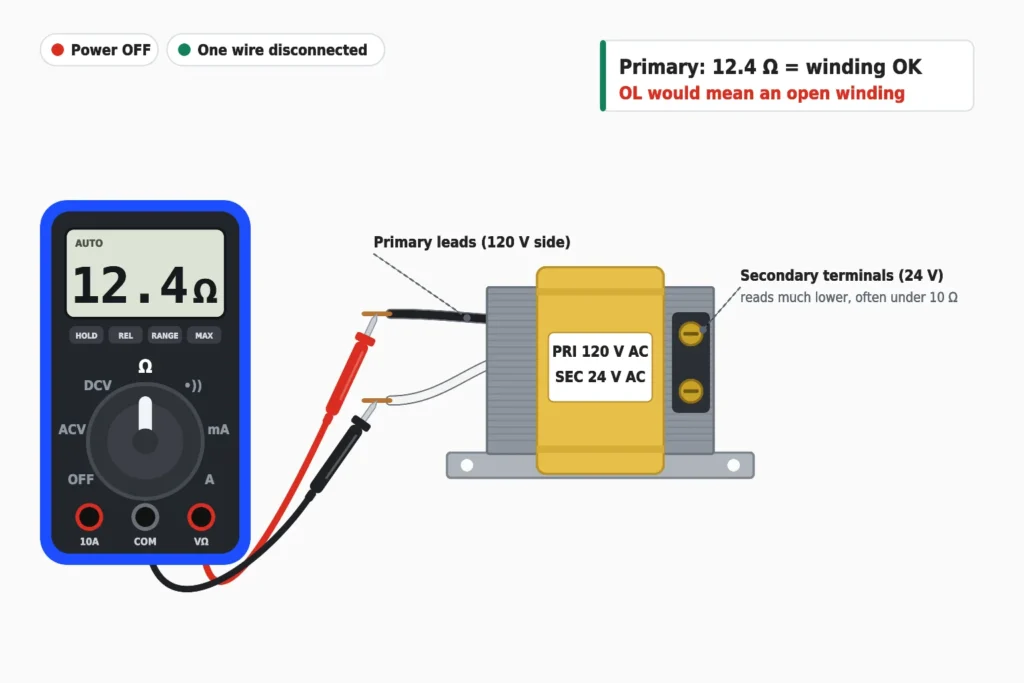
The primary winding connects to the higher input voltage (for example 120V). The secondary connects to the lower output (for example 24V). Check the label, or follow the wire colors in the datasheet. On a step-down transformer, the primary has more turns of thinner wire, so it has the higher resistance.
Step 3: Test the Primary Winding Resistance
- Disconnect the transformer from power and from the circuit.
- Set the meter to the lowest resistance range, or to auto-range.
- Touch one probe to each primary lead.
- Read the display and compare it with the datasheet.
A reading of a few ohms up to several hundred ohms is common, depending on the size of the transformer. If the meter shows OL, the winding is open and the transformer is dead.
Step 4: Test the Secondary Winding Resistance
Repeat the same test across the secondary leads. This winding has fewer turns of thicker wire, so the reading is usually much lower, often under 10 ohms on small control transformers. A very low reading is normal here. OL again means an open winding. If the transformer has a center tap, measure from the tap to each end as well. The two halves should read about the same.
Step 5: Check Insulation Between Windings and the Core
Now check that the windings are not touching each other or the metal core.
- Place one probe on a primary lead and the other on a secondary lead. The meter should show OL.
- Place one probe on each winding in turn and the other on the metal core or frame. The meter should show OL.
Any reading other than OL means current leaks where it should not. That is a failed insulation and a shock risk. A multimeter only finds gross leaks. For a proper test at high voltage, use an insulation resistance tester.
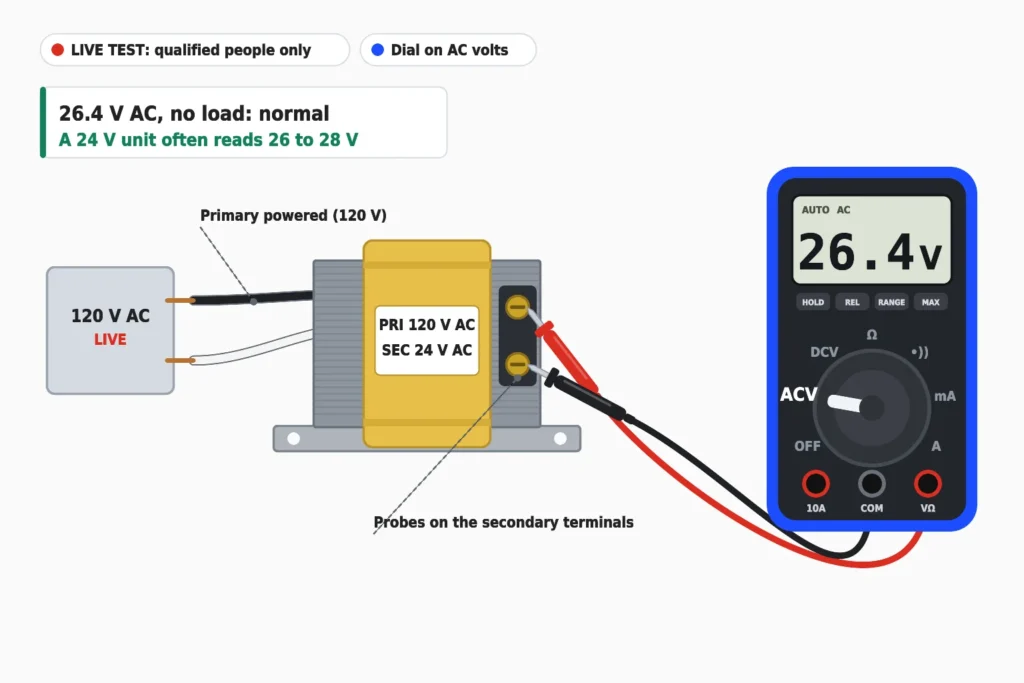
Step 6: Measure the Output Voltage (Optional, Live Test)
If both windings pass the resistance checks, you can confirm the transformer actually delivers the right voltage. Only do this if you are qualified to work on live circuits.
- Reconnect the primary to power and leave the secondary unloaded or connected to its normal load.
- Set the meter to AC voltage (V~) and pick a range above the expected output.
- Measure across the secondary terminals.
- Compare the result with the label.
With no load, a small transformer often reads a little above its rating. A 24V unit reading 26V to 28V is normal. If the output is far below the rating, or zero while the primary has power, the transformer is faulty. If you need help measuring AC correctly, see our guide on measuring AC voltage and current.
What Your Readings Mean
| Test | Good result | Bad result |
|---|---|---|
| Primary winding resistance | Low to moderate, close to the datasheet | OL (open) or 0 (shorted) |
| Secondary winding resistance | Low, often under 10 ohms on small units | OL (open) |
| Primary to secondary | OL | Any reading (leakage) |
| Winding to core | OL | Any reading (leakage) |
| Secondary AC voltage under power | Near the label, slightly higher with no load | Far below rating or zero |
Limits of a Multimeter Test
A multimeter cannot find every fault. A short between a few turns of the same winding barely changes the resistance, so the transformer can pass the resistance test and still run hot, hum, or give low output. If the readings look fine but the unit still fails in use, test the output under load, check for a blown fuse or a tripped thermal fuse inside the transformer, and replace the transformer if the symptoms continue.
Common Transformer Problems and Fixes
| Symptom | Likely cause | What to do |
|---|---|---|
| No output voltage | Open primary or secondary winding, or a blown fuse | Test both windings and check the fuse. Replace if open. |
| Low output voltage | Shorted turns or overloaded circuit | Reduce the load. Replace if the output stays low. |
| Hot case or burning smell | Overload or internal short | Disconnect power and replace the transformer. |
| Loud hum or buzz | Loose core laminations or overload | Check the load. Replace if the noise continues. |
| Breaker trips when powered | Short to the core or between windings | Run the insulation checks. Replace if any reading appears. |
FAQ
What resistance should a transformer have?
It depends on the size and ratio. Small step-down units usually show a higher reading on the primary and a much lower one on the secondary. Always compare against the datasheet if you have it. The key point is that each winding reads a steady value, not OL and not zero.
Can I test a transformer without removing it?
You can test the voltage in place, but resistance tests need the transformer disconnected from the circuit. Otherwise other components give false readings.
How do I tell the primary from the secondary?
Read the label. If there is no label, the winding with the higher resistance is normally the primary on a step-down transformer.
Can a transformer test fine and still be bad?
Yes. Shorted turns inside one winding can pass a basic resistance test. A live voltage test under load is the better check.
Final Thoughts
Testing a transformer takes only a few minutes. Check the windings for continuity, confirm there is no leakage between the windings and the core, and, if you are qualified, measure the live output. If any winding is open, any insulation reading appears, or the output is far off, replace the transformer. For more tests like this one, see our guide on how to use a multimeter.