The breaker clicks off the second you flip it back on. Or a car fuse blows every time you turn on the headlights. Both are classic signs of a short circuit.
A short does not fix itself. Every new fuse or breaker reset sends another burst of current through the fault, and that heat damages wiring. The good news is that a basic digital multimeter can find most shorts. You do not need a special short finder.
In this guide, I show you how to find a short with a multimeter in house wiring, in a car, and on a circuit board. You will also learn what each ohms reading means, so you can tell a real short from a normal load.
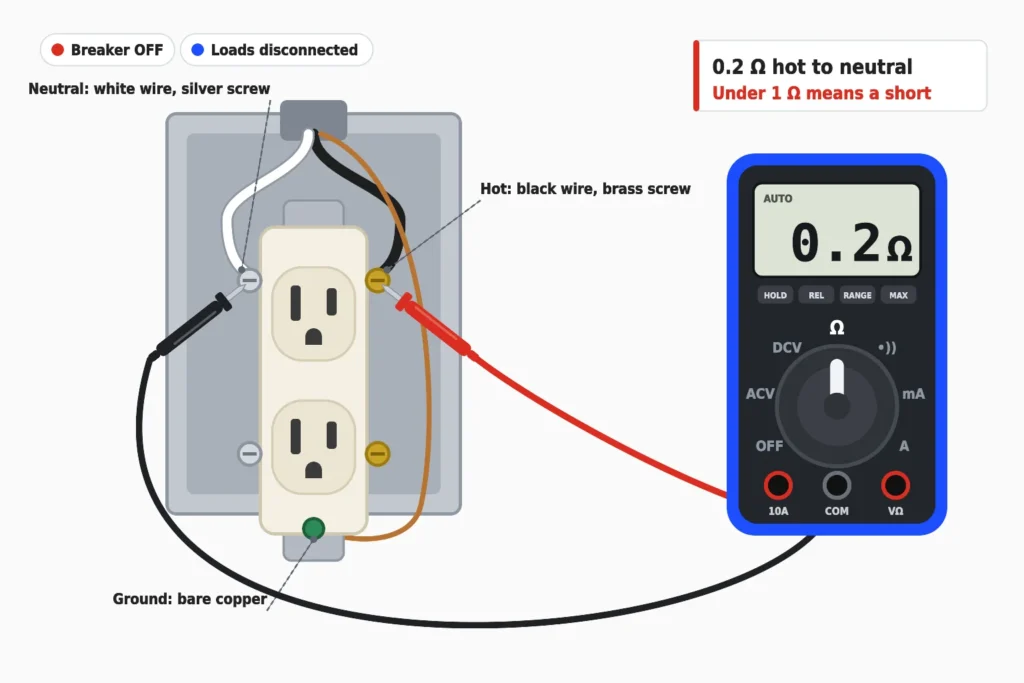
Quick answer: To find a short with a multimeter, turn off the power and set the meter to ohms (Ω). Disconnect every load on the circuit. Then measure between hot and neutral, and between hot and ground. A reading under 1Ω means there is a short. OL means there is no short. To find where the short is, split the circuit into sections and test each one. The section that still reads near 0Ω holds the fault.
What Is a Short Circuit?
A short circuit is a low-resistance path that lets current skip the load it is supposed to power.
In a working circuit, current flows from the hot wire, through a load such as a bulb or a motor, and back on the neutral. The load’s resistance limits how much current flows. In a short, the current finds a path with almost no resistance. The current shoots far past the circuit’s rating, and the fuse blows or the breaker trips.
That is also why a short is easy to find with an ohmmeter. With the power off, a shorted circuit reads close to 0Ω between two points that should be isolated from each other.
Types of Short Circuits
| Type | What touches what | Where you find it | Usual sign |
|---|---|---|---|
| Hot to neutral (dead short) | The hot wire touches the neutral wire | House wiring, cords, appliances | The breaker trips the instant you reset it |
| Hot to ground (ground fault) | The hot wire touches a ground wire or a metal box | House wiring, metal fixtures, appliances | The breaker or GFCI trips, sometimes with a spark at a box |
| Short to ground (chassis short) | A power wire touches the car body or frame | Cars, trucks, boats, trailers | The same fuse blows again and again |
| Internal component short | A failed part inside a device, such as a capacitor or diode | Circuit boards, power supplies, appliances | The device is dead, with a hot spot or a burnt smell |
| Winding short (turn to turn) | Insulation fails between the turns of a coil | Motors, transformers, solenoids | The coil reads lower than its rated resistance and runs hot |
A short is the opposite of an open circuit. An open circuit is a break in the path, and it reads OL. A short is an unwanted connection, and it reads near 0Ω. If your problem is a dead circuit with no blown fuse, you are probably looking for an open circuit instead. My guide on how to test continuity with a multimeter covers that test.
Safety and Tools
⚠️ Safety warning: Every resistance test in this guide is done with the power off. An ohmmeter on a live circuit gives a false reading and can blow the meter’s fuse or damage the meter. Before you test, prove the circuit is dead with the live-dead-live method: test a known live circuit, test your circuit, then test the known live circuit again.
Do not keep resetting a breaker that trips the moment you turn it on. Each reset pushes a large fault current through the short. Leave it off until you find the cause. The same goes for car fuses. Never fit a bigger fuse to stop it from blowing. The fuse protects the wire, and a larger fuse lets the wire overheat.
What you need:
- Digital multimeter with an ohms (Ω) range and continuity mode, rated CAT III for house wiring
- Non-contact voltage tester
- Insulated screwdrivers
- A long jumper lead with alligator clips, for testing long cable runs
- A wiring diagram or the owner’s manual, for car circuits
- A 12V test light, for the car method (optional)
💡 Tip: Do not trust the continuity beep alone. Most meters beep at any reading below a set threshold, not only at 0Ω. The Fluke 117, for example, beeps below 20Ω. A heater element or a cold bulb can read lower than that, so the meter beeps even though there is no short. Switch to the ohms range and read the actual number.
Still choosing a meter? My guide to the best multimeter for beginners covers meters that handle every test in this guide.
How to Check for a Short Circuit with a Multimeter: Step by Step
This basic method works on any circuit: a house circuit, a car circuit, an extension cord, or an appliance. The sections after it show how to apply it to each one.
Step 1: Turn Off the Power and Prove It Dead
Turn off the breaker, unplug the device, or disconnect the negative cable from the car battery. Then set your meter to AC or DC volts and confirm 0V.
Step 2: Disconnect the Loads
Unplug everything on the circuit and turn off the wall switches. In a car, pull the bulb or unplug the motor that the fuse feeds. A load left in the circuit gives a low reading that looks like a short.
Step 3: Zero Your Test Leads
Turn the dial to the lowest ohms range, often 200Ω, or use auto-range. Touch the probes together. The display shows your lead resistance, usually 0.1Ω to 0.5Ω. Subtract it from every reading, or press REL if your meter has that button.
Step 4: Measure Between the Wires
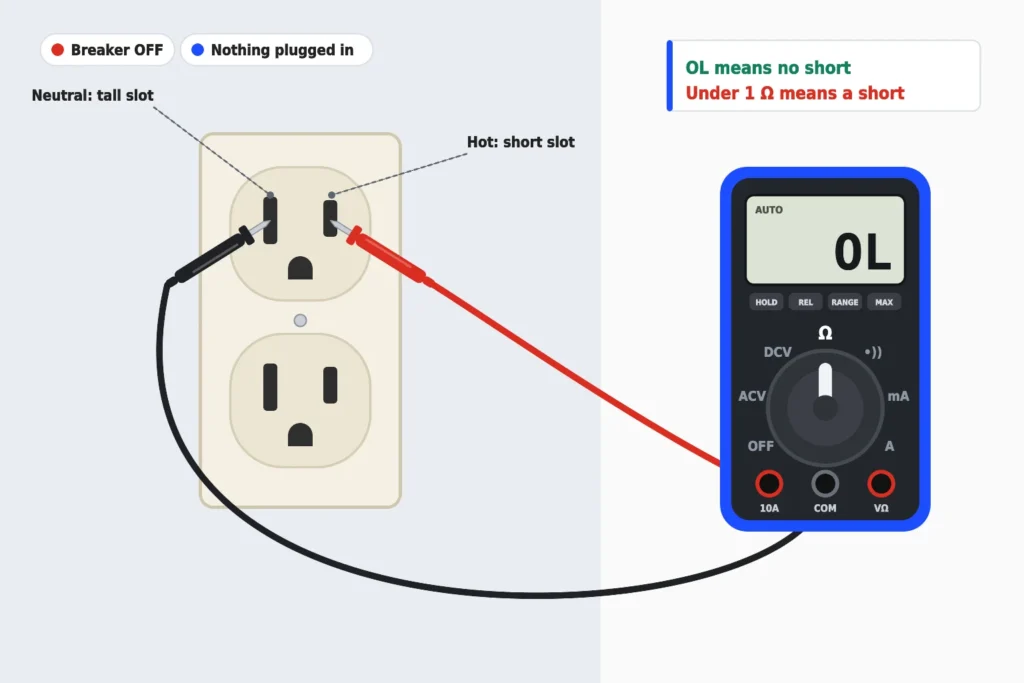
Put one probe on the hot wire and the other on the neutral. Then measure hot to ground and neutral to ground. In a car, measure from the load side of the fuse to a clean, bare metal spot on the chassis.
Step 5: Read the Result
| Reading (minus lead resistance) | What it means | What to do |
|---|---|---|
| OL, or several megohms | No short. The insulation is good | Look for the fault in the load you disconnected |
| Under 1Ω | Dead short | Split the circuit and find the section with the fault (Step 6) |
| A few ohms to a few thousand ohms | A load is still connected, or there is a partial short | Check that every load is off or unplugged, then test again. If the reading stays, treat it as a fault |
| Starts low, then climbs to OL | A capacitor is charging. This is normal on electronics | Wait for the reading to settle |
| Jumps around when you move the wire | Intermittent short from damaged insulation | Wiggle along the wire to find the spot |
Here is why the numbers matter. A 1,500-watt space heater has an element of about 9.6Ω (120V × 120V ÷ 1,500W). A dead short reads under 1Ω. Both may make the meter beep, but only one is a fault. My guide on how to measure resistance with a multimeter explains ohms ranges in more detail.
Step 6: Split the Circuit to Find the Short
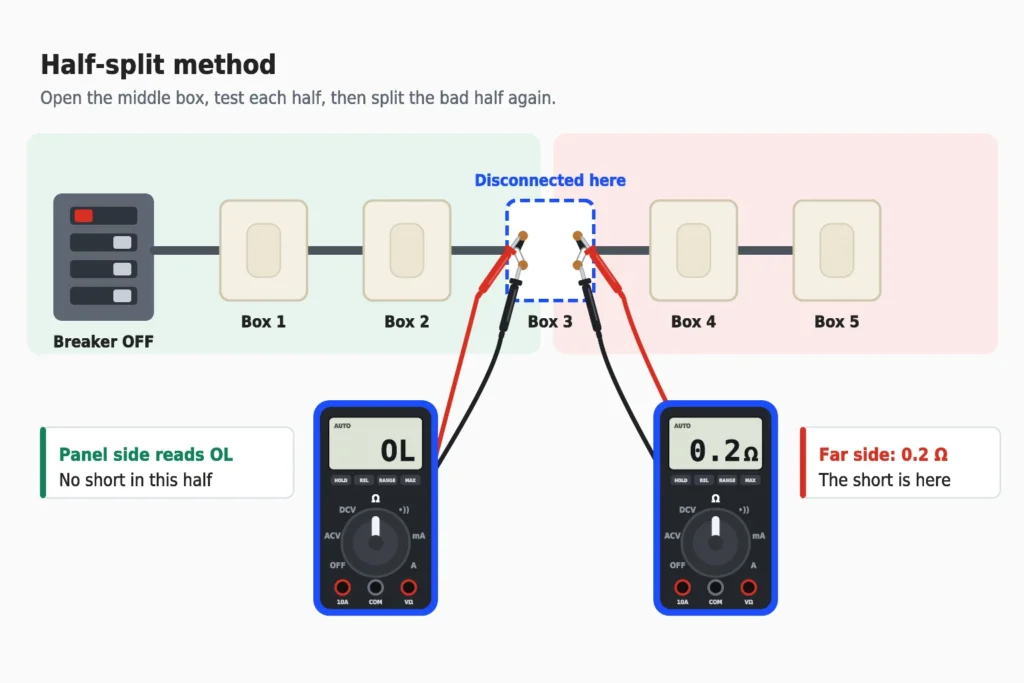
Once you know there is a short, you need to find where it is. The fastest way is the half-split method.
- Disconnect the circuit at a point near its middle, such as an outlet box or a wiring connector.
- Test each half on its own.
- The half that still reads near 0Ω has the short. The other half reads OL.
- Split the bad half again, and repeat until you are down to one cable, one device, or one connector.
A circuit with eight outlets takes about three splits to narrow down. That is much faster than checking every box in order.
How to Find a Short in House Wiring
In a home, your first clue is how the breaker trips. A short trips it instantly. An overload takes a while.
| Breaker behavior | Likely cause | First step |
|---|---|---|
| Trips the instant you reset it, even with everything unplugged | Short in the wiring, a box, or a device such as an outlet or switch | Leave it off and follow the steps below |
| Trips only when one appliance is plugged in or turned on | Short inside that appliance or its cord | Test the appliance (see below) |
| Trips after several minutes with many things running | Overload, not a short | Move some loads to another circuit |
| A GFCI outlet or GFCI breaker trips | Ground fault, often from moisture | Check outlets in the kitchen, bathroom, garage, and outdoors |
These patterns follow the trip guide from AJ Long Electric.
Step 1: Rule Out the Loads
Unplug everything on the circuit and turn off every wall switch. Reset the breaker once. If it holds, the short is in something you unplugged. Plug the items back in one at a time until the breaker trips. If it trips with nothing connected, the short is in the wiring or in a device on the circuit.
Step 2: Turn the Breaker Off and Prove It Dead
Turn the breaker off and put tape over it so nobody turns it back on. Check every outlet and switch box you will open with a non-contact tester, then confirm 0V with your meter.
Step 3: Test the Circuit at the First Outlet
Set the meter to ohms. Measure between the hot (short) slot and the neutral (tall) slot, then between the hot slot and the round ground hole. Because the circuit is still connected, this one reading checks everything downstream. Under 1Ω on either test means the circuit has a short somewhere. OL on both means the wiring is clear.
Step 4: Split the Circuit at the Boxes
Turn off the power, pull an outlet near the middle of the run, and disconnect the cable that feeds the rest of the circuit. Test each half as in Step 6 above. Keep splitting until one cable or one device reads near 0Ω on its own. A good outlet or switch reads OL between its hot and neutral screws when it is disconnected.
Step 5: Inspect the Bad Section
Once you know which cable or box has the short, look for the cause. These are the places I check first:
- A screw or nail driven through a cable behind the drywall
- A wire pinched between a box and a cover plate or fixture
- A loose wire in a back-stabbed outlet touching the metal box
- A cracked light socket or a damaged fixture
- Water inside an outdoor box
Some related problems have their own guides: how to test an outlet, how to test for ground, and how to test a light switch.
How to Test an Appliance or Extension Cord for a Short
Unplug it and turn its switch on. Measure between the two flat blades of the plug. A reading close to the appliance’s normal resistance is fine. A reading under 1Ω means a short inside it. Then measure from each flat blade to the round ground pin, or to bare metal on the case. Anything other than OL means a ground fault, so do not use it until it is repaired.
⚠️ Safety warning: If the short is in the cable between the panel and the first box, the next test means disconnecting the wire at the breaker inside the panel. I recommend leaving panel work to a licensed electrician.
A multimeter tests with only a few volts. It finds hard shorts, but it can miss insulation that only breaks down at full voltage. If the breaker still trips and every ohms test reads OL, an electrician can test the cable with an insulation resistance tester, which tests at 500V or 1,000V.
How to Find a Short in a Car When a Fuse Keeps Blowing
In a car, a short is usually a power wire that has rubbed through its insulation and is touching the metal body. The fuse blows the moment that circuit turns on.
Step 1: Find the Load Side of the Fuse
Pull the blown fuse and look up which circuits it feeds in the owner’s manual or the fuse box lid. With the battery still connected, set the meter to DC volts. Touch the black probe to the chassis and the red probe to each fuse terminal. The terminal that reads 12V is the battery side. The other terminal is the load side, and that is where you test.
Step 2: Disconnect the Battery and the Loads
Disconnect the negative battery cable. Then unplug the bulbs, motor, or module on that circuit. This matters more in a car than in a house. A cold headlight bulb can read close to 0Ω, which looks exactly like a short.
Step 3: Measure from the Fuse to Ground
Set the meter to ohms. Put one probe on the load-side fuse terminal and the other on clean, bare metal on the chassis. A reading near 0Ω confirms a short to ground. OL means there is no hard short in the wiring. The fault may be inside a part you unplugged, or it may only show up when a switch or relay closes.
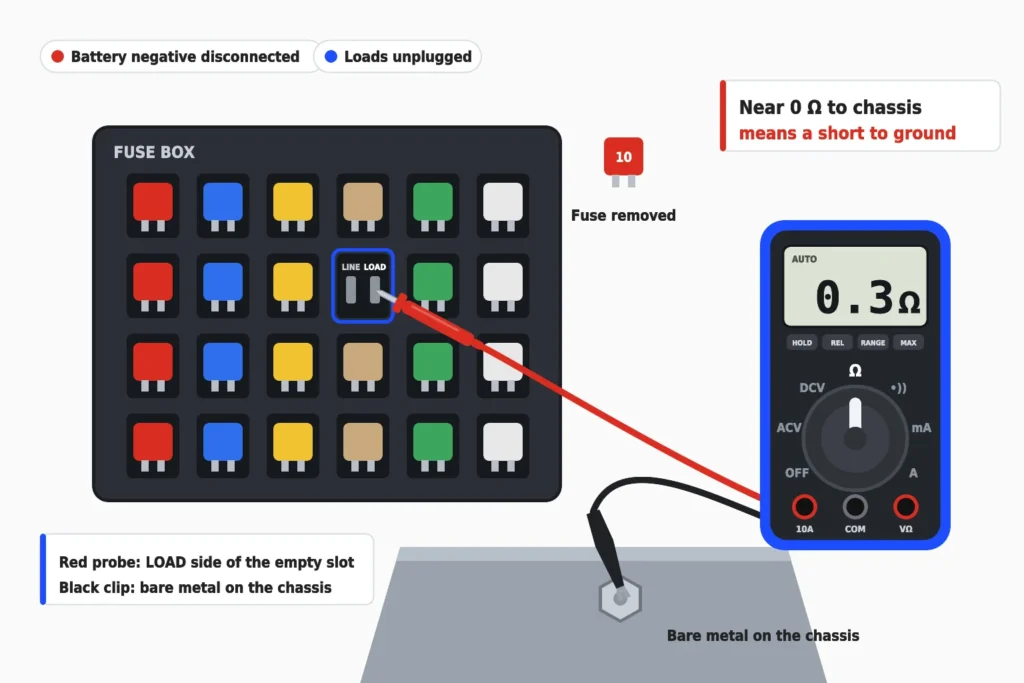
Step 4: Track Down the Short
Keep the meter connected and work your way along the wiring from the fuse box. You have two ways to do it:
- Wiggle test: Move the harness side to side every 6 inches or so while you watch the meter. When the reading jumps between OL and near 0Ω, the short is close to your hand. Factory service manuals use this same method.
- Unplug test: Unplug the connectors along the circuit one at a time. When the reading jumps to OL, the short is in the section you just disconnected.
Shorts in cars usually hide where wires move or rub: door jambs, trunk lid hinges, under the seats, near the exhaust, behind brackets, and in aftermarket stereo or trailer wiring.
💡 Tip: Many mechanics put a 12V test light across the two fuse terminals instead of a new fuse. With the circuit switched on, the light glows while the short is there and goes out when you unplug the shorted section. It works like a fuse that does not blow.
Not every short blows a fuse. A small leak to ground can drain the battery overnight instead. That calls for a parasitic draw test, which I cover in how to measure amps with a multimeter. For a full check of the battery, alternator, and wiring, see my car electrical diagnostic guide.
How to Check for Shorts on a Circuit Board
On a circuit board, the most common short is between a power rail and ground. The usual causes are a failed capacitor, a solder bridge, a shorted chip, or liquid damage.
Step 1: Unplug and Discharge
Disconnect the board from all power, including any battery. Large capacitors can hold a charge after the power is off, so discharge them first. My guide on how to test a capacitor shows how to do that safely.
Step 2: Measure the Rail to Ground
Set the meter to ohms. Put the black probe on a ground point, such as a metal USB shell or a mounting screw pad. Put the red probe on the power rail, such as the 5V or 3.3V line at a capacitor or the power connector.
Step 3: Read the Result
On a healthy board, the reading often starts low and climbs as the capacitors charge from the meter. A steady reading under 1Ω points to a short. Some rails on computer boards normally read only a few ohms, because the chips they feed draw a lot of current. If you have a known good board of the same model, compare the two readings.
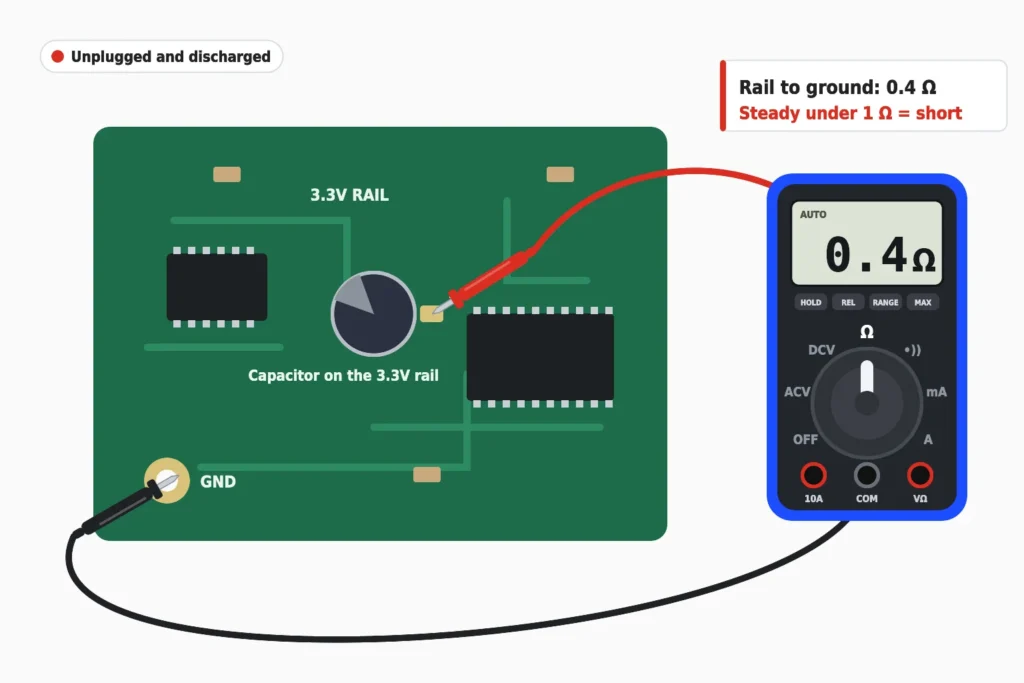
Step 4: Narrow It Down
Start with a close look for burnt, bulging, or cracked parts and for solder bridges between pins. Then measure the same rail at several capacitors along it. If your meter shows hundredths of an ohm, the lowest reading is usually closest to the shorted part.
For more board-level tests, including the one-second start problem on PC motherboards, see my guide on how to test a motherboard with a multimeter.
Real World Example: Finding a Short in Three Tests
Say a bedroom circuit has six outlets, and the breaker trips the instant you reset it, even with everything unplugged.
- With the breaker off, the first outlet reads 0.2Ω between hot and neutral. The circuit has a short.
- You pull outlet 3 and disconnect the cable that goes on to outlet 4. Outlets 1 to 3 now read OL. The cable to outlets 4, 5, and 6 still reads 0.2Ω. The short is downstream.
- You pull outlet 5 and disconnect the cable to outlet 6. Outlets 4 and 5 read OL. The cable to outlet 6 reads 0.2Ω, even with outlet 6 disconnected. The cable itself is shorted.
There is a new picture on the wall between outlets 5 and 6. The nail went straight through the cable. Three tests found a fault hidden behind the drywall, without opening every box.
Common Mistakes When Checking for Shorts with a Multimeter
- Leaving loads connected. A bulb, heater, or motor gives a low reading that looks like a short. Unplug everything first.
- Trusting the beep. Continuity mode beeps below a threshold, not only at 0Ω. Read the number on the ohms range.
- Testing ohms on a live circuit. It gives a false reading and can damage the meter. Prove the circuit dead first.
- Forgetting lead resistance. It barely matters on house wiring, but it matters a lot when you compare small readings on a circuit board.
- Fitting a bigger fuse, or resetting the breaker again and again. Both push more current through the fault and can overheat the wiring.
- Not retesting after the repair. Before you turn the power back on, the circuit should read OL between hot and neutral and between hot and ground.
FAQ
How do you find a short with a multimeter?
Turn off the power, disconnect the loads, and set the meter to ohms. Measure between hot and neutral, and between hot and ground. A reading under 1Ω means there is a short. Then split the circuit into sections and test each one until you find the section that still reads near 0Ω.
What setting do I use to check for a short circuit?
Use the lowest ohms (Ω) range, or auto-range. Continuity mode works for a quick check, but most meters beep at readings well above 0Ω. The ohms range shows the actual number, so you can tell a short from a normal load.
What does a short circuit read on a multimeter?
A short reads close to 0Ω, usually under 1Ω after you subtract the test lead resistance. A circuit with no short reads OL between hot and neutral and between hot and ground once every load is disconnected.
Can you find a short with the power on?
Not with the ohms setting. Ohms tests must be done with the power off. In a car, you can use a 12V test light across the fuse terminals with the circuit switched on. The light stays on until you disconnect the shorted section.
How do I find a short in a car without taking it apart?
Pull the blown fuse, disconnect the battery, and measure ohms from the load side of the fuse to chassis ground. Then wiggle the harness and unplug its connectors one at a time while you watch the meter. When the reading jumps to OL, you have found the section with the short.
Why does my breaker trip with nothing plugged in?
The short is in the wiring or in a device on the circuit, such as an outlet, switch, or light fixture. If every ohms test reads OL and the breaker still trips, the breaker itself may be faulty. Call a licensed electrician for that, because the test is inside the panel.
Conclusion
Finding a short with a multimeter comes down to one reading and one method. With the power off and the loads disconnected, a short reads under 1Ω where the circuit should read OL. The half-split method then takes you to the bad section in a few tests.
- House wiring: Test hot to neutral and hot to ground at the first outlet, then split the circuit at the boxes.
- Cars: Measure from the load side of the fuse to chassis ground, then wiggle and unplug along the harness.
- Circuit boards: Measure each power rail to ground, then look for the lowest reading along the rail.
Whatever you are testing, never fit a bigger fuse or keep resetting a breaker. Find the short first, fix it, and retest before you turn the power back on.
Ready to check for the opposite fault, a broken wire? My guide on how to test wires with a multimeter shows you how to find an open circuit, step by step.