Your car will not start on a cold morning. The battery is two years old. The mechanic says you need a new battery, a new alternator, or both.
The best automotive multimeter settles that question in about five minutes. It tells you whether the battery is charged, whether the alternator is charging, and whether something is draining power overnight.
The problem is that most multimeters are built for wall outlets, not cars. Many of them lack the features that matter under the hood, like capturing the lowest voltage while the engine cranks or measuring a small battery drain safely.
Quick answer: For most drivers, the Innova 3340 is the best automotive multimeter. It reads RPM, duty cycle, and injector pulse width for about $129. On a tight budget, the Innova 3320b covers the basics for about $41. If you want fused inputs and MIN/MAX on a budget, the Klein Tools MM400 costs about $55. Professional technicians should step up to the Fluke 88V.
💡 How I chose these picks: These recommendations are based on published specifications, manufacturer data, and long-term user reports, not on hands-on lab testing. I checked every spec against the tests you will actually run on a car: battery voltage, the cranking dip, alternator output, and parasitic draw. Prices were checked on 3 October 2026 and change often, so confirm them before you buy.
Need a meter mostly for home wiring or electronics? My Best Multimeters guide covers those picks instead.
Best Automotive Multimeter: Quick Picks
All five picks have 10MΩ input impedance on DC volts, so none of them will load down sensitive car sensors or control modules.
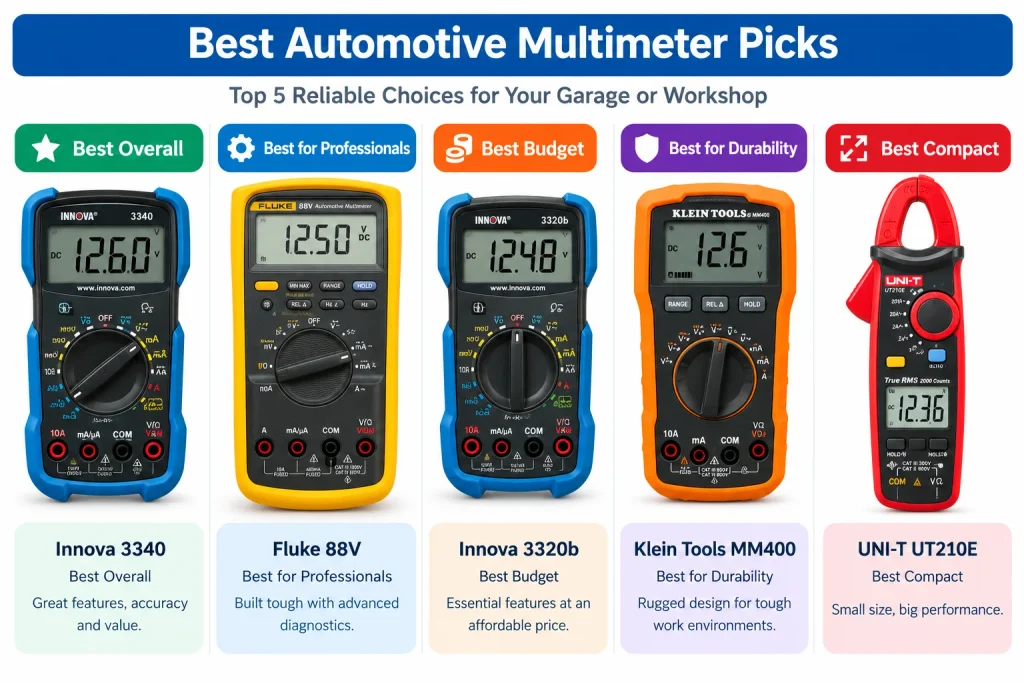
| Category | Pick | Price (3 Oct 2026) | Safety rating | Car-specific features | Current measurement |
|---|---|---|---|---|---|
| Best overall | Innova 3340 | About $129 | CAT II, UL listed | RPM, dwell, duty cycle, pulse width, temperature, min/max | 15A DC, unfused, 15 seconds at a time |
| Best for professionals | Fluke 88V | $659.99 list (meter), $939.99 list (kit) | CAT III 1000V, CAT IV 600V | RPM (pickup in kit), pulse width, duty cycle, 250µs peak capture, temperature | 10A continuous, 20A for 30 seconds |
| Best budget | Innova 3320b | About $41 | CAT II (per the 3320 manual) | Battery test LEDs for 1.5V, 9V, and 12V, pulse width | 10A DC, unfused, 15 seconds at a time |
| Best budget fused meter | Klein Tools MM400 | About $55 | CAT III 600V | Min/max, duty cycle, temperature, backlight | 10A, fused; 30 seconds at a time above 6A |
| Best for parasitic draw | UNI-T UT210E (clamp) | About $49 | CAT III 300V, CAT II 600V | DC clamp with 1mA resolution on the 2A range | Clamp only, up to 100A AC or DC |
What Makes a Multimeter Good for Car Testing?
A car runs on 12V DC, so almost any digital multimeter can read a battery. The real difference shows up in four tests: resting voltage, the cranking dip, alternator output, and parasitic draw. My Multimeter Buying Guide covers the general criteria. This section covers only what changes under the hood.
10MΩ Input Impedance
Modern cars are full of sensors and control modules that work at very small currents. A low-impedance meter pulls down the voltage it is measuring and gives you a false reading. Look for 10MΩ on DC volts. Every pick on this list meets it.
0.01V Resolution on the 12V Range
Battery health hides in the second decimal place. A resting reading of 12.6V means the battery is close to full. A reading of 12.3V means it has lost a quarter to half of its charge. That is only a 0.3V gap.
Any meter with at least 2,000 counts shows 0.01V on its 20V range. Most digital meters pass this test easily, but analog needle meters do not.
Min/Max Capture for the Cranking Test
While the starter turns, battery voltage dips for a second or two. A healthy battery stays above 9.6V during that dip. The dip is too fast to read reliably by eye, so a MIN/MAX button that records the lowest value makes the test easy.
The Innova 3340, Fluke 88V, and Klein MM400 all have it. The Fluke’s peak mode also catches events as short as 250 microseconds, which helps with intermittent faults. The Innova 3320b does not list it, so you need a helper to watch the screen.
A Safe Way to Measure Current
A parasitic draw test keeps the meter in series with the battery for 10 to 30 minutes. This is where budget automotive meters fall short.
The 10A and 15A inputs on the Innova 3320b and 3340 are unfused. Innova rates them for 15 seconds at a time, followed by a 15-minute rest. An unfused input also has nothing to stop a big current if you connect it the wrong way.
For a long draw test, use the fused milliamp input once the car’s modules are asleep, or use a DC clamp meter that never touches the circuit. The how-to section below links to the full method.
Automotive Functions: RPM, Duty Cycle, and Pulse Width
RPM mode reads engine speed through an inductive clamp around a spark plug wire. Duty cycle and pulse width show how long a solenoid or fuel injector stays switched on. That tells you what the engine computer is commanding. Dwell only matters on older cars with breaker-point ignition.
These modes help with engine diagnosis. You do not need them for battery and charging checks.
Safety Rating: CAT II Is Enough for a 12V Car
CAT ratings describe how well a meter survives voltage spikes on mains wiring. A 12V car battery is not a mains circuit, so a CAT II meter is fine for normal car work and for wall outlets at home.
Hybrid and electric vehicles are different. Their high-voltage systems run at several hundred volts. That work calls for a CAT III 1000V meter like the Fluke 88V, insulated gloves, and proper training. If you are not trained for high-voltage systems, leave them to a qualified technician.
Practical Extras That Matter Under the Hood
- Backlight. Engine bays and footwells are dark. The Innova 3340 has no backlight, while the Fluke 88V, Klein MM400, and UNI-T UT210E do.
- Back-probe pins and alligator clips. These let you test a connector without piercing the wire. The Fluke 88V kit includes both.
- Hands-free mounting. A magnetic hanger or built-in stand frees both hands while you crank the engine or wiggle a harness.
Best Overall Automotive Multimeter: Innova 3340
The Innova 3340 packs most of the car modes of a professional meter into a package that costs about $129.
Key specs
- Auto-ranging, 3,999-count display with 0.01V resolution on the 40V range
- RPM from 0 to 10,000 through the included inductive clamp, including coil-on-plug engines
- Duty cycle from 0.1% to 99.9%, pulse width from 1 to 999 ms, and dwell for 1 to 12 cylinders
- MIN/MAX and HOLD buttons, plus an included temperature probe
- UL listed, rated CAT II
Why I recommend it: It is the least expensive meter on this list that covers every common car test, including the cranking dip and basic engine diagnostics. A home mechanic can check batteries, alternator diodes, injectors, and sensors without buying a second tool.
Known limitations
- The display has no backlight, which is a real drawback in a dark engine bay.
- The 15A input is unfused. Innova rates it for 15 seconds at a time, with a 15-minute rest between tests. The milliamp input is fused at 500mA.
- CAT II only. That is fine for 12V cars, not for hybrid high-voltage systems.
- There is no capacitance mode, and reviewers often describe the stock test leads as basic.
Best for: DIY mechanics who want engine diagnostics without paying for a Fluke.
Best Automotive Multimeter for Professionals: Fluke 88V
The Fluke 88V is built for daily shop use, including work on hybrid vehicles.
Key specs
- 6,000-count display with 0.1% DC voltage accuracy and a two-level backlight
- CAT III 1000V and CAT IV 600V, with inputs that withstand impulses above 8,000V
- Peak capture down to 250 microseconds, plus MIN/MAX/AVG recording
- 10A continuous, or 20A for up to 30 seconds
- Pulse width, duty cycle, temperature, and capacitance up to 9,999µF
- Input Alert, which warns you when a test lead is in the wrong jack
- Lifetime warranty
Why I recommend it: It is the only pick here with the safety rating for hybrid high-voltage systems. The peak capture and Input Alert also catch fast faults and wiring mistakes that cheaper meters miss.
Known limitations
- Price. Fluke lists the meter at $659.99 and the 88V/A kit at $939.99. Street prices are often lower.
- The RPM pickup, back-probe pins, and magnetic hanger come in the 88V/A kit, not with the base meter.
- It is far more than you need for battery and charging checks alone.
Best for: Professional technicians and trained workers on hybrid and electric vehicles.
Best Budget Automotive Multimeter: Innova 3320b
The Innova 3320b is the cheapest car-focused meter here with auto-ranging and 10MΩ input impedance.
Key specs
- Auto-ranging, 4,000-count display
- Color LED battery test for 1.5V, 9V, and 12V batteries
- Pulse width mode, new on the 3320b
- 10A DC range, built-in stand, wrist strap, and rubber corner guards
- About $41 on Innova’s own store, which listed it as sold out on 3 October 2026
Why I recommend it: If you only need battery, alternator, fuse, and wiring checks, it covers them for about a third of the price of the 3340.
Known limitations
- No MIN/MAX is listed, so the cranking test needs a helper to watch the screen.
- The 10A input is unfused, with the same 15-second limit and 15-minute rest as the 3340.
- Innova calls the LED feature a “Small Battery Load Test.” It does not replace a cranking or load test on a car battery.
- No RPM, duty cycle, or dwell modes.
Best for: Drivers who want occasional battery and charging checks.
Best Budget Fused Car Multimeter: Klein Tools MM400
The Klein MM400 is a general-purpose meter, but it handles the battery and charging tests well and protects both current inputs with fuses.
Key specs
- Auto-ranging, 4,000-count display with 0.01V resolution on the 40V range
- MIN/MAX and HOLD buttons, plus a backlight
- Duty cycle, frequency, and temperature, with a thermocouple included
- Fused 10A and milliamp inputs (10A/600V and 500mA/600V fast-blow fuses)
- CAT III 600V, 10MΩ input impedance, rated for a 3.3-foot drop
- About $55 at SupplyHouse on 3 October 2026
Why I recommend it: It is the least expensive pick here that combines MIN/MAX for the cranking test with fused current inputs. Klein meters are sold by most US electrical and home-improvement stores. It also works as a home meter for 120V outlets and breaker panels.
Known limitations
- No RPM, pulse width, or dwell modes, so it cannot replace the Innova 3340 for engine diagnosis.
- Above 6A, Klein recommends measuring for 30 seconds, then recovering for 10 minutes. Use the fused milliamp input for a long draw test.
- CAT III 600V is fine for cars and homes, not for hybrid high-voltage systems.
Best for: DIY owners who want one safe meter for the car and the house.
Best Clamp for Parasitic Draw Testing: UNI-T UT210E
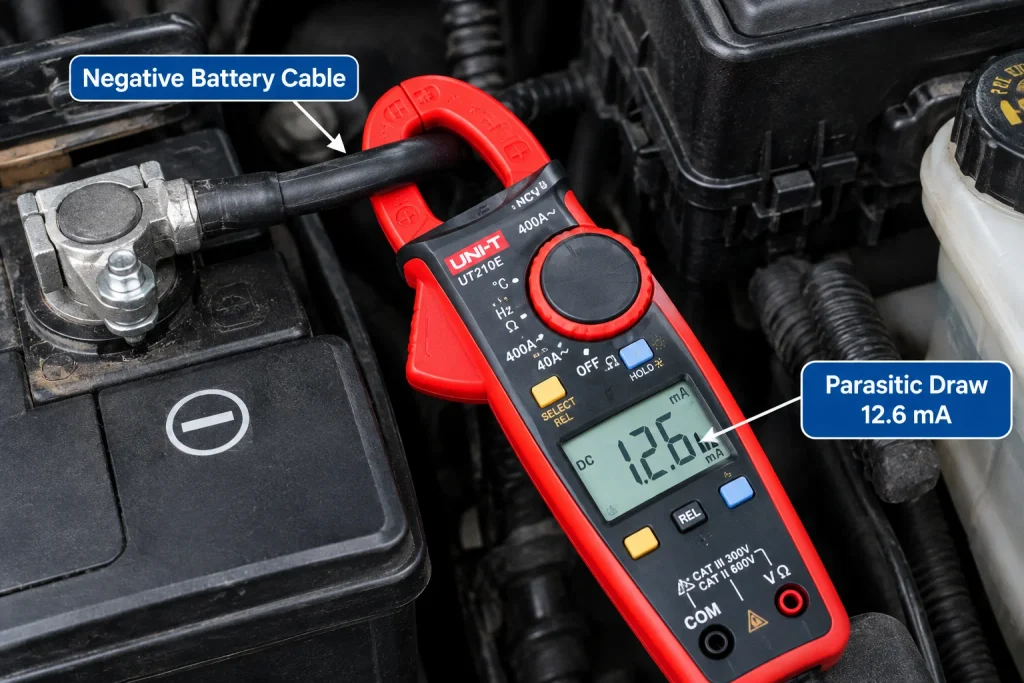
The UT210E is a mini clamp meter that reads DC current down to 1mA, which is rare at its price.
Key specs
- 2A, 20A, and 100A AC and DC ranges through the clamp
- 1mA resolution on the 2A range, rated ±(2% + 8 digits) for DC current
- ZERO button to cancel the offset before a DC reading
- Jaw opening of about 16mm
- CAT III 300V and CAT II 600V, 2,000-count display with backlight
- About $49 from a US eBay seller on 3 October 2026
Why I recommend it: It measures parasitic draw without disconnecting the battery. Disconnecting the battery wakes the car’s modules and can reset radio presets and learned settings, so a clamp keeps the test closer to real parked conditions.
At a 50mA reading, the rated accuracy works out to about ±9mA. That is good enough to spot a 200mA drain. Confirm borderline readings with a series test.
Known limitations
- The zero drifts. One long-term reviewer saw 2 to 3mA of drift within a minute of zeroing, so re-zero before every reading.
- Rotating the meter during a reading can shift it by several dozen milliamps. Keep it still.
- The same review thread reports that weak rechargeable batteries made the drift worse. Use fresh alkaline AAA cells.
- Like every clamp meter, it is least accurate at small currents. My amp clamp guide explains the multiple-wrap trick for small currents on thin wires.
Best for: Finding a battery drain without disconnecting anything.
How to Use an Automotive Multimeter: 4 Quick Checks
These four checks find most car electrical problems in under an hour. Each one links to a full step-by-step guide.
1. Resting Battery Voltage
Turn the car off and wait at least 15 minutes so the surface charge settles. Set the meter to DC volts, then touch red to positive and black to negative. A reading of 12.6V or above means the battery is healthy. My How to Test a Car Battery with a Multimeter guide has the full voltage chart.
2. Cranking Voltage
Press MIN/MAX, then have a helper crank the engine. A healthy battery stays above 9.6V. A lower reading means the battery is weak under load, even if its resting voltage looked fine.
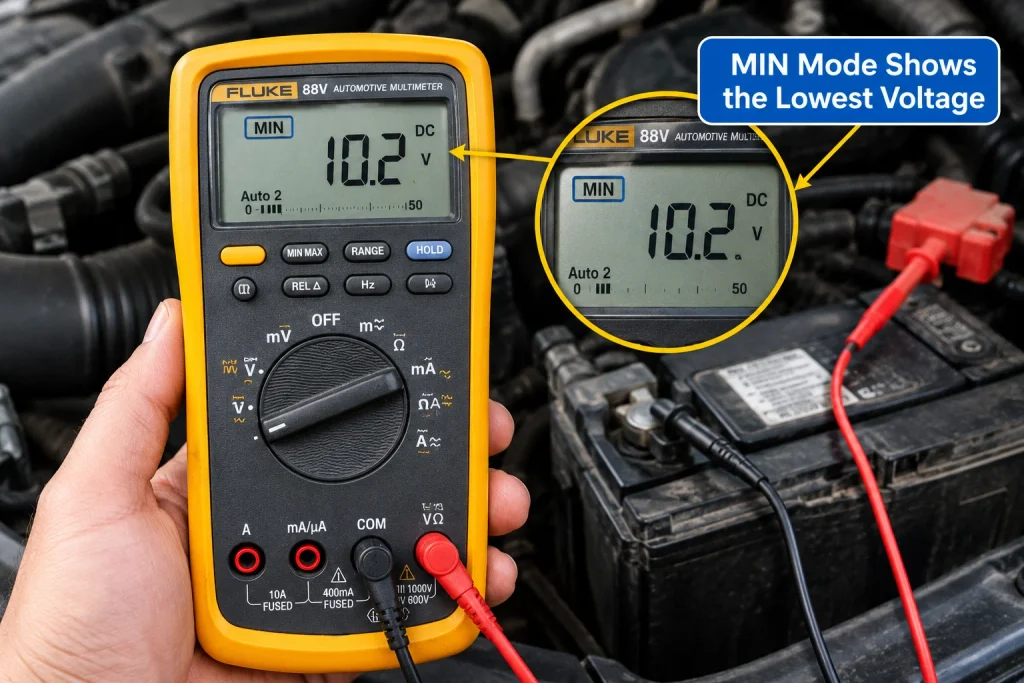
the engine cranks. A reading of 10.2V is healthy; anything below 9.6V
points to a weak battery.
3. Alternator Output
Start the engine and measure at the battery again. A healthy charging system reads 13.7V to 14.7V. If the reading stays near the resting voltage, follow my guide on how to test an alternator with a multimeter.
4. Parasitic Draw
Let the car sit until its modules go to sleep, usually 10 to 30 minutes. Under 50mA is normal, 50 to 100mA is borderline, and over 100mA means something is draining the battery.
With a series meter, follow the steps in How to Measure Amps with a Multimeter. With a DC clamp, press ZERO with the jaws closed and away from any cable, then clamp around the negative battery cable.
Real World Example: Reading All Three Numbers Together
Say a car reads 12.65V at rest, dips to 10.1V while cranking, and shows 13.2V with the engine running. The first two numbers say the battery is healthy. The third is below 13.7V, so the alternator is undercharging. A new battery would not have fixed this car.
Features to Skip on a Car Multimeter
More functions on the box do not mean a better car meter. Do not pay extra for these unless you have a specific use.
- Transistor (hFE) socket. No car test uses it.
- Dwell angle, unless you own a classic car. It only applies to breaker-point ignition, which modern cars do not have.
- True RMS for basic car work. Battery, alternator, and draw tests are DC readings, where True RMS adds nothing. It only helps with AC readings, such as alternator ripple.
- Data logging and Bluetooth. They are useful in a busy shop, but a MIN/MAX button covers what most drivers need.
Common Mistakes When Buying a Multimeter for Car Use
Trusting a battery-test LED for a car battery. These LEDs test small batteries under a light load. A car battery needs a resting voltage check and a cranking test.
Ignoring the current input limits. Read the time limit on the 10A input before you start a 30-minute draw test. Some budget 10A inputs are rated for only 10 to 15 seconds at a time.
Buying a CAT II meter for hybrid work. Hybrid high-voltage systems need a CAT III 1000V meter and proper training.
Choosing a clamp meter that only reads AC. Car current is DC, and many budget clamps measure AC only. Check that the listing says the clamp itself measures DC current.
Skipping the backlight. You will often read the meter in a dark footwell or under a dashboard.
FAQ
What is the best automotive multimeter?
For most drivers, the Innova 3340 is the best automotive multimeter. It adds RPM, duty cycle, pulse width, and MIN/MAX capture for about $129. Professionals should choose the Fluke 88V, and budget buyers can start with the Innova 3320b or the Klein Tools MM400.
Do I need a special automotive multimeter to test a car battery?
No. Any digital multimeter with a DC volts setting and 0.01V resolution can read resting and charging voltage. An automotive meter adds MIN/MAX capture for the cranking test, plus engine modes like RPM and duty cycle.
What features should an automotive multimeter have?
Look for 10MΩ input impedance, 0.01V resolution on the 20V range, and a MIN/MAX button. You also need a safe way to measure current, either a fused input or a DC clamp. A backlight helps in dark engine bays.
Can a clamp meter measure parasitic draw?
Only a clamp that reads DC current at low levels. The UNI-T UT210E has a 2A range with 1mA resolution, accurate to about ±9mA at a 50mA reading. Press ZERO before every reading, and confirm borderline results with a series test.
Is the Fluke 88V worth it for a DIY mechanic?
For battery and charging checks alone, no. It is worth it for daily professional use or trained work on hybrid systems. Its CAT III 1000V rating, 250-microsecond peak capture, and lifetime warranty justify the price there.
What CAT rating do I need for car testing?
CAT II is enough for a standard 12V car, because the battery is not a mains circuit. Hybrid and electric vehicle high-voltage systems need a CAT III 1000V meter, and only trained users should test them.
Conclusion
The best automotive multimeter is the one that handles your four core tests: resting voltage, the cranking dip, alternator output, and parasitic draw.
- Best overall: Innova 3340, for engine modes and MIN/MAX at about $129.
- Best for professionals: Fluke 88V, for CAT III 1000V safety, 250-microsecond peak capture, and a lifetime warranty.
- Best budget: Innova 3320b at about $41, or the Klein Tools MM400 at about $55 if you want fused inputs and MIN/MAX.
- Best for battery drains: UNI-T UT210E, which finds a parasitic draw without disconnecting the battery.
Whichever you choose, check the time limit on its current input before a long draw test. Re-zero any DC clamp before every reading.
Ready to put your meter to work? My Car Electrical Diagnostic guide walks you through finding the fault, step by step.