You open a switch box and find three black wires. Or you take down an old ceiling light and none of the colors make sense. Before you connect anything, you need to know which wire is live.
Wire colors give you a first guess, but they are not proof. Old homes, past repairs, and switch loops all break the color rules. A multimeter tells you for certain in under a minute.
The same test works at an outlet, in a switch box or light fixture, in a box with no ground wire, and in a car, with small changes for each. The part that trips most people up is ghost voltage, a dead wire that still shows a reading, so I cover how to spot that too.
Quick answer: Set your multimeter to AC volts (V~). Touch the black probe to a known ground, such as the bare copper wire or a grounded metal box. Touch the red probe to each unknown wire, one at a time. The wire that reads about 120V is hot. A wire that reads 0V to 2V is neutral, ground, or switched off. In a car, use DC volts with the black probe on the chassis. The wire that reads about 12V is hot.
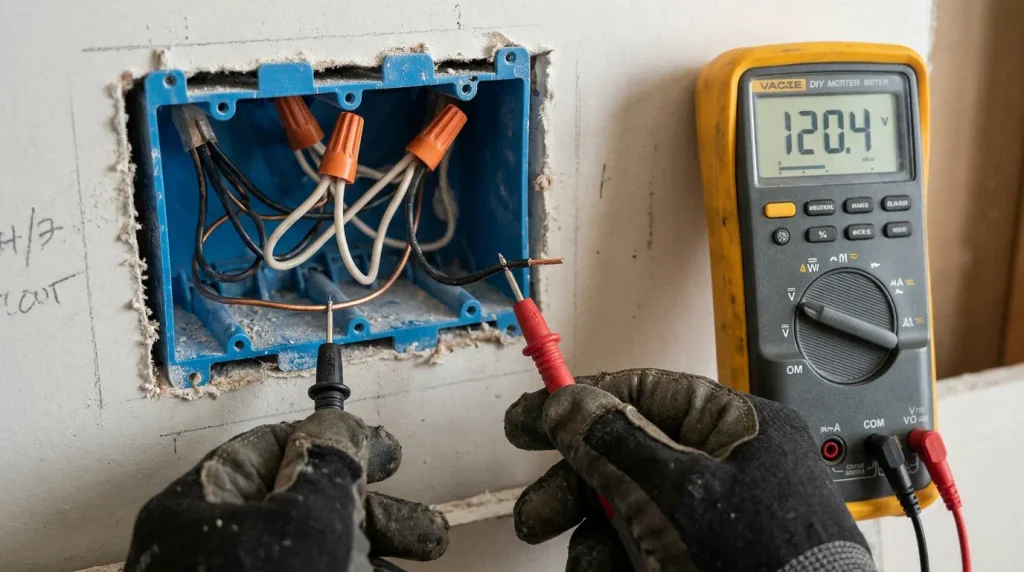
about 120V is hot; a wire reading near 0V isn’t carrying power.
Wire Colors: A Clue, Not Proof
In US homes, the National Electrical Code (NEC) sets the colors for neutral and ground wires. It does not set a color for hot wires. Black and red are simply the most common choices.
| Wire color | What it usually is | Watch out for |
|---|---|---|
| Black | Hot | It may be a switched hot that reads 0V when the switch is off |
| Red | Second hot on a 240V circuit, a switch leg, or a 3-way traveler | It can read 0V or 120V, depending on the switch position |
| Blue or yellow | Hot, often a switch leg or traveler | Same as red |
| White or gray | Neutral | It can be a hot wire in a switch loop |
| Green or bare copper | Ground | It should never carry current |
The NEC requires white or gray for the neutral and green or bare copper for the ground, according to EC&M’s Code Q&A on conductor identification. The same article explains that a white wire in a cable may be used as a hot wire in a switch loop, as long as it is re-marked with tape or paint. Many installers skip the tape, so a plain white wire can still be hot.
Older homes add more surprises: faded insulation, painted-over wires, and past repairs that ignore the rules. That is why you always confirm with a meter.
Safety and Tools
⚠️ Safety warning: Finding the hot wire is one of the few tests done with the power on. Use a meter rated CAT III 600V or higher. Hold the probes only behind the finger guards, and keep your other hand away from the box. Never touch a bare wire end. Once you know which wire is hot, turn the breaker off and prove the circuit dead before you touch, cut, or connect anything.
Do not pull wires apart or strip them while the power is on. Turn the breaker off first. Separate the wires so the bare ends cannot touch each other or the metal box. Then turn the breaker back on and test.
Prove your meter works before and after the test. Measure a known live outlet first, test your wires, then measure the known outlet again. A meter with a blown fuse or a bad lead reads 0V everywhere, which makes a live wire look dead.
What you need:
- Digital multimeter with AC and DC volts, rated CAT III 600V
- Non-contact voltage tester
- Insulated screwdriver
- Electrical tape and a marker, to label the hot wire
- A long extension cord, if the box has no ground wire (see below)
- For a car: alligator clip leads or back-probe pins
💡 Tip: A non-contact voltage tester is great for a fast first scan, but it only shows that voltage may be present. It cannot prove a wire is dead, and it can beep on a wire that only carries ghost voltage. Use it to narrow things down, then confirm with the multimeter. My guide to the best voltage tester compares the main types.
How to Check Which Wire Is Hot with a Multimeter: Step by Step
This is the main method. It works anywhere you have a ground wire or a grounded metal box close by.
Step 1: Set Up the Meter
Plug the black lead into COM and the red lead into VΩ. Turn the dial to AC volts, marked V~. Use auto-range, or pick a range above 120V, such as 200V or 600V. Not sure which symbol is which? See my guide to multimeter symbols.
Step 2: Find a Known Ground
You need a reference point that is grounded. Good choices are the bare copper or green wire, the green ground screw, or a metal box that is bonded to ground. At an outlet, the round hole is ground.
Step 3: Test Each Wire to Ground
Hold the black probe on the ground. Touch the red probe to the bare end of each unknown wire, one at a time. Write down every reading. The hot wire reads about 120V. The others read close to 0V.
Step 4: Confirm Between Two Wires
Measure from the hot wire to the wire you think is neutral. A real hot and neutral pair also reads about 120V. Then measure neutral to ground. That should read close to 0V, usually under 2V.
Step 5: Mark the Hot Wire and Turn Off the Power
Wrap a band of black or red tape around the hot wire. Then turn the breaker off and prove the wires are dead before you work on them.
On a standard US outlet, you can do the same test through the slots. The short slot is hot, the tall slot is neutral, and the round hole is ground. Put the black probe in the round hole and the red probe in each slot. Only the short slot should read about 120V. My guide on how to test an outlet with a multimeter covers polarity and GFCI checks too.
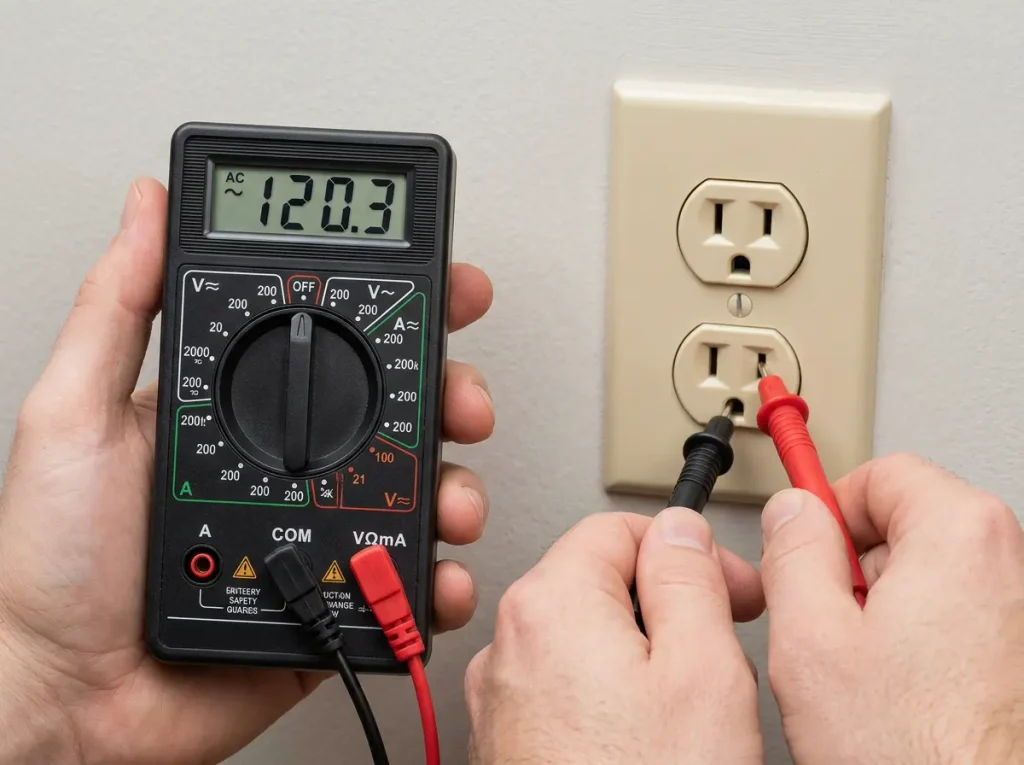
against the ground hole, it reads about 120V, while the taller
neutral slot reads near 0V.
What the Readings Mean
| Reading | What it means | What to do |
|---|---|---|
| 114V to 126V from the wire to ground | Hot wire on a 120V circuit | Mark it as hot |
| About 240V between two wires, and about 120V from each one to ground | Both wires are hot on a 240V circuit | Treat both as hot |
| 0V to 2V from the wire to ground | Neutral, ground, or a hot wire that is switched off | Flip the wall switch and test again |
| A partial reading, such as 10V to 90V | Ghost voltage on a dead wire, or a loose connection | Retest in LoZ mode (below) |
| 0V everywhere, even at a known live outlet | The meter has a problem, or the power is off | Check the meter and the breaker |
Watch Out for Ghost Voltage
A digital multimeter has a very high input resistance, so it can pick up voltage that leaks from a live wire into a dead wire running beside it. Fluke’s application note on dual impedance meters says these ghost voltages can reach 80% to 85% of the real voltage. The meter shows a number, but the wire is not actually connected to power.
To check, switch to LoZ (low impedance) mode if your meter has it. LoZ puts a small load on the wire, about 3kΩ on the Fluke 289. A ghost reading drops to near 0V, while a real hot wire still reads about 120V. If your meter has no LoZ mode, treat the wire as hot until you can prove otherwise. For more on AC readings, see my guide on how to measure AC voltage with a multimeter.
How to Find the Hot Wire in a Switch Box or Light Fixture
Switch boxes confuse most people, because some wires are hot all the time and some are hot only when the switch is on.
Line and Load in a Single-Pole Switch
The line wire comes from the panel and is hot all the time. The load wire goes to the light and is hot only when the switch is on.
- Turn the breaker off, remove the cover plate, and gently pull the switch out of the box. Leave its wires connected.
- Turn the breaker back on.
- With the switch off, touch the black probe to ground and the red probe to each screw on the side of the switch.
- The screw that reads about 120V is the line. The screw that reads 0V is the load.
- Flip the switch on. Both screws now read about 120V.
| Switch position | Line screw to ground | Load screw to ground |
|---|---|---|
| Off | About 120V | 0V, or a small ghost reading |
| On | About 120V | About 120V |
If both screws read 0V in either position, no power reaches this box. The circuit may be a switch loop.
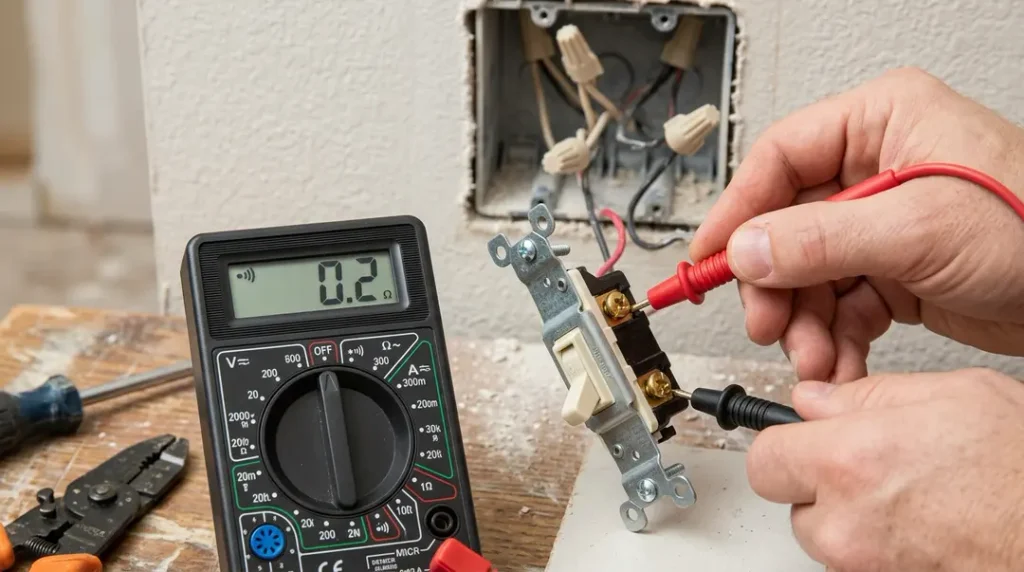
Flip it off and the meter should show OL. Anything else means the
switch needs replacing.
Switch Loops
In many older homes, power goes to the ceiling light first. A two-wire cable then runs down to the switch. In that case, the white wire in the switch box is the hot feed, and the black wire carries power back up to the light. The white wire should be wrapped with black or red tape, but it often is not. Test it to ground like any other wire. If the white wire reads about 120V, it is hot.
3-Way Switches
A 3-way switch has one common screw, usually darker than the other two. The two traveler wires, often red and black, switch between 0V and 120V as you flip the switches. To find the line, test the common screw of each switch to ground. At the switch that holds the line, the common screw reads about 120V no matter how either switch is set.
Ceiling Lights and Fans
At a ceiling box, measure each wire to the bare ground with the wall switch on, then off.
- A wire that reads 120V only when the switch is on is the switched hot for the light.
- A wire that reads 120V with the switch off is an always-hot feed. It often continues to other rooms.
- On a ceiling fan with a separate light switch, a red wire is often a second switched hot.
For testing the switch itself, see my guide on how to test a light switch with a multimeter.
How to Find the Hot Wire When There Is No Ground
Many older homes have two-wire circuits with no ground wire. You can still find the hot wire, but you need a different reference point.
Option 1: Measure Wire to Wire
Measure across the two wires. About 120V means one is hot and the other is neutral. Then scan each wire with a non-contact voltage tester. The one that makes it beep is the hot wire. A reading of 0V means both wires are dead, or the power reaches them through a switch that is off.
Option 2: Bring a Ground in with an Extension Cord
Plug a three-prong extension cord into an outlet that you know is grounded. Run the cord to the box you are testing. Clip the black probe into the round ground hole at the free end of the cord, using an alligator clip lead. You now have a known ground in any room. Test each wire to it, as in Step 3 above. My guide on how to test for ground with a multimeter shows how to confirm the outlet is grounded first.
Option 3: Use a Metal Box, Only If It Is Grounded
A metal box or metal conduit is a good reference only if it is bonded to ground. Check it first: measure from a known hot wire to the box. About 120V means the box is grounded. A low or zero reading means it is not, so do not use it.
⚠️ Safety warning: Do not use a water pipe or a radiator as your ground reference. It may have plastic sections or may not be bonded at all, which gives you a false 0V reading on a live wire.
On a two-wire lamp cord with no colors, look at the insulation. The ribbed side is the neutral, and the smooth side is the hot wire that goes to the narrow prong.
How to Find the Hot Wire in a Car
In a car, you usually need a 12V power source for a dash cam, a stereo, or trailer lights. There are two kinds of hot wire: constant and switched. A constant wire is live all the time. A switched wire is live only when the key is on.
Step 1: Set the Meter to DC Volts
Turn the dial to DC volts, marked V with a straight line, and pick the 20V range or auto-range.
Step 2: Ground the Black Probe
Clip the black probe to clean, bare metal on the chassis, such as a body bolt, or to the negative battery terminal.
Step 3: Test with the Key Off
Touch the red probe to each wire or fuse you want to check. On most blade fuses, you can touch the two small metal test points on top without pulling the fuse. Anything that reads about 12V with the key off is a constant hot.
Step 4: Test Again with the Key On
Turn the key to the accessory position and test the same points. A wire that reads 0V with the key off and about 12V with the key on is a switched hot.
| Key off | Key on | Wire type | Typical use |
|---|---|---|---|
| About 12V | About 12V | Constant hot | Dash cam parking mode, stereo memory |
| 0V | About 12V | Switched (accessory) hot | Dash cam that turns off with the car, stereo power |
| 0V | 0V | Not a power wire, or a ground | Keep looking |
This key-off, key-on check is the same method dash cam makers use to find a constant fuse and a switched fuse, as Nexar’s hardwiring guide shows with a fuse tester.
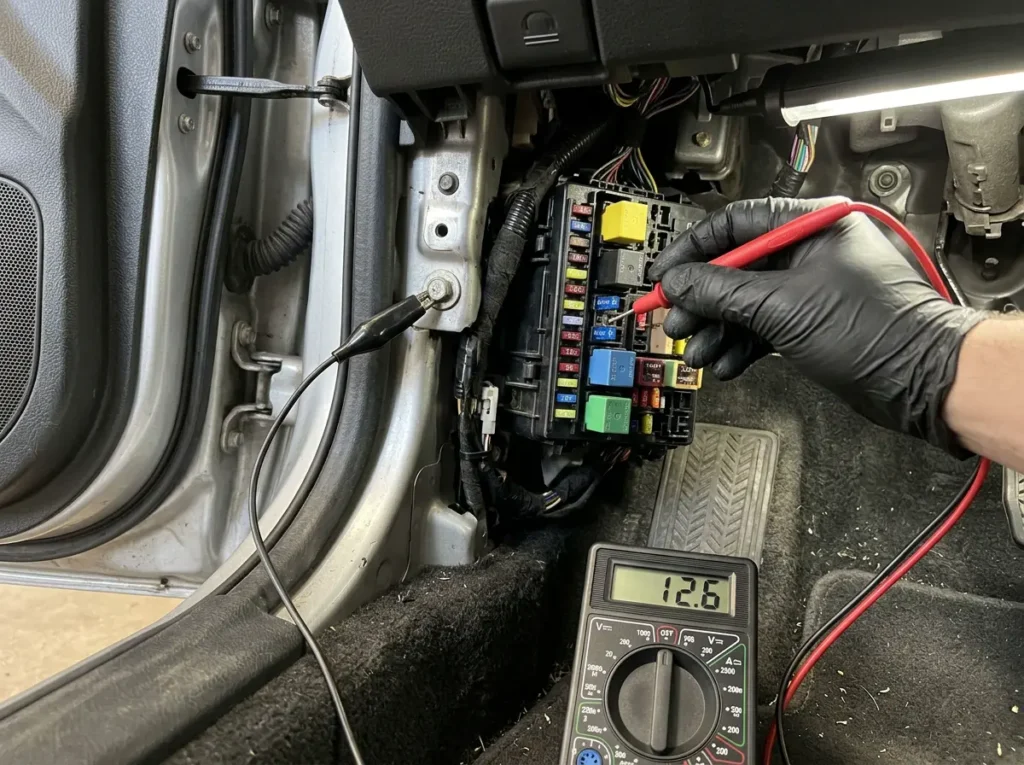
both means power is flowing; 12.6V on one side and 0V on the other
means the fuse is blown.
💡 Tip: Some cars keep accessory power on for several minutes after you turn the key off, or until you open a door. Wait a few minutes before you decide a wire is switched.
On an aftermarket stereo harness, yellow is the constant wire and red is the switched wire. Factory car wiring uses its own colors, so always test it. Do not pierce wire insulation with the probe, because the hole lets water in. Back-probe the connector instead. Stay away from yellow airbag connectors.
With the engine running, a healthy charging system reads 13.7V to 14.7V at a constant hot. For a full check of the battery and wiring, see my car electrical diagnostic guide.
Real World Example: The White Wire That Was Hot
Say you are replacing a hallway light in an older home. The ceiling box has two cables. Each one has a black wire, a white wire, and a bare ground. None of the wires are taped.
With the wall switch off, you measure each wire to the bare ground:
| Wire | Switch off | Switch on |
|---|---|---|
| Cable 1, black | 120V | 120V |
| Cable 1, white | 0.3V | 0.3V |
| Cable 2, white | 120V | 120V |
| Cable 2, black | 0V | 120V |
Cable 1 comes from the panel: its black wire is the feed and its white wire is the neutral. Cable 2 is a switch loop. Its white wire carries power down to the switch, and its black wire brings switched power back.
So the light’s black wire connects to cable 2’s black wire, and the light’s white wire connects to cable 1’s white wire. Before you finish, wrap black tape around cable 2’s white wire, so the next person knows it is hot.
Common Mistakes When Finding the Hot Wire
- Trusting the colors. A white wire can be hot, and a black wire can be dead. Test every wire.
- Testing in only one switch position. A switched hot reads 0V when the switch is off. Test with the switch off, then on.
- Using the wrong setting. House wiring is AC. On the DC volts setting, a hot wire may read close to 0V.
- Using an unproven ground. A water pipe or an ungrounded metal box can make a live wire read 0V.
- Ignoring partial readings. A reading such as 40V is either ghost voltage or a loose connection. Recheck it in LoZ mode.
- Touching the wires right after the test. Once you find the hot wire, turn the breaker off and prove the wires dead before you work.
FAQ
How do you find the hot wire with a multimeter?
Set the meter to AC volts and touch the black probe to a known ground, such as the bare copper wire. Touch the red probe to each wire, one at a time. The wire that reads about 120V is hot. The others read close to 0V.
What setting should my multimeter be on to find a hot wire?
Use AC volts (V~) for house wiring, on auto-range or a range above 120V. Use DC volts on the 20V range for a car. Never use the ohms or continuity setting on a live wire.
What voltage does a hot wire read on a multimeter?
On a 120V household circuit, a hot wire reads about 114V to 126V to ground. On a 240V circuit, each hot reads about 120V to ground and about 240V between the two hots. In a car, a hot wire reads about 12V with the engine off.
Can a white wire be hot?
Yes. In a switch loop, the white wire in the cable often carries power to the switch. It should be marked with black or red tape, but many are not. Always test white wires too.
How do I find the hot wire if there is no ground wire?
Measure across the two wires. About 120V means one is hot, and a non-contact tester shows which one. You can also run a grounded extension cord from a working outlet and use its round ground hole as your reference.
Why does my multimeter show voltage on a wire that should be dead?
It is probably ghost voltage. A digital meter can pick up voltage that leaks from a nearby live wire. Switch to LoZ mode if your meter has it. A ghost reading drops to near 0V, while a real hot wire still reads about 120V.
Conclusion
Finding the hot wire with a multimeter comes down to one test: measure each wire to a known ground on the right setting. The wire that reads about 120V in a house, or about 12V in a car, is hot.
- Outlets: Only the short slot should read about 120V to the round ground hole.
- Switch boxes and fixtures: Test with the switch off, then on, to tell the always-hot line from the switched load.
- No ground: Measure wire to wire, then use a non-contact tester or a grounded extension cord.
- Cars: Test with the key off, then on, to tell a constant hot from a switched one.
Whatever you find, mark the hot wire, turn off the power, and prove it dead before you touch it.
Ready to fix a breaker that keeps tripping? My guide on how to find a short with a multimeter shows you how to track it down, step by step.