You need to watch a battery’s voltage while someone cranks the engine. Or you need to check a 50-foot wire run for continuity, alone. Two hands on two probes will not work.
Alligator clip test leads solve that problem. They grip the wire or terminal, so the meter does the watching while your hands stay free.
Quick answer: Alligator clip test leads, also called crocodile clip leads, grip a test point so you can measure hands-free. For anything plugged into the wall, choose clips with their own CAT III or CAT IV rating, like the Fluke AC175 or Klein Tools 69381. Clip on with the power off, black lead first. Cheap unrated jumper clip leads are for low-voltage electronics only.
💡 How I chose these picks: They are based on manufacturer specifications and US retailer listings, not on hands-on testing. Prices were checked on 3 October 2026 and change often.
What Are Alligator Clip Test Leads?
Alligator clip test leads are multimeter leads that end in spring-loaded clips, so they can grip a wire or terminal without your hands.
Some sets have clips built on. Others use clips that attach to your normal probe tips. Either way, the clip holds the connection while you read the meter, flip a switch, or crank an engine.
Alligator Clips vs Crocodile Clips: Same Part, Two Names
“Alligator clip” is the American name. “Crocodile clip” is the British name. Both describe the same spring-loaded clip with toothed jaws.
So multimeter leads with crocodile clips and multimeter leads with alligator clips are the same product. Search both terms when you shop, because sellers use either one.
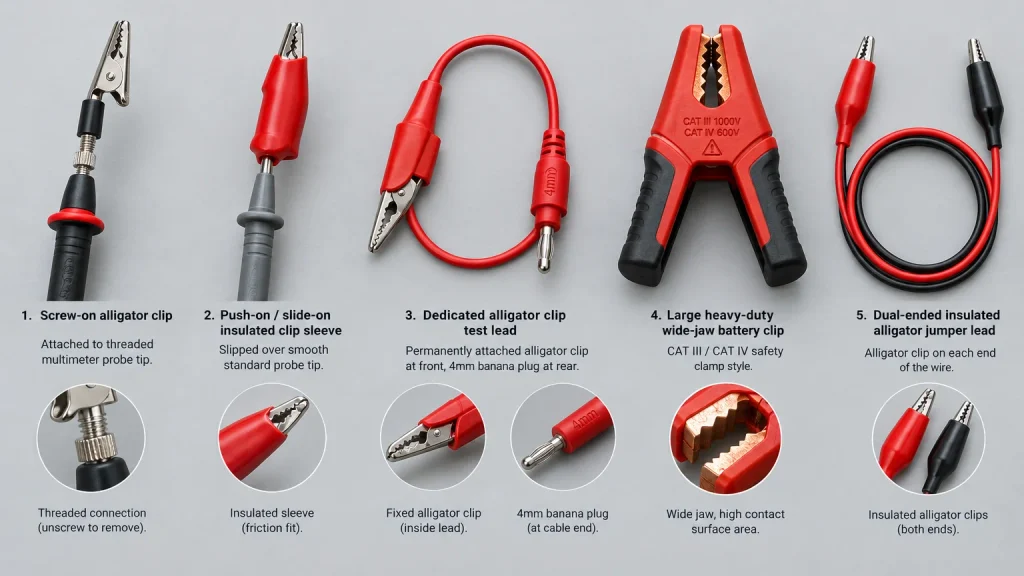
Types of Alligator Clip Leads
| Type | How it attaches | Best for | Watch out for |
|---|---|---|---|
| Screw-on clip | Threads onto the probe tip | Mains and general work | Fits only probes with matching threads |
| Slide-on (push-on) clip | Pushes over the probe tip | Quick, occasional use | Can pull off if the fit is loose |
| Dedicated clip leads | Banana plug on one end, clip on the other | Insulation testing, long hands-free tests | No probe tip for spot checks |
| Large heavy-duty clip | Slides onto the lead’s plug end | Bolts, bus bars, battery terminals | Too bulky for small terminals |
| Jumper clip leads | Clip on both ends | Electronics bench work, temporary links | Usually unrated and low-voltage only |
Screw-on clips stay on better than slide-on clips. The Fluke AC175, for example, has a threaded shaft that twists onto compatible probes.
Dedicated clip leads skip the adapter entirely. The plug goes in the meter, and the clip goes on the circuit.
Jumper clip leads are the colorful clip-to-clip wires sold in packs. They are useful test clips for connecting parts on a bench. Most use thin wire and carry no CAT rating, so keep them away from wall-powered circuits.
For mains voltage, use only insulated clips with a CAT rating that
matches your meter.
Are Alligator Clip Leads Safe on Live Circuits?
They can be, if the clips are rated for the job and you connect them the right way. The clip is part of the test setup, so its rating matters as much as the meter’s.
The Clip’s Rating Sets the Limit
Fluke’s probe instructions say not to exceed the CAT rating of the lowest-rated component in a setup. Put an unrated clip on CAT IV leads, and the whole setup is only as safe as that clip.
Rated clips print their category and current limit. The Fluke AC175 and AC285 are both rated CAT III 1000 V, CAT IV 600 V, and 10 A. The Klein 69381 leads carry the same CAT III 1000 V and CAT IV 600 V rating.
Many Clip Leads Are Low-Voltage Only
Jumper clip leads and small grabber leads often have low ratings or none at all. Pomona’s popular minigrabber set, for example, is rated for only 30 V AC and 60 V DC.
Use those for battery-powered electronics. Never clip them onto an outlet, a breaker panel, or a 240 V appliance.
Check the Boot and the Plug
A good mains-rated clip has a flexible boot that covers the metal jaws except at the tip. If the boot is torn or missing, retire the clip.
Fluke also warns against pushing a shrouded clip onto an unshrouded banana tip in a hazardous installation. That combination can leave metal exposed where your fingers go.
⚠️ Safety warning: Voltages above 30 V AC or 60 V DC can give a dangerous shock. Whenever you can, turn off the power before attaching or removing clips. Clipping onto a live terminal risks a slip that shorts two conductors.
My Multimeter Test Leads guide covers CAT ratings and tip safety in more depth.
How to Choose Alligator Clip Test Leads
Five details decide whether a set of clip leads will work for you.
1. Jaw Opening
Match the jaw to what you are gripping. A small jaw holds wires and screw terminals securely. A large jaw is needed for battery posts, bolts, and bus bars.
The Fluke AC175 opens to 7 mm (0.275 inch), which suits wires and small terminals. The Fluke AC285 grips anything from fine wire to a 20 mm bolt.
2. CAT and Current Rating
The clips should match or exceed your meter’s CAT rating. For home electrical work, look for CAT III at minimum. Check the current rating too; rated clips like the AC175 and AC285 are rated for 10 A.
3. How the Clip Attaches
Screw-on clips need matching threads on your probes. Slide-on clips need the right tip diameter. Dedicated clip leads plug straight into any meter with standard 4mm banana jacks.
Check compatibility before you buy. Fluke lists the AC175 for its TL71, TL75, TL175, and TP175 probes.
4. Wire Gauge and Length
Thicker wire carries more current with less resistance. The Klein 69381 uses 18 AWG wire, a common gauge for meter leads. Many jumper clip packs use thinner 22 AWG wire, which is fine for signals but not for heavy current.
Three feet is enough for bench and panel work. Choose longer leads for car engine bays or long cable runs.
5. Jaw Material and Teeth
Most clips use nickel-plated steel or iron jaws, which resist rust. Sharp, deep teeth bite through light oxidation on a terminal. Worn, rounded teeth slip.
Which Clip for Which Job?
| Job | Best clip |
|---|---|
| Battery voltage over time | Large clips on both terminals |
| Continuity on a long wire run | Dedicated clip leads, one clip at each end |
| Insulation resistance test | Dedicated rated clip leads |
| Thermostat or control wiring | Small screw-on clips |
| Circuit board signals | Jumper clip leads or micro grabbers (low voltage only) |
Best Alligator Clip Test Leads
All four picks carry their own CAT III 1000 V and CAT IV 600 V rating. Prices are from US listings on 3 October 2026.
| Category | Product | Price | Jaw size |
|---|---|---|---|
| Best clip-on add-on | Fluke AC175 | $52.99 list; about $42 on sale | 7 mm |
| Best dedicated clip leads | Klein Tools 69381 | $19.99 | Not listed (“heavy-duty”) |
| Best for large conductors | Fluke AC285 | $49.99 list; about $41 on sale | Up to a 20 mm bolt |
| Best budget probes with clips | Klein Tools 69410 | About $20 to $30 | Not listed |
Fluke AC175: Best Clip-On Alligator Clips
The AC175 adds alligator clips to probes you already own. Each clip has a threaded shaft, a flexible insulating boot, and nickel-plated steel jaws. It is rated CAT III 1000 V, CAT IV 600 V, and 10 A.
Known limitations: It fits only Fluke’s TL71, TL75, TL175, and TP175 probes. The 7 mm jaw is too small for battery posts and large lugs.
Klein Tools 69381: Best Dedicated Alligator Clip Leads
These 3-foot leads have a right-angle banana plug on one end and a heavy-duty alligator clip on the other. They use 18 AWG double-insulated wire, and Klein recommends them for insulation resistance testing.
Known limitations: Klein does not list a current rating or jaw size. With clips fixed on, you still need a separate probe set for quick spot checks.
Fluke AC285: Best Alligator Clips for Large Conductors
The AC285 SureGrip clips have rubber-covered bodies and a tooth pattern that grips anything from fine wire to a 20 mm bolt. They are rated CAT IV 600 V, CAT III 1000 V, and 10 A, and UL listed.
Known limitations: Fluke recommends them for its TL222 and TL224 leads, so check fit with other brands. They are bulky on small terminals.
Klein Tools 69410: Best Budget Probes with Alligator Clips
This replacement lead set gives you standard probes plus removable alligator clips that screw onto the tips. It is rated CAT III 1000 V and CAT IV 600 V, with 41-inch leads.
Known limitations: The cable is not silicone, so it stiffens in the cold. Klein does not list the clip jaw size.
A Note on Jumper Clip Leads
Multi-color packs of clip-to-clip jumper leads are cheap and handy on an electronics bench. Most list no CAT rating and use thin wire. Treat them as low-voltage test clips only.
How to Use Alligator Clips with a Multimeter
This method keeps your hands clear of live metal the whole time.
- Inspect the clips. Check for torn boots, cracked bodies, and worn teeth.
- Set up the meter. Plug the leads into the correct jacks and choose the function before you connect anything.
- Turn off the power to the circuit whenever you can.
- Clip the black lead first to ground, neutral, or the negative terminal.
- Clip the red lead to the test point. Make sure the jaws grip only that conductor and do not touch anything nearby.
- Restore power and step back. Read the meter without touching the leads.
- Disconnect in reverse. Turn the power off, remove the red clip, then the black clip.
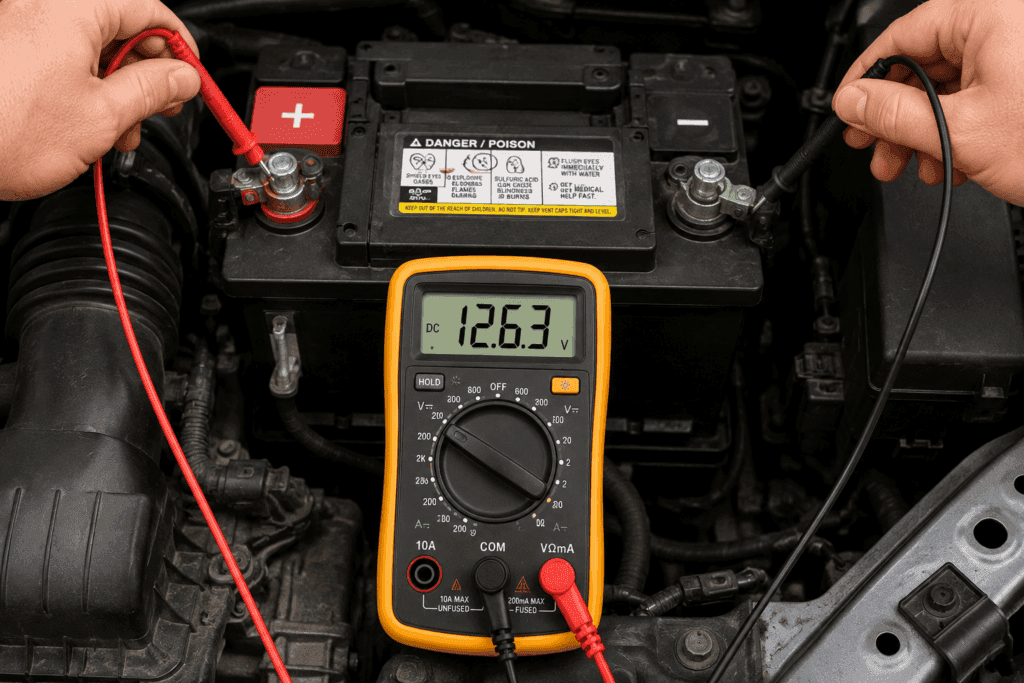
Real World Example 1: Cranking Voltage, Hands-Free
Clip black to the negative battery post and red to the positive post. Set the meter to DC volts and press MIN/MAX. Have a helper crank the engine, then read the lowest value. A healthy battery stays above 9.6 V. My guide on How to Test a Car Battery with a Multimeter explains the full test.
Real World Example 2: Continuity on a Long Wire Run
At the far end of a de-energized cable, twist two conductors together. At the near end, clip one lead to each conductor. A reading close to 0 Ω means both wires are continuous. You did it alone, without walking back and forth. See How to Test Continuity with a Multimeter for the full method.
Common Mistakes with Clip Leads
Using unrated jumper clips on mains wiring. Clip-to-clip jumper packs are for low-voltage electronics. On a 120 V or 240 V circuit, use clips with a printed CAT rating.
Clipping onto a live terminal. The jaws can slip and bridge two conductors. Turn the power off, clip on, then turn it back on.
Letting the clips touch. Two clips touching across a battery or power source create a dead short. Keep them apart, and route the leads so they cannot swing together.
Changing the meter function with clips attached. Switching to the amps setting while the clips sit across a voltage source can blow the meter’s fuse. Disconnect first, then change the setting.
Using a small jaw on a big terminal. A 7 mm clip on a battery post can pop off mid-test. Use large clips for posts, lugs, and bolts.
Assuming any clip fits any probe. Threads and tip sizes vary. Check the clip maker’s compatibility list before you buy.
FAQ
What are alligator clip test leads used for?
They hold a connection so you can measure hands-free. Common uses include watching battery voltage while an engine cranks, checking continuity on long wire runs alone, insulation resistance tests, and readings on control wiring.
Are crocodile clips the same as alligator clips?
Yes. “Alligator clip” is the American name and “crocodile clip” is the British name for the same spring-loaded, toothed clip. Multimeter leads with crocodile clips and leads with alligator clips are the same product.
Are alligator clip leads safe for household voltage?
They are safe when the clips carry their own CAT rating, CAT III at minimum for home wiring. Connect them with the power off whenever possible. Unrated jumper clip leads are not safe on household circuits.
Do alligator clips affect multimeter readings?
A clean, tight clip adds very little resistance. Loose or oxidized jaws add more, which shows up on low-ohm readings. Clip the two jaws together and note the reading, or use the REL button, to cancel it out.
Can I add alligator clips to my existing test leads?
Yes, if the clips match your probe tips. Screw-on and slide-on clips are made for specific probes; the Fluke AC175, for example, fits the TL71, TL75, TL175, and TP175. Check the compatibility list before buying.
What size alligator clip do I need for a car battery?
A large clip. A small 7 mm jaw can slip off a battery post. Large clips like the Fluke AC285, which grips up to a 20 mm bolt, hold posts and cable lugs securely.
Conclusion
Alligator clip test leads, or crocodile clip leads, turn a two-handed job into a hands-free one. Three points keep them safe and useful:
- Check the rating. For household wiring, use clips with their own CAT III or CAT IV rating. Keep unrated jumper clips on low-voltage electronics.
- Match the jaw to the job. Small jaws suit wires and terminals. Large jaws suit battery posts, lugs, and bolts.
- Connect in the right order. Power off, black first, red second, then power on and step back.
For a dedicated set, the Klein 69381 is a strong value at about $20. To add clips to Fluke probes, choose the AC175, and for large conductors, the AC285.
Ready for a bigger test? My guide to the insulation resistance tester shows where rated clip leads earn their keep.