
A plant does not make money when its machines stop. One failed motor on a conveyor can halt a whole production line, and every hour of downtime costs output, overtime, and missed orders.
Industrial maintenance is how plants prevent that. It is the planned, ongoing work of inspecting, testing, and repairing production machinery before it fails, and fixing it fast when it does.
Quick answer: Industrial maintenance is the work of keeping factory and plant machinery running safely and reliably. It includes reactive repairs, scheduled preventive maintenance, and predictive maintenance based on tests and measurements. Common electrical tests include insulation resistance testing on motors, voltage and current checks on three-phase circuits, and control circuit troubleshooting with a multimeter.
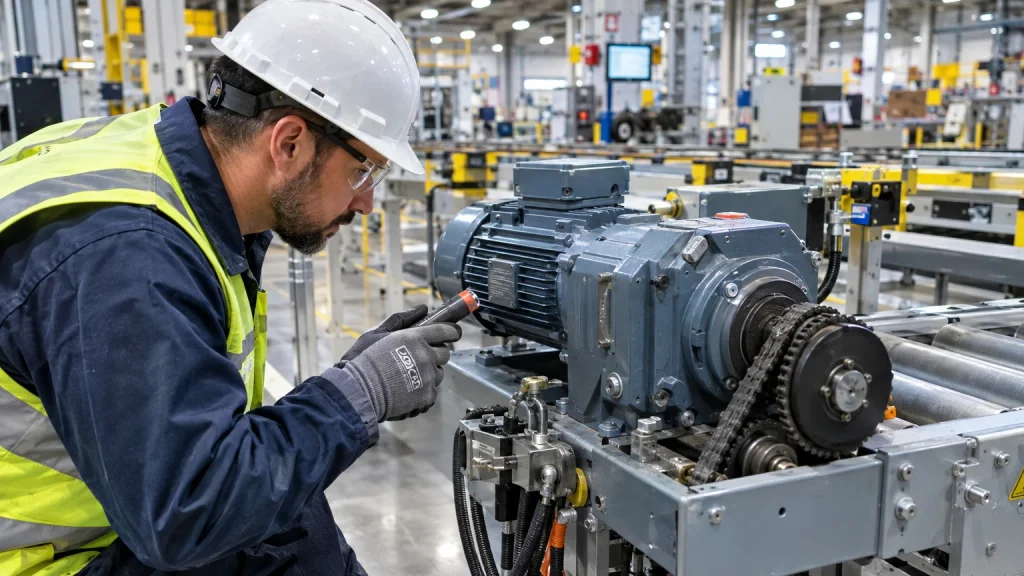
For this kind of work, use a meter rated at least CAT III.
What Is Industrial Maintenance?
Industrial maintenance is the inspection, testing, repair, and upkeep of the machinery and equipment used in factories, plants, and other industrial facilities. It is also called plant maintenance.
The goal is simple: keep production equipment running safely, at full output, for as long as possible. Conveyors, pumps, compressors, presses, motors, drives, and their controls all need regular care.
The work is done by industrial maintenance technicians, also called industrial mechanics. My guide to the industrial maintenance technician role covers their duties, skills, and pay.
Industrial Maintenance vs Facility Maintenance
| Industrial maintenance | Facility maintenance | |
|---|---|---|
| Looks after | Production machines and process equipment | The building: lighting, HVAC, plumbing, doors |
| Effect of a failure | Production stops or slows | People are uncomfortable or inconvenienced |
| Typical equipment | Motors, drives, conveyors, pumps, hydraulics, PLCs | Air handlers, boilers, fixtures, elevators |
A burnt-out office light is a facility job. A tripped conveyor motor is an industrial maintenance job, because the production line is waiting on it.
What Industrial Maintenance and Repair Covers
Industrial maintenance and repair covers the full life of a machine:
- Installation and startup: setting, aligning, wiring, and testing new equipment.
- Routine care: lubrication, cleaning, adjustment, and part replacement on a schedule.
- Inspection and testing: measuring vibration, temperature, current, voltage, and insulation to spot wear early.
- Repair: finding and fixing faults, from a worn bearing to a failed motor winding.
- Improvement: changing a part, a procedure, or a design so the same failure does not happen again.
Types of Industrial Maintenance
There are five main types of industrial maintenance. They differ in one thing: when you act.
| Type | When you act | Motor example | Best for |
|---|---|---|---|
| Reactive (corrective) | After the machine fails | Replace the motor when it burns out | Cheap, non-critical equipment with a spare on the shelf |
| Preventive | On a fixed schedule | Grease the bearings every 3 months | Wear parts with a predictable life |
| Predictive | When test results show a trend | Insulation resistance has dropped every quarter, so plan a rewind | Critical equipment where failure is costly |
| Condition-based | When a measured value crosses a limit | Vibration sensor alarms above its set limit | Equipment with continuous monitoring |
| Reliability-centered (RCM) | Strategy chosen per machine | A critical conveyor gets predictive care; a spare fan gets run-to-failure | Plants balancing cost against risk |
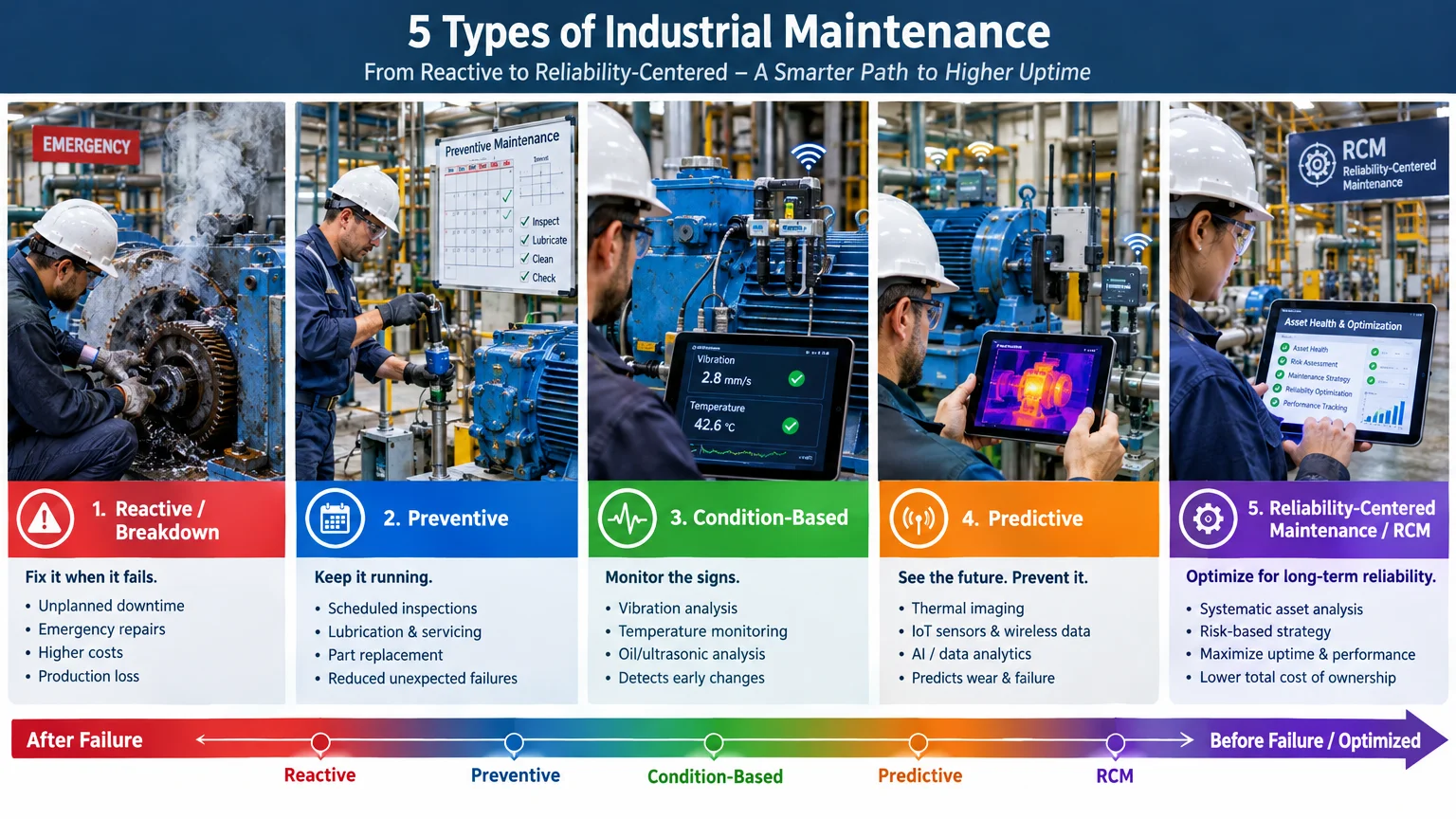
maintenance strategies. RCM is the framework that decides which one
each machine needs, sometimes even run-to-failure.
Reactive maintenance looks cheap until it fails at the worst time. It suits only equipment whose failure does not stop production.
Preventive maintenance is the backbone of most plants. It works well for parts that wear at a steady rate, such as belts, filters, and lubricant. Its weakness is that it can replace parts that still had life left, or miss a part that fails early.
Predictive maintenance measures the machine and watches the trend. A single reading tells you little; a falling series of readings tells you a failure is coming. This is where electrical testing earns its place, and it is covered in detail below.
Total productive maintenance (TPM) adds one more idea: operators do basic daily care, such as cleaning, checking, and reporting changes, so technicians can focus on skilled work.
Most plants mix all of these. The skill is matching the right type to each machine.
Industrial Machine Maintenance Tasks
Industrial machine maintenance falls into four areas. A good technician works across all of them.
| Area | Common tasks | Typical tools |
|---|---|---|
| Mechanical | Lubrication, belt tension, bearing replacement, shaft alignment, vibration checks | Grease gun, alignment tools, vibration meter |
| Electrical | Panel inspections, checking starters and contactors, motor insulation tests, current and voltage checks | Multimeter, clamp meter, insulation tester, thermal camera |
| Instrumentation and controls | Calibrating transmitters, testing temperature sensors, checking proximity and limit switches, backing up PLC programs | Process calibrator, multimeter, laptop |
| Fluid power | Oil level and condition, filter changes, leak checks, pressure checks | Pressure gauges, oil sampling kit |
Sample Monthly Checklist for a Conveyor Motor
This is the kind of short, repeatable checklist that catches problems early:
- Listen for new noise and feel for heat or vibration at the bearings.
- Check that guards are in place and the motor is clean, with clear cooling fins.
- Measure running current on all three phases with a clamp meter and record it.
- Measure supply voltage on all three phases at the starter and record it.
- Inspect the terminal box seal and cable gland for damage or moisture.
- Log the readings next to last month’s, and flag any change.
The last step matters most. A reading means little on its own. A change from last month is the early warning.
For temperature sensors in process equipment, see my guide on how to check a PT100.
Electrical Testing in Industrial Maintenance
Motors, drives, and controls are behind many plant breakdowns. These four tests catch most electrical problems before they stop production.
Insulation Resistance Testing
An insulation resistance tester applies a high DC voltage to a motor’s windings and measures how much current leaks to ground. Good insulation leaks almost nothing, so the reading is very high.
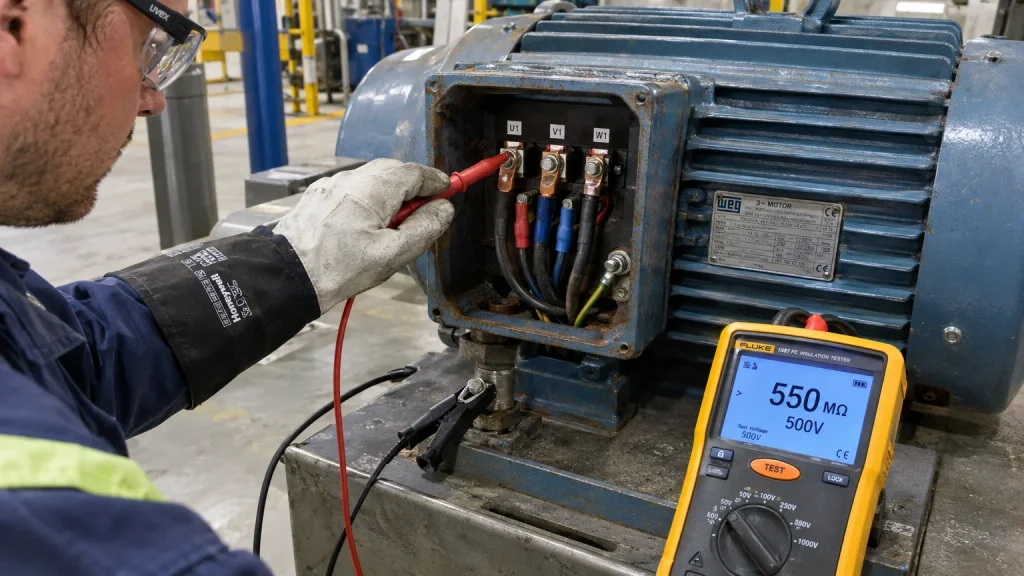
motors rated below 1 kV, so this motor’s windings are in good shape.
The US standard for motors is IEEE 43-2013. Its key rules for a typical plant motor:
| Rule | Value |
|---|---|
| Test voltage for motors rated below 1,000V | 500V DC |
| When to read | 60 seconds after applying voltage |
| Temperature | Correct the reading to 40°C before comparing |
| Minimum for most low-voltage random-wound motors | 5MΩ |
| Minimum for modern form-wound AC windings (built after about 1970) | 100MΩ |
| Polarization index (10-minute reading ÷ 1-minute reading) | At least 2.0 for Class B insulation and above |
A healthy modern motor usually reads far above these minimums, often hundreds of megohms or more. That is why the trend matters more than any single pass or fail.
⚠️ Safety warning: A winding stays charged after an insulation test. Ground it until the stored charge is fully gone before you touch the leads.
My insulation resistance tester guide explains the tools and the test method.
Voltage Unbalance on Three-Phase Motors
Three-phase motors need equal voltage on all three phases. A small voltage unbalance causes a much larger current unbalance, and that extra current turns into heat.
To calculate it, measure the three phase-to-phase voltages with a multimeter at the motor while it runs:
Voltage unbalance (%) = 100 × largest deviation from the average ÷ average voltage
For example, readings of 460V, 450V, and 467V average 459V. The largest deviation is 9V (459 − 450). So the unbalance is 100 × 9 ÷ 459 = 1.96%.
The NEMA MG1 motor standard says motors should run at no more than 1% unbalance without derating. Above 1%, the motor must be derated, and above 5%, it should not be run at all.
Motor Current Checks
A clamp meter measures each phase’s current without breaking the circuit. Compare the readings in two ways:
- Against the nameplate full-load amps: current above nameplate points to overload, a mechanical problem such as a failing bearing, or low voltage.
- Against each other: unequal phase currents point to supply unbalance or a winding problem.
Record the readings each month. A slow climb in current is often the first sign of a bearing or gearbox going bad. See my Clamp Meter Guide for the method.
Control Circuits and Sensors
Many breakdowns are not in the motor at all. They are in the control circuit that tells it to run.
- Coils and contacts: check the coil voltage at a contactor while it is commanded on. Correct voltage with no pull-in points to the contactor. No voltage points upstream.
- Safety circuits: with the power off, check continuity through emergency stops, door switches, and interlocks.
- 4–20 mA signals: many process transmitters send 4 mA at 0% and 20 mA at 100% of their range, so 12 mA is 50%. A reading of 0 mA means the loop is broken, which is why the signal starts at 4 mA instead of zero. My guide on How to Measure Amps with a Multimeter covers measuring milliamps.
Real World Example: A Trend That Saved a Motor
This example uses typical values to show how trending works.
A 460V, 50 hp conveyor motor is insulation tested every quarter at 500V DC. Each reading is corrected to 40°C:
| Quarter | Corrected reading |
|---|---|
| Q1 | 1,800MΩ |
| Q2 | 1,500MΩ |
| Q3 | 420MΩ |
| Q4 | 35MΩ |
The Q4 reading still passes the 5MΩ minimum. But it has fallen by about 98% in a year. The team schedules the motor for cleaning and drying during the next planned shutdown, instead of waiting for it to fail mid-shift. After drying, it reads 1,200MΩ again.
A single pass/fail check would have missed the warning. The trend caught it.
Industrial Maintenance Systems and Metrics
An industrial maintenance system is how a plant plans, records, and measures its maintenance work. In most plants today, that system runs on software called a CMMS (computerized maintenance management system).
What a Good Maintenance System Does
Whatever software a plant uses, the system should handle five jobs:
- Work orders: every repair and inspection gets a written task, an owner, and a record when it is done.
- Preventive maintenance schedules: tasks come due automatically by date, run hours, or cycle count.
- Asset history: each machine keeps a record of its repairs, parts, and test readings, which is what makes trending possible.
- Spare parts: stock levels and reorder points for critical spares such as motors, bearings, and fuses.
- Reports: the numbers that show whether maintenance is improving.
A paper logbook can do all five for a small shop. A large plant needs software. The tool matters less than the habit of recording every job.
The Metrics That Matter
| Metric | What it measures | How to calculate it |
|---|---|---|
| MTBF (mean time between failures) | How long equipment runs between breakdowns | Operating hours ÷ number of failures |
| MTTR (mean time to repair) | How quickly the team fixes a breakdown | Total repair hours ÷ number of repairs |
| PM compliance | How reliably scheduled maintenance gets done | Preventive tasks completed on time ÷ tasks scheduled × 100 |
| Planned vs reactive work | How much work is planned instead of urgent | Planned hours ÷ total maintenance hours × 100 |
| OEE (overall equipment effectiveness) | How well a machine performs overall | Availability × performance × quality |
Example: A pump runs 2,000 hours and fails 4 times, so its MTBF is 500 hours. The 4 repairs took 10 hours in total, so its MTTR is 2.5 hours. If the line runs at 90% availability, 95% performance, and 99% quality, its OEE is 0.90 × 0.95 × 0.99 = 84.6%.
Rising MTBF and falling MTTR mean the maintenance program is working.
Safety in Industrial Maintenance
Industrial machines store energy in many forms: electrical, mechanical, hydraulic, pneumatic, and thermal. Maintenance is the moment when people put their hands into those machines, so safety rules are strict.
Lockout/Tagout
In the US, OSHA’s standard on the control of hazardous energy (29 CFR 1910.147) requires a lockout/tagout procedure before workers service machines. A typical sequence:
- Notify the operators and everyone affected.
- Shut down the machine using its normal controls.
- Isolate every energy source: electrical disconnects, valves, and air supplies.
- Lock and tag each isolation point with your own lock.
- Release stored energy: bleed hydraulic and air pressure, block moving parts, and discharge capacitors.
- Verify: try the start button, then test for voltage with the live-dead-live method.
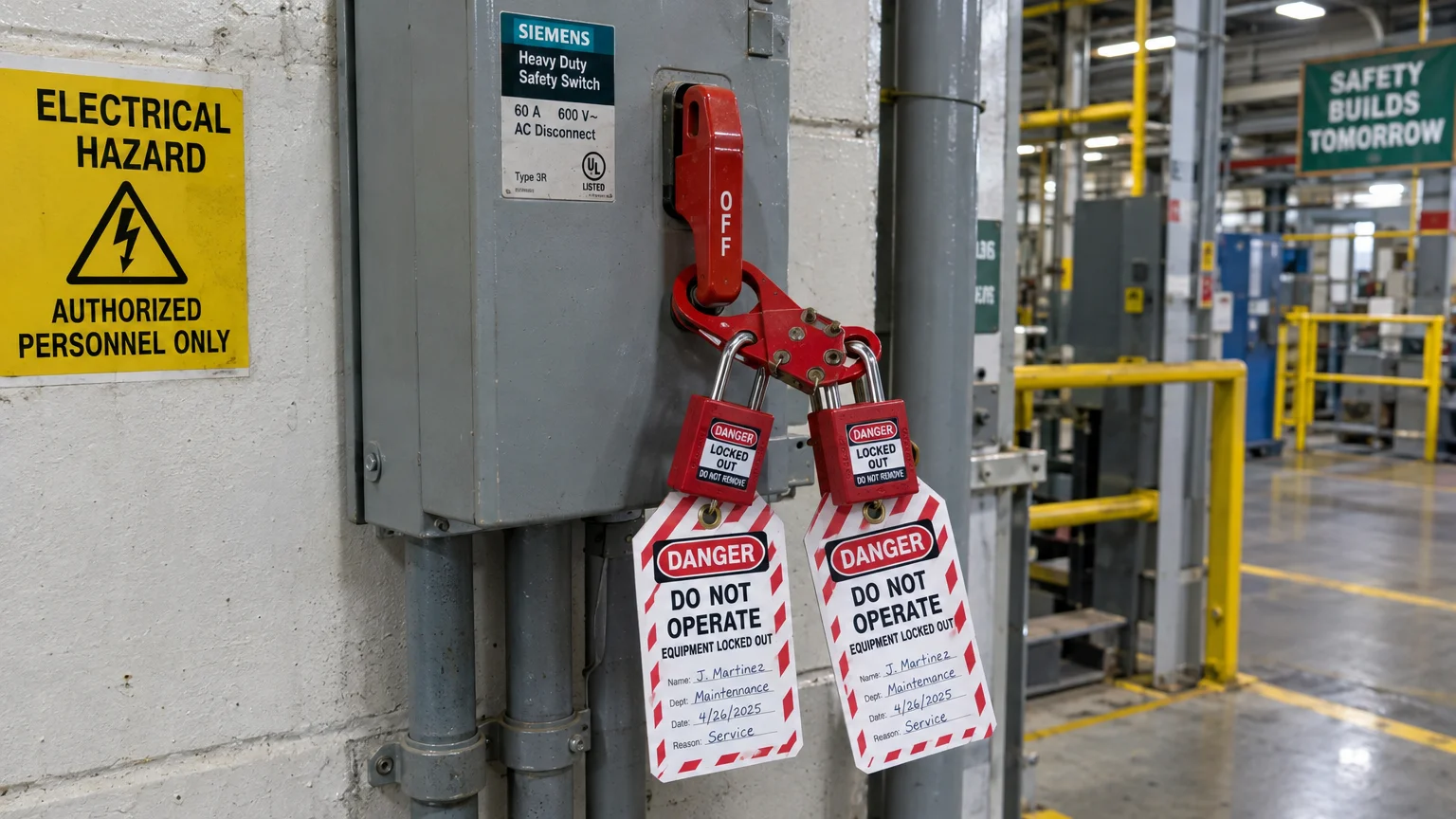
verify zero energy with a meter: test a known live source, then the
circuit, then the live source again.
Electrical Safety and Arc Flash
NFPA 70E is the US standard for electrical safety in the workplace. Its core rule is to put equipment in an electrically safe condition before work. When live testing cannot be avoided, such as measuring supply voltage to diagnose a fault, workers need training and the right arc-rated PPE for that panel.
Meter and Lead Ratings
Plant panels and motor control centers are high-energy circuits. Your test equipment must be rated for them:
| Where you test | Minimum rating |
|---|---|
| Motor control centers, distribution panels, fixed plant wiring | CAT III for the voltage present |
| Service entrance and outdoor feeders | CAT IV |
The whole setup is only as safe as its lowest-rated part, so the test leads must match the meter. Use a dedicated voltage tester to prove circuits dead, and see my Multimeter Buying Guide for choosing a properly rated meter.
FAQ
What is industrial maintenance?
Industrial maintenance is the inspection, testing, repair, and upkeep of machinery in factories and plants. It keeps production equipment such as motors, conveyors, pumps, and controls running safely and reliably. It is also called plant maintenance.
What are the main types of industrial maintenance?
The main types are reactive, preventive, predictive, condition-based, and reliability-centered maintenance. They differ in when you act: after a failure, on a schedule, when a test shows a trend, or when a measurement crosses a limit. Most plants combine several types.
What is the difference between industrial and facility maintenance?
Industrial maintenance looks after production machinery, so a failure stops or slows production. Facility maintenance looks after the building itself, such as lighting, HVAC, and plumbing.
What tests are used in industrial maintenance?
Common electrical tests include insulation resistance tests on motors, voltage and voltage unbalance checks on three-phase supplies, motor current checks with a clamp meter, and control circuit troubleshooting with a multimeter. Mechanical tests include vibration and temperature checks.
What is a CMMS in industrial maintenance?
A CMMS, or computerized maintenance management system, is software that manages work orders, preventive maintenance schedules, equipment history, and spare parts. It also tracks metrics such as MTBF and MTTR, which show whether maintenance is improving.
What is an acceptable insulation resistance for a motor?
Under IEEE 43-2013, most low-voltage random-wound motors should read at least 5MΩ, corrected to 40°C, after 60 seconds at 500V DC. Modern form-wound AC windings should read at least 100MΩ. A healthy motor usually reads far higher, so watch the trend as well as the minimum.
Conclusion
Industrial maintenance keeps production machinery running, and the best programs act before a failure, not after it. Three points sum it up:
- Match the maintenance type to the machine. Run cheap spares to failure, schedule wear parts, and test and trend critical equipment.
- Test, record, and trend. Insulation resistance, voltage unbalance, and motor current readings mean most when you compare them with last month’s.
- Work safely every time. Lock out, prove dead with the live-dead-live method, and use meters and leads rated for plant circuits.
Ready to see who does this work every day? My guide to the industrial maintenance technician covers the job description, skills, test tools, and pay.