Your electricity bill went up and you have no idea which appliance is responsible. Your car’s electrical system seems to be drawing more power than it should. You want to know if an outlet can safely handle a space heater without tripping the breaker.
All three questions come down to one measurement: watts. And while a multimeter cannot measure watts directly, it measures the two values that calculate watts in seconds.
This guide shows you exactly how to test watts with a multimeter, with and without a clamp meter, for both AC and DC devices, plus a reference chart so you know what a normal reading looks like.
What Is Wattage and Why Test It?
Wattage measures how much electrical power a device consumes or produces. It is calculated by multiplying voltage by current. A device rated at higher wattage uses more electricity per second than one rated lower.
The Power Formula: Watts = Volts x Amps
The formula behind every wattage test is simple:
Watts (W) = Volts (V) x Amps (A)
A multimeter measures voltage directly. With a second measurement of current, either from the same multimeter or a clamp meter, you have everything needed to calculate watts.
Example: A device reading 12V and drawing 5A consumes 60W (12 x 5 = 60).
Common Appliance Wattage Reference Table
Use this table to sanity-check your own readings against typical values.
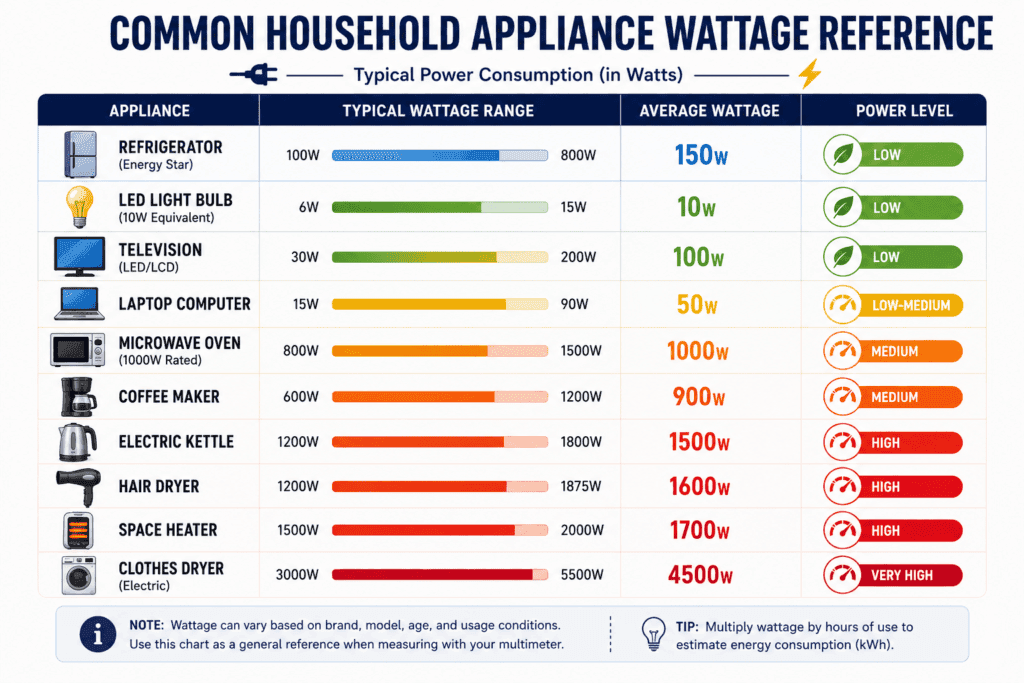
| Appliance | Typical Wattage |
|---|---|
| LED light bulb | 5W to 15W |
| Phone charger | 5W to 20W |
| Laptop charger | 45W to 100W |
| Box fan | 50W to 100W |
| Desktop computer | 200W to 500W |
| Refrigerator (running) | 100W to 400W |
| Microwave | 600W to 1,200W |
| Coffee maker | 800W to 1,500W |
| Toaster | 800W to 1,500W |
| Electric kettle | 1,000W to 1,500W |
| Space heater | 750W to 1,500W |
| Hair dryer | 1,200W to 1,800W |
| Window AC unit | 500W to 1,500W |
| Electric clothes dryer (240V) | 1,800W to 5,000W |
💡 Note: Many appliances draw a brief power spike when first switching on, sometimes double their steady-state wattage, before settling to their normal running value.
Why Wattage Matters for Outlet and Circuit Safety
Every household circuit has an amperage rating printed on its breaker, usually 15A or 20A. Multiply that rating by your outlet voltage (110V to 125V in the US) to find the safe maximum wattage the circuit can handle. Exceeding it trips the breaker, or worse, overheats the wiring if the breaker fails to trip.
What You Need Before You Start
Multimeter-Only Method vs Multimeter Plus Clamp Meter
There are two ways to test watts:
Multimeter-only method: Measure voltage, then measure current by breaking the circuit and placing the meter in series. This works well and is genuinely safe for DC devices like car electronics and battery-powered equipment. It is not recommended for most home users on live AC household circuits, since breaking a live AC circuit safely requires training most homeowners do not have.
Multimeter plus clamp meter method: Measure voltage with the multimeter, then measure current with a clamp meter clamped around a single conductor, no circuit breaking required. This is the safer and more practical method for AC household appliances.
How to Set Up Your Multimeter for Voltage and Current
- Plug the black probe into the COM port
- For voltage: plug the red probe into the VΩ port
- For current: move the red probe to the dedicated A or 10A port, never the VΩ port
- Set the dial to DC (V⎓ or A⎓) for batteries and DC devices, or AC (V~ or A~) for mains-powered devices
⚠️ Critical: Never measure current through the VΩ port. This instantly blows the multimeter’s internal fuse. Always move the red probe to the dedicated current port first.
How to Test Watts with a Multimeter (Multimeter-Only Method)
This method works best for DC devices: car batteries, car accessories, battery-powered electronics, and low-voltage DC equipment.
Step 1: Measure Voltage
Set your multimeter to DC voltage (V⎓). Touch the red probe to the positive terminal and the black probe to the negative terminal of the device. Record the voltage reading.
Step 2: Move the Red Probe to the Current Port
Unplug the red probe from the VΩ port. Plug it firmly into the A or 10A port. Set the dial to DC current (A⎓).
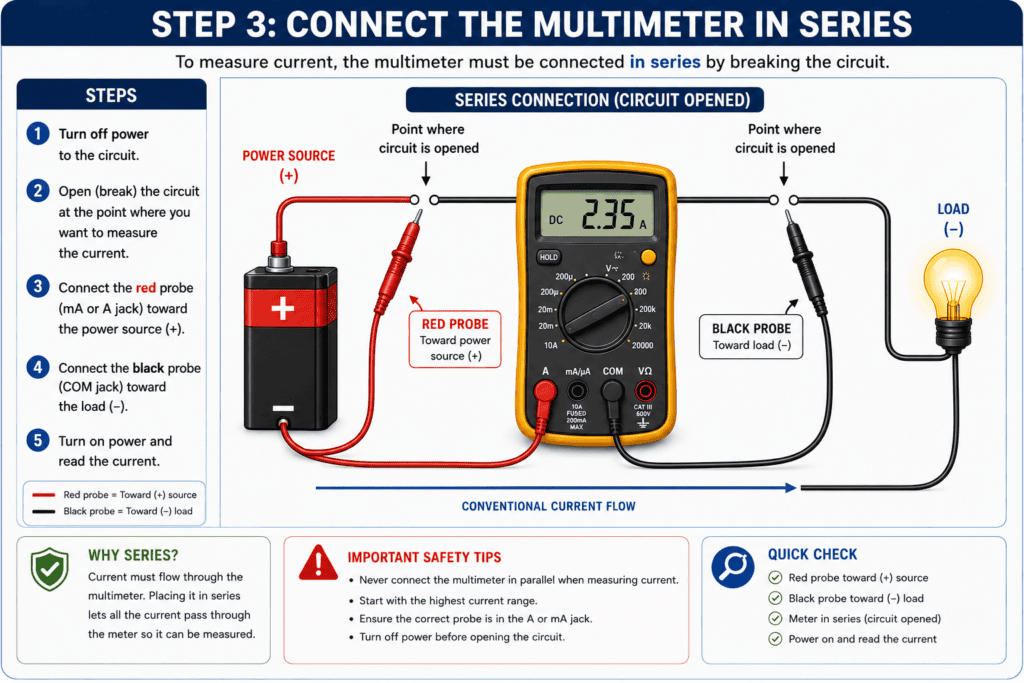
Step 3: Measure Current in Series
This is the key difference from voltage measurement. Current must flow through the multimeter itself.
- Turn off power to the circuit
- Disconnect one wire to create a gap
- Connect the multimeter across that gap, red probe toward the positive supply side, black probe toward the load
- Turn the circuit back on
- Record the current reading
Step 4: Calculate Watts (Volts x Amps)
Multiply your voltage reading by your current reading.
Watts = Voltage x Current
Worked Example: Calculating Wattage Step by Step
You want to know how many watts your car’s dash camera draws from the 12V accessory socket.
- Voltage reading: 12.6V (engine off, resting battery voltage)
- Current reading: 0.4A (measured in series with the dash cam’s power wire)
- Calculation: 12.6 x 0.4 = 5.04 watts
This tells you the dash cam draws about 5 watts continuously, useful information if you are trying to estimate how much it will drain your battery overnight.
How to Test Watts with a Multimeter and Clamp Meter
Why Use a Clamp Meter Instead
A clamp meter measures current by clamping around a single wire and reading the magnetic field it generates, with no need to break the circuit. This makes it dramatically safer for AC household appliances, where breaking a live circuit is not something most homeowners should attempt.
Step by Step Clamp Meter Wattage Test
- Set your multimeter to voltage mode (AC or DC, matching your device) and measure the voltage at the device or outlet
- Set your clamp meter to current mode (AC or DC, matching your device)
- Open the clamp jaws and clamp around one single conductor only, either the positive/hot wire or the negative/neutral wire, never both together
- Turn on the device if it is not already running
- Read the current on the clamp meter display
- Multiply the voltage reading by the current reading to get watts
⚠️ Important: Clamping around both wires of a cable at once cancels out the magnetic fields and gives a reading of zero or near zero. You must isolate a single conductor. For appliance cords, this sometimes means carefully separating the wires or using an adapter designed for clamp meter testing.
Worked Example Using a Clamp Meter
You want to know the running wattage of a window air conditioner.
- Voltage reading: 120V (measured at the outlet with the multimeter)
- Current reading: 8.3A (measured with the clamp meter around the hot wire while the AC unit runs)
- Calculation: 120 x 8.3 = 996 watts
This falls within the typical window AC wattage range in the reference table above, confirming the unit is operating normally.
AC Watts vs DC Watts: Does It Matter Which You Are Testing?
Testing DC Wattage (Batteries, Car Electronics)
DC wattage calculation is straightforward. Voltage and current stay constant (not fluctuating direction), so a simple multiplication gives an accurate result every time. The multimeter-only series method works well and safely here.
Testing AC Wattage (Household Appliances)
AC wattage is more complex because voltage and current constantly change direction and magnitude. For simple resistive loads, like an incandescent bulb or a space heater with a basic heating element, a straightforward voltage times current calculation is accurate enough.
Why True RMS Matters for AC Wattage Accuracy
For devices with motors, electronic controls, dimmers, or switching power supplies, the current waveform becomes distorted and non-sinusoidal. A standard average-responding multimeter or clamp meter can misread these waveforms by 20% or more.
| Device Type | Accuracy Without True RMS |
|---|---|
| Incandescent bulb, simple heating element | Accurate |
| Refrigerator, AC unit, motor-driven appliance | Can be inaccurate without True RMS |
| LED lighting, electronics with switching supplies | Can be significantly inaccurate without True RMS |
| Variable speed devices | Can be inaccurate without True RMS |
If you are testing anything with a motor or electronic control board, use a True RMS multimeter and clamp meter for an accurate wattage calculation.
How to Test Watts on a Car Battery or Automotive Circuit
Why Automotive Wattage Testing Matters
Understanding wattage draw in a vehicle helps you diagnose battery drain issues, size aftermarket electronics correctly, and confirm your alternator can support your electrical load.
Step by Step Automotive Wattage Test
- Set your multimeter to DC voltage and measure the resting battery voltage (should read 12.6V or above when healthy)
- Move the red probe to the current port and set the dial to DC current
- Break the circuit for the specific accessory you are testing and connect the meter in series, or use a clamp meter around the accessory’s power wire for a non-invasive reading
- Record the current draw
- Multiply voltage by current to get watts
Automotive Wattage Reference Table
| Component | Typical Wattage |
|---|---|
| Interior dome light (LED) | 1W to 3W |
| Phone charger (12V accessory socket) | 5W to 20W |
| Headlight (halogen, each) | 55W to 65W |
| Headlight (LED, each) | 20W to 35W |
| Car radio / infotainment | 10W to 50W |
| Starter motor (cranking) | 1,000W to 2,000W+ (brief) |
| Alternator output (typical) | 720W to 1,900W |
💡 See our How to Test a Car Battery with a Multimeter guide for a complete battery health testing process, and our How to Measure Amps with a Multimeter guide for a full parasitic draw testing walkthrough.
Understanding Phantom Power (Standby Wattage Draw)
What Is Phantom Power?
Phantom power, also called standby power or vampire power, is the electricity a device draws while turned off but still plugged in. Many modern devices with remote controls, clocks, or standby modes, like TVs, game consoles, and microwaves, continue drawing a small wattage even when appearing to be off.
How to Test for Phantom Power with a Multimeter
- Ensure the device is plugged in but switched off
- If using the clamp meter method, clamp around the hot wire of the power cord and read the current
- Measure the voltage at the outlet
- Calculate watts using the formula
- A reading of 0W confirms no phantom power draw; any reading above 0W indicates standby power consumption
How Much Phantom Power Actually Costs You
A single device drawing 3W continuously adds roughly $0.20 to $0.30 per month to your electricity bill at typical residential rates. This seems trivial for one device, but 10 to 15 such devices running continuously in a household can add several dollars per month, adding up over a year.
The simplest fix for phantom power is unplugging devices when not in use, or using a smart plug or timer to cut power automatically.
Watts and Outlet Safety Limits
How to Calculate Safe Maximum Wattage for a Circuit
Multiply your outlet voltage by the circuit breaker’s amperage rating to find the safe maximum wattage.
Example: A standard US 120V circuit on a 15A breaker supports up to 1,800W (120 x 15). A 20A breaker on the same voltage supports up to 2,400W (120 x 20).
💡 Best practice: Do not run continuous loads above 80% of the circuit’s rated capacity. For a 15A circuit, that means keeping continuous loads under about 1,440W.
15A vs 20A Outlets Explained
| Outlet Type | Slot Shape | Max Safe Wattage (120V) |
|---|---|---|
| 15A outlet | Two straight vertical slots plus a round ground hole | 1,800W |
| 20A outlet | One straight slot, one sideways T-shaped slot | 2,400W |
The T-shaped slot on a 20A outlet accepts both 15A and 20A rated plugs, while a standard 15A outlet only accepts 15A rated plugs.
Common Mistakes When Testing Watts with a Multimeter
Measuring Current Through the Wrong Port
Leaving the red probe in the VΩ port while attempting a current measurement gives no reading and often blows the internal fuse instantly. Always move the red probe to the dedicated A or 10A port before measuring current.
Measuring Current in Parallel Instead of Series
Voltage is measured in parallel, current is measured in series. Connecting the multimeter in parallel while set to current mode creates a direct short circuit through the meter. Always break the circuit and connect in series for current measurement, or use a clamp meter to avoid this step entirely.
Forgetting AC Devices Must Be Powered On to Test
Unlike a resting DC battery, which can be tested on or off, an AC device must actually be running and drawing current for a wattage measurement to mean anything. Testing an unplugged or powered-off AC device gives a reading of zero, which is expected but not useful for wattage calculation.
Using Average RMS Instead of True RMS on Non-Linear Loads
A standard multimeter or clamp meter without True RMS can misread the current on motors, electronics, and variable-speed devices by a significant margin. If your wattage calculation seems far off from the appliance’s rated label, this is often the reason.
FAQ
Can a multimeter measure watts directly?
No. A standard multimeter measures voltage, current, and resistance, but not watts directly. You calculate watts by measuring both voltage and current, then multiplying them together using the formula Watts equals Volts times Amps. Some advanced multimeters include a built-in power calculation function, but the underlying process is the same.
How do I test watts with a multimeter?
Measure the voltage across the device using your multimeter set to voltage mode. Then measure the current, either by moving the red probe to the current port and connecting the meter in series, or by using a clamp meter around a single conductor. Multiply the voltage reading by the current reading to get the wattage.
What is a normal wattage reading for a household appliance?
It depends entirely on the appliance. LED bulbs typically draw 5 to 15 watts, while a space heater or hair dryer can draw 1,200 to 1,800 watts. Check the appliance wattage reference table in this guide, or look for the wattage rating printed on the appliance’s label, usually near the power cord connection.
Can I calculate watts without a clamp meter?
Yes, using the multimeter-only series method. This works well for DC devices like car batteries and battery-powered electronics, where you can safely break the circuit and connect the multimeter in series to measure current. For AC household appliances, a clamp meter is strongly recommended instead, since breaking a live AC circuit safely requires training most homeowners do not have.
Why does my wattage reading spike when I turn on a device?
Many appliances, especially those with motors or compressors like refrigerators and air conditioners, draw a brief surge of current when first powered on, sometimes double their normal running wattage. This spike typically lasts only a few seconds before the reading settles to the appliance’s steady-state wattage. Wait for the reading to stabilize before recording your final measurement.
Do I need True RMS to measure watts accurately?
For simple resistive devices like incandescent bulbs or basic heating elements, a standard average-responding multimeter gives accurate results. For anything with a motor, electronic control board, or switching power supply, including refrigerators, AC units, and modern LED lighting, a True RMS multimeter or clamp meter gives significantly more accurate wattage calculations.
Conclusion
Testing watts with a multimeter comes down to one formula: Watts equals Volts times Amps.
For DC devices like car batteries and battery-powered electronics, measure voltage, then break the circuit and measure current in series with your multimeter, moving the red probe to the current port first. For AC household appliances, measure voltage with your multimeter and current with a clamp meter clamped around a single conductor, avoiding the need to break a live circuit.
Always confirm you are using the correct current port, always connect current measurements in series (or use a clamp meter instead), and use True RMS equipment when testing motors, electronics, or variable-speed devices for the most accurate results.