There is no single best multimeter, because “best” depends entirely on what you are testing. A homeowner checking outlets and batteries needs something completely different from an electronics hobbyist testing capacitors, or a mechanic diagnosing a car battery.
This guide gives you specific, real picks organized by exactly how you plan to use your multimeter, plus honest budget and beginner recommendations. If you want to understand the criteria behind these picks first, our full Multimeter Buying Guide covers CAT ratings, True RMS, auto-ranging, and everything else in depth.
💡 A note on how we chose these picks: These recommendations are based on published manufacturer specifications and consistent, independently verified reputation across multiple established sources, not on hands-on lab testing performed by our team. We prioritize models that appear repeatedly and reliably across reputable, independent reviews rather than obscure or unverifiable products. Prices fluctuate constantly with sales and supply, so treat any pricing mentioned as general positioning rather than exact current cost, and always check current listings before buying.
Quick Picks at a Glance
| Category | Recommended Model | Why It Stands Out |
|---|---|---|
| Best overall | Fluke 117 | Balances CAT III safety, True RMS, and daily reliability |
| Best budget / best cheap multimeter | AstroAI AM33D (or similar current AstroAI model) | Auto-ranging basics at the lowest reasonable price |
| Best for beginners / easiest to use | Extech EX330 | Auto-ranging, large display, non-contact voltage detection |
| Best for automotive diagnostics | Innova 3340 | Built specifically for automotive electrical testing |
| Best clamp meter | Klein Tools CL800 | Measures current safely without breaking the circuit |
| Best value | Klein Tools MM325 | Strong mid-tier features at an accessible price |
| Best for electronics repair | Any DMM with diode test, capacitance, and hFE socket | Covers component-level diagnostics |
| Best professional/high quality multimeter | Fluke 179 | Higher accuracy, temperature probe, industry-standard reliability |
How We Chose These Picks
Unlike some buying guides that reuse a generic scoring template across completely unrelated product categories, every criterion below is specific to multimeters:
- Safety and input protection. CAT rating, fused inputs, and whether current and voltage share a port (they should not)
- Accuracy. Published DC accuracy percentage and display resolution (count)
- Core functionality fit. Whether the feature set matches the stated use case (automotive, electronics, home, professional)
- Ease of use. Auto-ranging, display clarity, and dial layout
- Consistency of reputation. Whether the model shows up reliably across multiple independent, reputable sources rather than appearing only in a single questionable listing
We do not fabricate testing claims we have not performed. Where a pick’s exact current price or spec has likely changed since publication, we say so rather than guess.
Best Multimeter Overall: Fluke 117
Fluke consistently earns the “best overall” recommendation across independent reviews, and the Fluke 117 in particular is a frequently recurring pick for good reason. It is a CAT III-rated, auto-ranging digital multimeter with True RMS accuracy, meaning it gives reliable readings even on the non-sinusoidal waveforms found in modern electronics and appliances.
What makes it a top rated digital multimeter:
- CAT III safety rating, suitable for home electrical work near a breaker panel
- True RMS for accurate readings on modern non-linear loads
- Auto-ranging with non-contact voltage detection
- Covers voltage, current, resistance, continuity, frequency, and capacitance
Best for: Homeowners and DIYers who want one high quality multimeter that handles nearly everything without needing an upgrade later.
Best Digital Multimeter Brands (Good Multimeter Brands to Know)
Before diving into individual picks, it helps to know which good multimeter brands consistently earn trust across independent reviews and professional use.
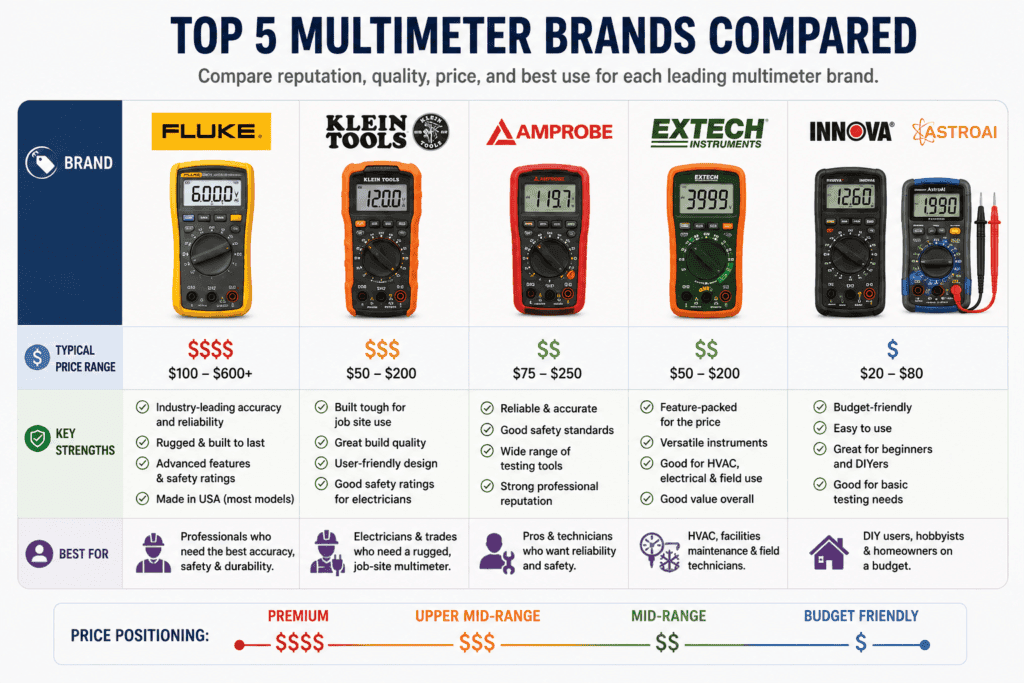
| Brand | Reputation | Typical Positioning |
|---|---|---|
| Fluke | The industry-standard name; consistently earns “best overall” and “best professional” picks across independent reviews | Midrange to premium |
| Klein Tools | Known for durability and strong clamp meter and multimeter lineups aimed at electricians | Midrange |
| Extech | Reliable, feature-rich, frequently recommended as a beginner-friendly option | Midrange |
| Innova | Automotive-focused, purpose-built for car diagnostics rather than general electrical work | Midrange |
| AstroAI | The most consistently recommended budget and inexpensive option across review sites | Budget |
| Amprobe | Strong clamp meter heritage, solid mid-range multimeter value | Midrange |
Best Budget, Cheap, and Inexpensive Multimeters
If you only need a multimeter occasionally, you do not need to spend heavily to get a good cheap multimeter that handles the basics reliably.
AstroAI: The Most Consistently Recommended Budget Pick
AstroAI models show up repeatedly across independent budget and beginner-focused rankings, which is a strong signal for a low cost multimeter category that is otherwise full of unreliable, unbranded options. Look for a current AstroAI model that includes:
- Auto-ranging (check the specific model, as not all budget AstroAI units include this)
- A rubberized casing and kickstand for durability
- A double ceramic fuse for overload protection
- Basic voltage, current, resistance, and continuity coverage
This is consistently one of the best inexpensive multimeter categories to shop in if your needs are basic to moderate, and it remains an affordable multimeter option even as prices shift over time.
⚠️ One thing to verify on any budget pick: confirm the meter uses separate, individually fused ports for voltage and current measurement, not a single shared port. This is the single most important safety detail on any good budget multimeter, and it is worth checking before you buy rather than after.
Best Multimeter for Beginners (The Easiest Multimeter to Use)
Extech EX330
The Extech EX330 recurs as a beginner recommendation across independent reviews for good reason. It combines auto-ranging with a large, easy-to-read display and a non-contact AC voltage detector that alerts you to nearby live wires using lights and sound before you even touch a probe to anything.
What makes it the easiest multimeter to use:
- Auto-ranging removes the single biggest source of beginner confusion
- Non-contact voltage detection adds a layer of safety for first-time users
- Covers continuity, frequency, temperature, capacitance, and diode function beyond the basics
Best for: First-time buyers who want a best automatic multimeter (auto-ranging) that will not overwhelm them with a confusing dial, while still leaving room to grow into more advanced functions later.
💡 Once you have your meter, our How to Use a Multimeter guide walks you through every function step by step.
Best Multimeter for Home Use
For general household work, prioritize a CAT III rating (since home electrical work can mean testing near a breaker panel), a fast continuity beeper for tracing wires and fuses, and auto-ranging.
Both the Fluke 117 and Extech EX330 fit this category well depending on your budget. A CAT III rated, auto-ranging DMM in the midrange price tier covers testing outlets, batteries, fuses, switches, and extension cords without any functional gaps for typical homeowner needs.
Best Multimeter for Automotive Diagnostics: Innova 3340
Innova builds multimeters specifically for automotive diagnostics rather than adapting a general-purpose meter, and the Innova 3340 reflects that focus directly.
What makes it stand out for automotive work:
- Auto-ranging AC/DC voltage, resistance, and current
- Additional automotive-specific tests: continuity, ignition dwell time, engine speed (tachometer), temperature, frequency, pulse width, and duty cycle
- Rugged construction with protective corner bumpers designed for garage use
- Includes a temperature probe, clamp, basic probes, and carrying bag
Best for: Both professional and amateur mechanics testing alternator diodes, ignition switches, batteries, and other automotive electronic components.
💡 Once you have your meter, our How to Test a Car Battery with a Multimeter guide walks you through the exact process.
Best Clamp Meter (Multimeter Alternative for High Current): Klein Tools CL800
A clamp meter measures current without breaking the circuit, which makes it a safer and faster option than a standard multimeter for high-current work like HVAC compressors, motors, and electrical panels. The Klein Tools CL800 is a frequently recommended pick in this category.
What makes it stand out:
- Auto-ranging with True RMS accuracy
- Measures AC/DC voltage, current, resistance, continuity, capacitance, and frequency, alongside temperature and diode testing
- Large, backlit display designed for dim work environments
- Rated to survive drops from a meaningful height, a genuine durability signal for jobsite use
Best for: Anyone regularly measuring high current loads who wants clamp functionality without giving up standard multimeter capabilities.
💡 For a full explanation of when to choose a clamp meter over a standard multimeter, see our Multimeter Buying Guide.
Best Value: Klein Tools MM325
If Fluke pricing feels like a stretch but AstroAI-tier budget options feel too basic, the Klein Tools MM325 sits in a genuinely useful middle ground.
What makes it a strong value pick:
- Measures AC/DC voltage up to 600V and 10A of DC current
- Lead-protection alert system that indicates proper test lead placement, reducing user error
- Backlit display and rated to withstand drops from a meaningful height
- Includes a battery test mode, useful for household battery checks
Best for: Buyers who want a step up from entry-level budget multimeters without paying professional-tier prices.
Best Multimeter for Electronics Repair
A multimeter for electronics repair has a different priority list than one built for automotive or home electrical work. A good multimeter for electronics should include:
- A diode test mode with a clear forward voltage readout
- Capacitance measurement, ideally extending into the nanofarad range
- An hFE socket if you work with discrete transistors
- Fine-tipped probes capable of reaching small solder joints and closely spaced pins
CAT rating matters less for pure electronics bench work since you are typically working at low voltages, but do not go below CAT I. Look at multimeters in the midrange tier that explicitly list capacitance and hFE testing among their features, since not every general-purpose meter includes them.
💡 Once you have your meter, our How to Test a Diode with a Multimeter guide covers diode, resistor, and transistor testing in full detail.
Best High Quality Multimeter for Professionals: Fluke 179
For daily professional use, the Fluke 179 sits a tier above the 117, adding a temperature probe, higher precision, and the kind of rugged build quality that justifies its premium positioning for people who use a multimeter every working day.
What makes it a top-rated multimeter for professionals:
- True RMS accuracy with a higher-precision display than entry-level models
- Built-in temperature measurement, saving the need to carry a separate thermometer
- CAT III and CAT IV safety ratings appropriate for fixed wiring and utility-level work
- Rugged, overmolded design built for daily jobsite use
Best for: Electricians, HVAC technicians, and industrial maintenance professionals whose livelihood depends on measurement accuracy and tool durability.
Best Multimeter by Application (CAT Rating Guide)
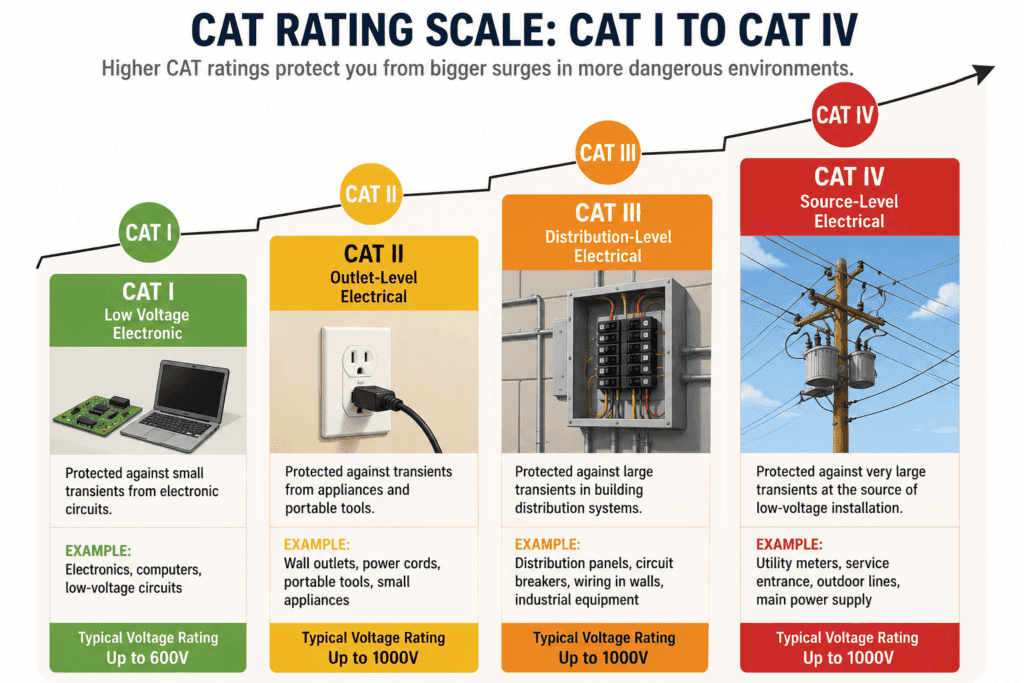
| Your Situation | Minimum CAT Rating | Recommended Type |
|---|---|---|
| Electronics bench, circuit boards | CAT I | Any meter with diode and capacitance testing |
| Home DIY, outlets, appliances | CAT II | Any auto-ranging beginner-friendly meter |
| Automotive diagnostics | CAT II to CAT III | Automotive-specific meter like the Innova 3340 |
| Breaker panels, fixed building wiring | CAT III | Fluke 117 or equivalent |
| HVAC, motors, variable-speed drives | CAT III, True RMS required | Fluke 117, Fluke 179, or a True RMS clamp meter |
| Utility, industrial, outdoor construction | CAT IV | Fluke 179 or an industrial-rated meter |
FAQ
What is the best multimeter overall?
The Fluke 117 is one of the most consistently recommended overall picks across independent reviews, combining CAT III safety, True RMS accuracy, auto-ranging, and daily reliability. For most home, automotive, and light professional use, it covers everything without gaps.
What is the best voltage meter or DMM for home use?
DMM stands for Digital Multimeter, and for home use, a CAT III-rated auto-ranging DMM with a reliable continuity beeper is the best voltage meter option. Both the Fluke 117 and Extech EX330 fit this description well at different price points.
What is the best budget multimeter?
AstroAI models are the most consistently recommended budget and cheap multimeter option across independent reviews. Confirm any budget pick includes auto-ranging and separate, individually fused current and voltage ports before buying, since this is the one feature not worth skipping even on the most affordable multimeter.
What is the easiest multimeter to use for beginners?
The Extech EX330 is frequently recommended as one of the best multimeters for beginners because of its auto-ranging function, large easy-to-read display, and non-contact voltage detector that adds a layer of safety for first-time users.
What is the best multimeter for automotive diagnostics?
The Innova 3340 is purpose-built for automotive work, including automotive-specific tests like ignition dwell time, tachometer readings, and duty cycle alongside standard voltage, current, and resistance measurement, making it a strong pick for both professional and amateur mechanics.
Should I get a multimeter or a clamp meter?
A standard multimeter covers the vast majority of home, automotive, and general electronics needs. A clamp meter, like the Klein Tools CL800, becomes worth adding when you regularly measure high current loads such as HVAC compressors or motors, since it measures current safely without breaking the circuit.
What multimeter brands are considered high quality?
Fluke consistently earns top-rated recommendations across independent reviews for accuracy and reliability. Klein Tools, Extech, and Amprobe are also widely considered good multimeter brands with strong reputations, while AstroAI has built a solid reputation specifically in the budget category.
Conclusion
The multimeter crowned “best” changes by source, by year, and by exactly what you plan to test with it. What stays consistent is that certain models and brands, like the Fluke 117 and 179, Extech EX330, Innova 3340, Klein Tools CL800 and MM325, and AstroAI’s budget lineup, show up reliably across independent, reputable sources again and again, which is the strongest signal available short of testing every unit yourself.
Match your pick to your actual use case using the categories above, confirm the CAT rating fits your work, and you will end up with a multimeter that serves you well regardless of what any single ranking claims this year.
3 thoughts on “Best Multimeters 2026: Top Picks by Category and Budget”