You pick up your multimeter and turn the dial to voltage. But two voltage settings are staring back at you. One has a wavy line. One has a straight line. Which one do you choose?
Getting this wrong does not just give you a false reading. In some situations, it can damage your multimeter or give you dangerously misleading results.
This guide explains exactly what AC and DC mean on a multimeter, what ACV and DCV stand for, when to use each setting, and what happens if you pick the wrong one.
What Is AC Voltage?
AC stands for alternating current. It is a type of electrical voltage that constantly changes direction and magnitude in a repeating cycle.
Think of AC voltage like ocean waves. The voltage rises to a positive peak, falls back to zero, drops to a negative peak, and rises again. This cycle repeats many times every second.
In the United States, this cycle happens 60 times per second — measured in hertz (Hz). In most other countries, including Pakistan, the UK and Europe, it runs at 50 Hz.
How Does AC Voltage Work?
AC voltage is generated at power stations and delivered to homes and buildings through the electrical grid. It is used for mains power because it travels long distances through power lines more efficiently than DC and can be stepped up or down easily using transformers.
The constantly changing voltage in AC creates what is called a sine wave — a smooth wave pattern that oscillates between positive and negative values.
Where Is AC Voltage Used in Everyday Life?
- Wall outlets and power sockets in your home
- All mains-powered appliances — refrigerators, washing machines, ovens
- Extension cords and power strips
- HVAC systems and air conditioners
- Industrial motors and equipment
What Does AC Look Like on a Multimeter?
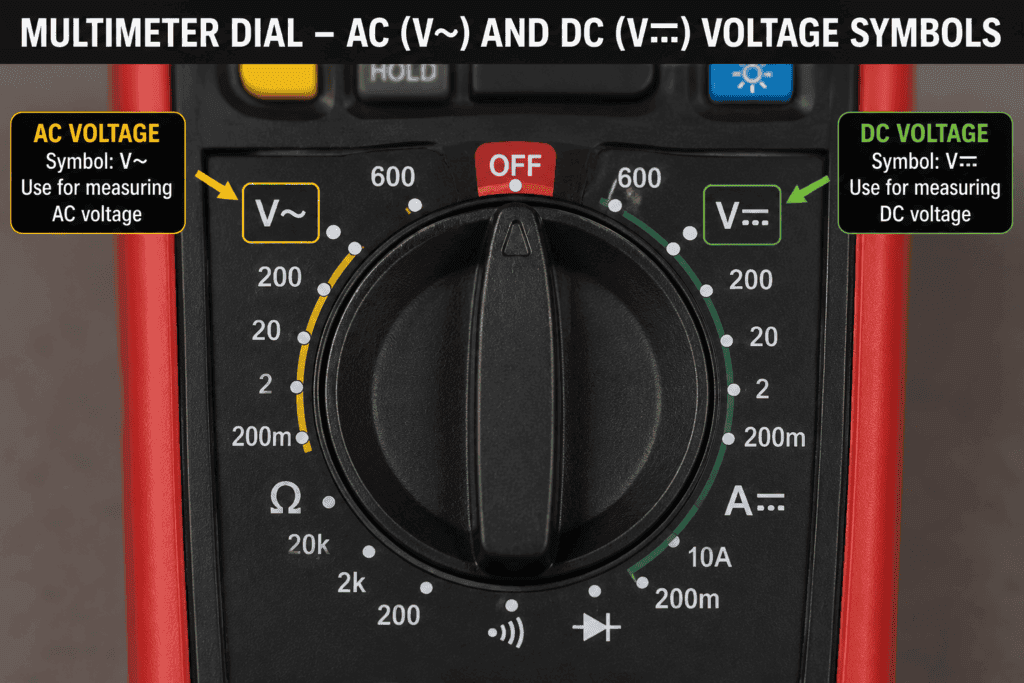
On a multimeter dial, AC voltage is represented by the symbol V~, where the tilde (~) represents the wavy alternating waveform. Some multimeters label it VAC or ACV instead.
What Is DC Voltage?
DC stands for direct current. It is a type of electrical voltage that flows in one direction only at a constant level.
Think of DC voltage like a river flowing steadily in one direction. The voltage stays at a fixed positive or negative level without changing direction or cycling up and down.
How Does DC Voltage Work?
DC voltage comes from sources that maintain a steady electrical charge — batteries, solar panels, rectifiers, and DC power supplies. The positive terminal always stays positive, and the negative terminal always stays negative.
Where Is DC Voltage Used in Everyday Life?
- Car batteries and vehicle electrical systems
- AA, AAA, 9V, and all other household batteries
- Phone and laptop batteries
- USB chargers and phone chargers
- Solar panel systems and battery storage
- LED lighting and low-voltage electronics
What Does DC Look Like on a Multimeter?
On a multimeter dial, DC voltage is represented by the symbol V—, where the straight line (—) represents the constant flat waveform. Some multimeters label it VDC or DCV instead.
AC vs DC: Side by Side Comparison Table
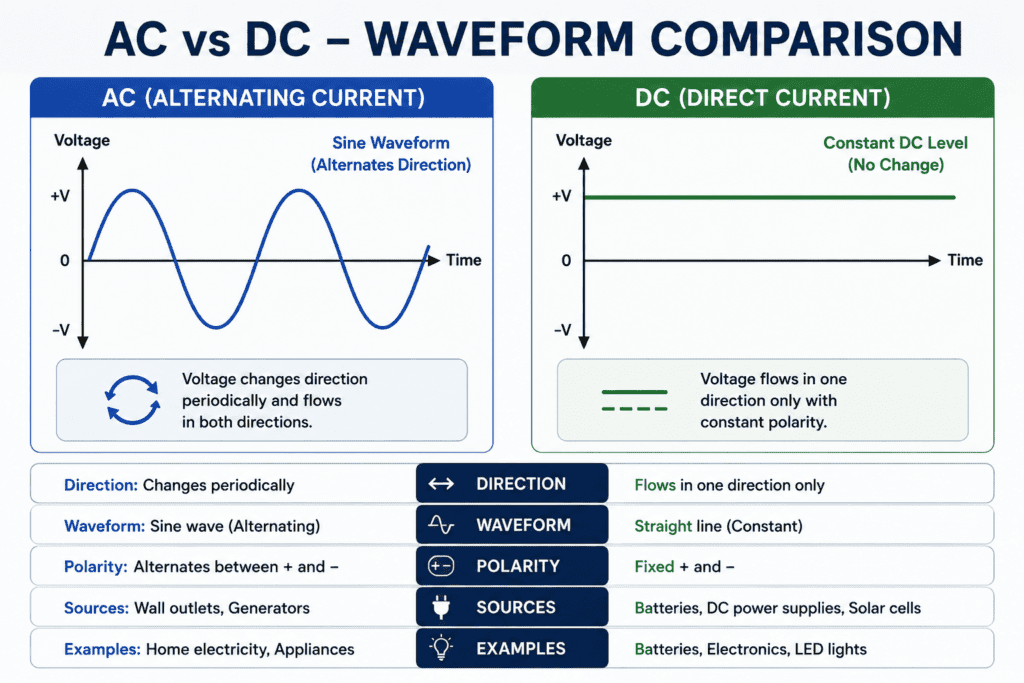
| Feature | AC Voltage | DC Voltage |
|---|---|---|
| Current direction | Changes direction repeatedly | Flows in one direction only |
| Waveform | Sinewave — rises and falls | Flat constant line |
| Frequency | 50Hz or 60Hz | No frequency — constant |
| Voltage symbol | V~ or VAC or ACV | V— or VDC or DCV |
| Common sources | Wall outlets, mains power | Batteries, solar panels, chargers |
| Voltage level | 110V to 240V (household) | 1.5V to 48V (common devices) |
| Multimeter setting | AC voltage mode (V~) | DC voltage mode (V—) |
| Transformers compatible | Yes | No |
| Long distance transmission | Very efficient | Less efficient |
ACV vs DCV on a Multimeter
What Does ACV Mean on a Multimeter?
ACV stands for AC Volts. When you see ACV on a multimeter dial or display, it means the meter is set to measure alternating current voltage. Use this setting when testing wall outlets, mains-powered appliances, and extension cords.
What Does DCV Mean on a Multimeter?
DCV stands for DC Volts. When you see DCV on a multimeter dial or display, it means the meter is set to measure direct current voltage. Use this setting when testing batteries, car electrical systems, USB chargers, and any battery-powered device.
What Is the Difference Between ACV and DCV?
ACV and DCV are simply two different measurement modes for two different types of electricity. ACV measures the effective value (RMS value) of an alternating voltage. DCV measures the steady constant voltage of a direct current source.
VAC vs VDC on a Multimeter
What Does VAC Mean on a Multimeter?
VAC means Volts Alternating Current. It is the same as ACV — just written in a different order. Both mean the meter is measuring AC voltage. Some multimeter brands use VAC while others use ACV or V~. All three mean the same thing.
What Does VDC Mean on a Multimeter?
VDC means Volts Direct Current. It is the same as DCV— just written in a different order. Both mean the meter is measuring DC voltage. Some multimeter brands use VDC while others use DCV or V—. All three mean the same thing.
Are VAC and ACV the Same Thing?
Yes. VAC and ACV are identical. They both mean AC voltage measurement mode. The difference is only in how the manufacturer chose to label the dial or display on their specific multimeter model.
| Label | Full Meaning | What to Use It For |
|---|---|---|
| V~ | Volts AC (symbol version) | AC voltage measurement |
| ACV | AC Volts | AC voltage measurement |
| VAC | Volts Alternating Current | AC voltage measurement |
| V— | Volts DC (symbol version) | DC voltage measurement |
| DCV | DC Volts | DC voltage measurement |
| VDC | Volts Direct Current | DC voltage measurement |
When to Use the AC Setting on a Multimeter
Use the AC voltage setting (V~ or ACV or VAC) whenever you are measuring voltage from the electrical grid or any mains-powered source.
Common situations where you use the AC setting:
- Testing a wall outlet to confirm it is live
- Checking voltage at an extension cord
- Measuring voltage at an HVAC unit
- Testing appliance input voltage
- Checking wiring in a junction box
Step by Step AC Voltage Measurement
- Set the multimeter dial to AC voltage (V~ or ACV)
- If not auto-ranging, select a range above the expected voltage — 200V for most household testing
- Plug the black probe into the COM port
- Plug the red probe into the VΩ port
- Insert one probe into each slot of the outlet or touch the probes to the circuit
- Read the voltage on the display
What Should an AC Reading Look Like?
| Location | Expected AC Reading |
|---|---|
| US wall outlet | 110V to 125V |
| UK or Pakistan wall outlet | 220V to 240V |
| US dryer or oven outlet (240V) | 220V to 250V |
| Extension cord (powered) | Same as outlet it is plugged into |
| Unpowered circuit | 0V |
💡 Tip: Polarity does not matter when measuring AC voltage. You can insert the probes into either slot of an outlet and still get a correct reading.
When to Use the DC Setting on a Multimeter
Use the DC voltage setting (V— or DCV or VDC) whenever you are measuring voltage from a battery, charger, or any DC-powered source.
Common situations where you use the DC setting:
- Testing a car battery
- Checking AA, AAA, or 9V batteries
- Testing a phone or laptop charger output
- Measuring voltage in a car electrical circuit
- Testing a solar panel output
- Checking USB port voltage
Step by Step DC Voltage Measurement
- Set the multimeter dial to DC voltage (V— or DCV)
- If not auto-ranging, select a range above the expected voltage — 20V for most battery testing
- Plug the black probe into the COM port
- Plug the red probe into the VΩ port
- Touch the red probe to the positive terminal and the black probe to the negative terminal
- Read the voltage on the display
What Should a DC Reading Look Like?
| Source | Expected DC Reading |
|---|---|
| New AA battery | 1.5V to 1.6V |
| New 9V battery | 9.0V to 9.6V |
| Car battery (fully charged) | 12.6V to 12.8V |
| Car battery (engine running) | 13.7V to 14.7V |
| USB port | 4.75V to 5.25V |
| Phone charger output | Within 5% of rated voltage |
⚠️ Important: Polarity matters for DC voltage. If you connect the probes in reverse (red to negative and black to positive) the display shows a negative reading. Swap the probes and try again.
What Happens If You Use the Wrong Setting?
Using AC Mode on a DC Circuit
If you set your multimeter to AC mode and measure a DC source like a battery, you will usually get a reading of 0V or a very low incorrect reading. This is because AC mode measures the changing component of voltage. A constant DC voltage has no changing component, so the meter reads near zero.
This will not damage your multimeter, but it will give you a completely wrong reading that could lead to incorrect diagnosis.
Using DC Mode on an AC Circuit
If you set your multimeter to DC mode and measure an AC source like a wall outlet, you may get a reading close to 0V because DC mode is looking for a steady constant voltage while AC voltage alternates rapidly.
Again, this will not damage the meter, but it gives you a false zero reading — making a live outlet appear dead. This is the more dangerous mistake because it could lead you to believe a live circuit is safe to touch.
Is It Dangerous to Use the Wrong Setting?
Using the wrong voltage mode on a standard multimeter will not damage the meter or hurt you. However, getting a false zero reading on a live AC circuit is a serious safety risk. Always confirm you have the correct mode selected before assuming a circuit is de-energized.
What Is True RMS and Why Does It Matter?
True RMS vs Average Responding Multimeters
When measuring AC voltage, multimeters use one of two calculation methods:
True RMS: Measures the actual effective value of the AC voltage regardless of the waveform shape. More accurate for non-sinusoidal waveforms found in modern electronics and variable speed drives.
Average responding: Assumes a perfect sine wave and calculates accordingly. Less accurate when the waveform is distorted — common in modern electronic loads.
When Do You Need a True RMS Multimeter?
For basic household outlet testing (testing standard wall outlets and appliances), an average-responding multimeter gives acceptable results because household power is close to a perfect sine wave.
For testing motors, variable frequency drives, inverters, UPS systems, or any modern electronic power supply, you need a True RMS multimeter for accurate results. Non-sinusoidal waveforms cause average-responding meters to read up to 40% too low.
💡 Tip: Most mid-range and professional digital multimeters include True RMS measurement. Check your multimeter specifications or look for the text “True RMS” on the label or packaging.
AC vs DC Safety: Which Is More Dangerous?
Why AC Is Generally More Dangerous Than DC
At the same voltage level, AC is generally considered more dangerous to the human body than DC. This is because the alternating nature of AC causes muscles to contract repeatedly and uncontrollably, making it harder to let go of a live conductor. DC at the same voltage causes a single contraction.
AC also penetrates deeper into body tissue at standard power frequencies (50Hz to 60Hz), increasing the risk of cardiac fibrillation.
Safe Voltage Levels for Both AC and DC
| Voltage Level | AC Risk | DC Risk |
|---|---|---|
| Below 50V AC / Below 120V DC | Generally considered safe for brief contact | Generally considered safe |
| 50V to 120V AC | Risk of shock and injury | Lower risk but still dangerous |
| Above 120V AC | Serious risk of fatal shock | Serious risk |
| 230V to 240V AC (household) | Potentially fatal | N/A for household DC |
⚠️ Safety Rule: Never assume any voltage is safe. Always treat any energized circuit with caution regardless of whether it is AC or DC.
FAQ
What does DC mean on a multimeter?
DC on a multimeter stands for direct current. When you see DC or the symbol V— or DCV on the dial, it means the meter is set to measure direct current voltage. Use this setting for testing batteries, car electrical systems, USB chargers, solar panels, and any battery-powered device.
What does AC mean on a multimeter?
AC on a multimeter stands for alternating current. When you see AC or the symbol V~ or ACV on the dial, it means the meter is set to measure alternating current voltage. Use this setting for testing wall outlets, household appliances, extension cords, and any mains-powered circuit.
What is the difference between VAC and VDC?
VAC means Volts Alternating Current and VDC means Volts Direct Current. VAC is used to measure AC voltage from sources like wall outlets. VDC is used to measure DC voltage from sources like batteries and chargers. They are the two fundamental voltage measurement modes on any multimeter.
What is ACV on a multimeter?
ACV stands for AC Volts. It means the multimeter is set to measure alternating current voltage. ACV, VAC, and V~ all mean the same thing, just different labeling conventions used by different multimeter manufacturers. Use this setting when testing anything powered by the electrical grid.
Should I use AC or DC to test a car battery?
Use the DC setting (V— or DCV or VDC) to test a car battery. Car batteries are DC power sources that supply a constant 12V. A fully charged car battery at rest should read between 12.6V and 12.8V. Never use the AC setting for a car battery — it will give you a false reading close to 0V.
What happens if I measure AC with the DC setting on my multimeter?
If you set your multimeter to DC mode and measure an AC source like a wall outlet, you will likely get a reading of 0V or a very low incorrect value. DC mode looks for a steady constant voltage while AC voltage alternates rapidly, so the meter reads near zero. This will not damage your multimeter, but it is dangerous because it makes a live outlet appear dead. Always confirm you have the correct mode selected before touching any circuit.
Conclusion
The difference between AC and DC on a multimeter comes down to one simple rule.
Use AC mode (V~ or ACV or VAC) for anything powered by the electrical grid wall outlets, appliances, and mains circuits. Use DC mode (V— or DCV or VDC) for anything powered by a battery or DC supply: car batteries, phone chargers, and electronics.
Getting the setting right takes two seconds and prevents false readings that could lead to dangerous mistakes.
2 thoughts on “AC vs DC on a Multimeter: What Is the Difference?”