You glance at your dashboard and see a number where a fuel light used to be. That number is your car voltmeter, and it is quietly telling you more about your vehicle’s health than almost any other gauge on the panel.
A voltmeter shows you the electrical state of your car in real time. A dropping number can warn you of a dying battery days before it leaves you stranded. A number that never rises when the engine starts can point to a failing alternator. This guide covers how to read one correctly, how to install one yourself, and how to pick the right gauge for your dashboard.
What Is a Car Voltmeter?
A car voltmeter is a gauge, usually mounted on the dashboard, that continuously displays the voltage of your vehicle’s electrical system. It watches the same 12 volt system your battery and alternator share, and it never stops reporting on it while the car is running.
Automotive Voltmeter vs a Handheld Multimeter
An automotive voltmeter stays fixed in your dashboard and shows a live number all the time. A handheld multimeter is a diagnostic tool you bring out for a specific test, then put away.
A gauge is built for constant, at-a-glance monitoring. A multimeter is built for precision, when you actually need to know the exact voltage at a specific terminal, connection, or component. The two tools work best together, not as substitutes for each other.
💡 For the precise, hands-on version of this test, see our How to Test a Car Battery with a Multimeter guide.
Why Install a Voltage Gauge in Your Car
A car voltmeter earns its dashboard spot because it catches problems early. A battery that is slowly failing, an alternator belt that is slipping, or a corroded ground connection all show up as a voltage trend long before the car actually refuses to start. Owners of older vehicles, classic cars, off-road builds, and RVs often add one specifically for this early warning.
How to Read a Car Voltmeter Gauge
Normal Reading with the Engine Off
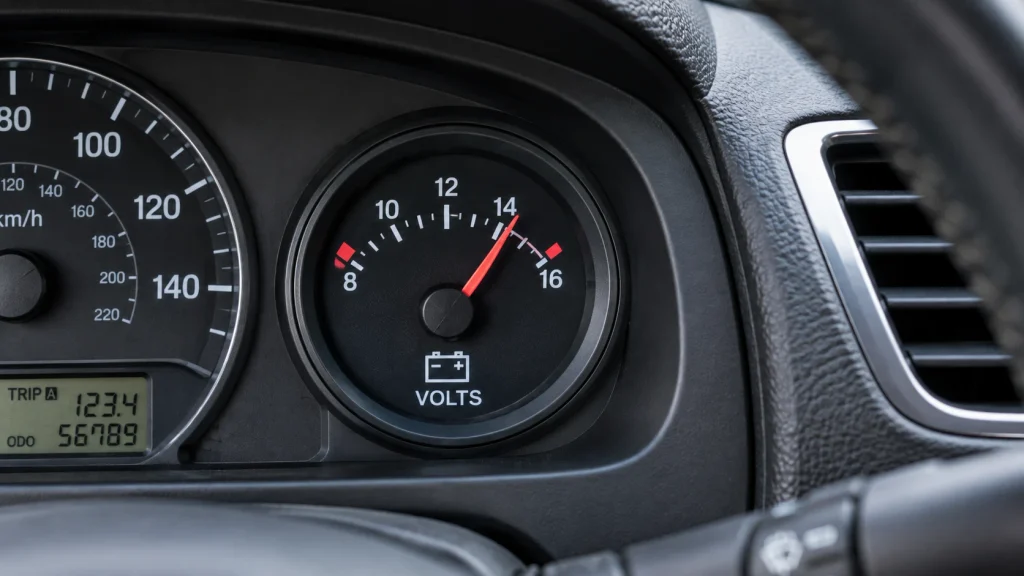
With the engine off and the car sitting for a few minutes, a healthy 12 volt battery reads between 12.6V and 12.8V. This is called the resting voltage, and it reflects the battery’s actual state of charge with no engine or alternator activity involved.
Normal Reading with the Engine Running
Once the engine starts, the alternator takes over and should push the voltage up to between 13.7V and 14.7V. This higher reading confirms the alternator is actually charging the battery while the car runs, not just letting it coast on its existing charge.
What a Low Reading Means
A reading that stays low, either at rest or while running, usually points to one of a few causes: a weak or aging battery, a failing alternator that cannot keep up with demand, corroded battery terminals or ground connections, or an electrical accessory drawing more current than the system can supply.
What a High Reading Means
A reading consistently above roughly 14.7V to 15V suggests the charging system is overcharging the battery. This is most often caused by a faulty voltage regulator. Left unaddressed, overcharging can boil the battery’s internal electrolyte and shorten its life dramatically, and in some cases damage sensitive onboard electronics.
Car Voltmeter Reading Reference Table
| Reading | Condition | What to Do |
|---|---|---|
| 12.6V to 12.8V, engine off | Fully charged, healthy | No action needed |
| 12.2V to 12.5V, engine off | Partially discharged | Charge and monitor |
| Below 12.2V, engine off | Weak or failing battery | Test and likely replace |
| 13.7V to 14.7V, engine running | Charging system working correctly | No action needed |
| Same as resting voltage while running | Alternator not charging | Inspect belt, alternator, and connections |
| Above 14.7V to 15V, engine running | Overcharging | Check voltage regulator immediately |
Types of Automotive Voltmeters
Analog Automotive Voltmeter (Needle Gauge)
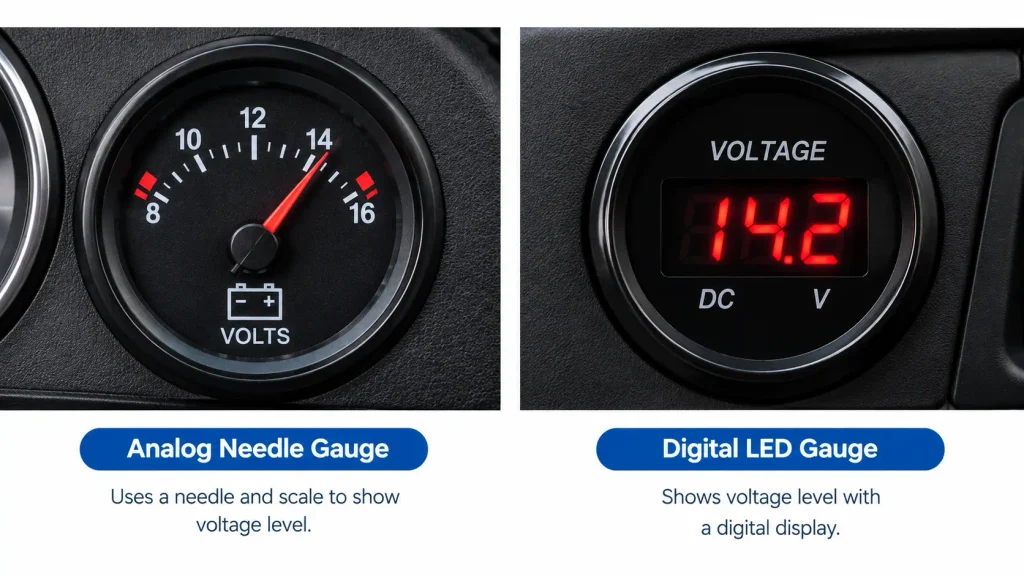
An analog automotive voltmeter uses a moving needle across a printed scale, the same working principle covered in depth in our Analog Voltmeter Guide. A needle makes it easy to notice a slow drift or a sudden drop simply by glancing at its position, without needing to read an exact number.
Automotive Digital Voltmeter (LED/LCD Display)
An automotive digital voltmeter shows the exact voltage as a number, usually on an LED or LCD display. This gives you precision at a glance, useful when you want to know exactly how many tenths of a volt you are seeing rather than estimating a needle’s position.
Digital vs Analog Automotive Voltage Gauge Comparison
| Feature | Analog Voltage Gauge | Digital Voltage Gauge |
|---|---|---|
| Display style | Moving needle | Numeric LED or LCD |
| Best for | Spotting trends and sudden changes | Reading an exact value |
| Visibility in bright sunlight | Generally good | Varies by display brightness |
| Classic dashboard look | Strong match | Less traditional |
| Precision | Approximate | Exact, to a decimal point |
12V Voltmeter Gauge: Understanding Your Vehicle’s Electrical System
Why Most Cars Use a 12V System
Nearly every standard passenger car, light truck, and SUV runs on a 12 volt electrical system, which is why a 12v voltmeter gauge is the standard choice for the vast majority of vehicles on the road. The battery, alternator, and every reading discussed in this guide assume this 12V baseline.
24V Systems in Trucks and Heavy Equipment
Some heavy trucks, buses, and industrial or marine equipment run on 24V systems instead, typically built from two 12V batteries wired in series. If you are installing a gauge on this kind of vehicle, confirm you are using a gauge rated for 24V, since a standard 12v voltmeter gauge for car use will not read correctly, or may be damaged, on a 24V system.
How to Install a Car Voltmeter Gauge
What You Need Before You Start
- Your chosen voltage gauge (digital or analog)
- Mounting hardware or a gauge pod appropriate for your dashboard
- Wire sized appropriately for a low-current signal connection
- An inline fuse holder and a small fuse
- A test light or multimeter to confirm your wiring before final connection
Where to Tap Power (Ignition Switched vs Constant)
You have two options for where the gauge draws its power signal.
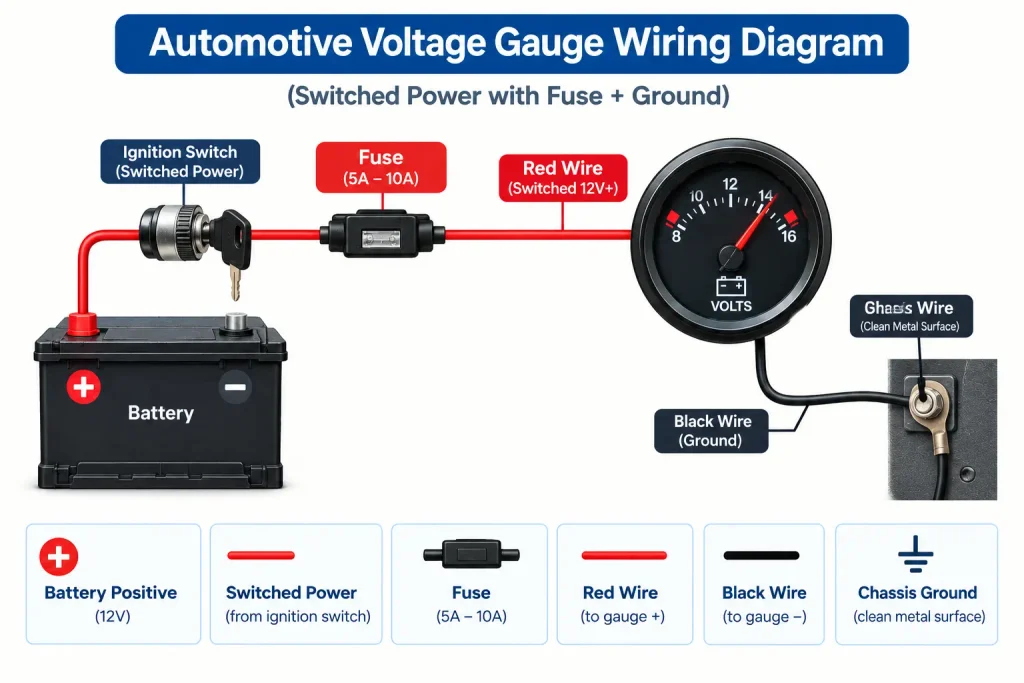
Ignition switched power means the gauge only reads voltage when the key is in the on or running position. This is the most common choice, since it avoids drawing any current from the battery while the car is parked.
Constant (battery direct) power means the gauge reads voltage at all times, even with the car off. This can be useful for spotting a slow parasitic drain overnight, but it draws a very small amount of current continuously, and the connection needs a bit more care.
Step by Step Installation
- Choose a mounting location with a clear view from the driver’s seat
- Run the gauge’s positive signal wire to your chosen power source, switched or constant
- Install an inline fuse close to the power source connection, not at the gauge end
- Connect the ground wire to a clean, unpainted chassis ground point or directly to the battery negative terminal
- Connect the backlight wire, if your gauge has one, to a source that matches your desired lighting behavior
- Turn the key on and confirm the gauge reads a normal voltage before finishing the installation
Fuse Protection
Always fuse the positive wire close to the power source, not at the gauge itself. A voltage gauge draws very little current, so a small fuse rating is normal. Skipping this step leaves an unprotected wire run through your vehicle, a genuine fire risk if that wire is ever pinched or shorted.
Using Your Voltage Gauge to Diagnose Problems
Battery Voltage Dropping Over Time
If your resting voltage reading trends downward across several days or weeks of parking, suspect a parasitic drain, something drawing power while the car is off. Our Amp Meter Guide covers how to track down this kind of drain directly.
Charging System Not Reaching Full Voltage
If your gauge sits at the same number whether the engine is running or off, the charging system is not doing its job. Check the alternator belt first, since a slipping or broken belt is one of the most common and least expensive causes.
Overcharging Warning Signs
A reading that consistently sits above roughly 15V while driving means the voltage regulator is very likely failing. Address this quickly, since ongoing overcharging degrades the battery and can damage other electronics on the same circuit.
When to Follow Up with a Multimeter
A dashboard gauge is excellent for noticing that something has changed. It is not precise enough to diagnose exactly what changed or where. Once your gauge flags a problem, follow up with an actual multimeter test at the battery terminals, the alternator output, and any suspect ground connections to pin down the real cause.
💡 For the full diagnostic process once your gauge flags a problem, see our Car Electrical Diagnostic guide.
How to Choose an Automotive Voltage Gauge
Digital vs Analog Display
Choose based on how you actually want to use the gauge day to day. Pick analog if you want to notice trends and changes at a glance. Pick digital if you want an exact number every time you look.
Gauge Size and Mounting Style
Automotive gauges come in a handful of standard diameters. Measure your intended mounting location, or your existing gauge cutout if you are replacing one, before buying to avoid a mismatch.
Backlighting and Visibility
Look for a backlight color that matches or complements your existing dashboard lighting, and confirm the display stays readable in direct sunlight if the gauge will sit somewhere exposed to it.
Accuracy and Update Speed
Not every gauge updates its reading at the same speed or with the same precision. For genuinely useful trend-spotting, a gauge with a reasonably fast update rate and decent accuracy matters more than flashy extra features.
Common Mistakes When Using or Installing a Car Voltmeter
Wiring to the Wrong Power Source
Connecting to a circuit that also carries a heavy load can introduce a voltage drop on that wire, making your gauge read lower than the battery’s actual voltage. Choose a clean, dedicated power source whenever possible.
Skipping the Fuse
An unfused wire run through your vehicle is a genuine fire hazard if it is ever damaged or shorted. Always fuse the positive connection close to the power source.
Ignoring a Gauge Reading That Looks Wrong
A reading that suddenly looks off is worth investigating, not dismissing as a faulty gauge. Confirm it with a multimeter before assuming the gauge itself is the problem.
Trusting the Gauge Over an Actual Multimeter Test
A dashboard gauge is a monitoring tool, not a diagnostic instrument. When you need a precise answer, especially before replacing a battery or alternator, always confirm with a proper multimeter test first.
FAQ
What should a car voltmeter read with the engine running?
A healthy car voltmeter should read between 13.7V and 14.7V with the engine running, confirming the alternator is actively charging the battery. If the reading stays the same as the resting voltage or lower while the engine runs, the charging system is not working correctly.
What does it mean if my car voltage gauge reads low?
A low reading, either at rest or while driving, usually points to a weak or failing battery, a struggling alternator, corroded battery or ground connections, or an accessory drawing more current than the electrical system can supply. Follow up with a multimeter test to confirm the exact cause.
Is 12.6 volts good for a car battery?
Yes. A resting voltage between 12.6V and 12.8V, measured with the engine off and the car sitting for a few minutes, indicates a fully charged, healthy 12V battery. Anything consistently below 12.2V suggests the battery needs charging or may be nearing the end of its life.
How do I install a voltmeter gauge in my car?
Choose a mounting location with good visibility, run the gauge’s power wire to either switched ignition power or a constant battery source, install an inline fuse close to the power connection, connect the ground wire to a clean chassis point, and test the gauge with the key on before finishing the installation.
What is the difference between a digital and analog automotive voltmeter?
An analog automotive voltmeter uses a moving needle, making trends and sudden changes easy to spot at a glance. A digital automotive voltmeter shows an exact numeric reading on an LED or LCD display, giving you precision down to a decimal point. Neither is objectively better, the right choice depends on whether you prioritize trend visibility or exact numbers.
Can I use a multimeter instead of installing a voltage gauge?
Yes, for spot-checking. A multimeter gives you a precise, on-demand reading whenever you test the battery. A permanently installed voltage gauge offers something a multimeter cannot: continuous, real-time monitoring while you drive, letting you notice a developing problem without needing to stop and test manually.
Conclusion
A car voltmeter turns an invisible electrical system into something you can watch in real time. A healthy reading sits between 12.6V and 12.8V at rest and climbs to 13.7V to 14.7V once the engine starts and the alternator takes over.
Choose analog if you want to spot trends at a glance, or digital if you want exact numbers every time. Whichever you pick, wire it to a clean power source through a fuse, and treat it as an early warning system rather than a final diagnosis. When the gauge flags something unusual, a proper multimeter test is still the tool that tells you exactly what is wrong and where.