The smoke alarm chirps at 3 a.m. Or your guitar pedal suddenly sounds thin. You have a drawer full of 9V batteries and no idea which ones are still good.
Here is how to test a 9 volt battery with a multimeter in about a minute, what the reading means for each battery type, and a simple load test that catches weak batteries a plain voltage check misses.
Quick answer: Set your multimeter to DC volts on the 20V range. Touch the red probe to the small round terminal (positive) and the black probe to the larger six-sided terminal (negative). A new alkaline 9V battery reads 9.2V to 9.6V, and anything above 8.5V is still good. Below 7.5V, replace it, especially in a smoke alarm. Rechargeable 9V batteries read lower even when full, so check the voltage printed on the label first.
9V Battery Voltage Chart
A 9V battery multimeter reading only makes sense once you know the battery type. “9V” describes the size and shape of the battery, not always its voltage.
Alkaline 9V Batteries
The most common 9V batteries are alkaline, such as the Energizer 522 or Duracell Coppertop. They are rated at 9.0V and read slightly higher when new.
| Reading (no load) | Condition | What to do |
|---|---|---|
| 9.2V to 9.6V | New or nearly new | Use it anywhere |
| 8.5V to 9.1V | Good, partly used | Fine for most devices |
| 7.5V to 8.4V | Weak | Replace it in smoke alarms and other safety devices. Use it up in toys or remotes. |
| Below 7.5V | Nearly empty | Replace and recycle it |
| 0V or close to it | Dead or internally shorted | Recycle it |
This chart is a practical guide, not a hard rule. When a battery is “dead” depends on the device. Smoke alarms, for example, start chirping anywhere between 6.0V and 7.6V, depending on the maker. Energizer even measures its 9V battery’s rated capacity all the way down to 4.8V in lab tests.
Lithium and Rechargeable 9V Batteries
These read differently from alkaline batteries. Judge them against the voltage printed on their own label, never against the alkaline chart.
| Battery type | Label voltage | Reading when full | What to know |
|---|---|---|---|
| Lithium (disposable), such as Energizer Ultimate Lithium | 9.0V | At or a little above 9V | Voltage stays flat for most of its life, then drops quickly. A voltage test gives little early warning. |
| NiMH rechargeable, 7 cells | 8.4V | Can read close to 10V right after charging, then settles | The most common rechargeable 9V. Do not mistake 8.4V for “weak.” |
| NiMH rechargeable, 8 cells | 9.6V | Higher than an alkaline when full | Less common |
| Lithium-ion rechargeable | 7.4V | About 8.4V when full | Some have a built-in circuit that outputs a steady 9V until it suddenly cuts off. A voltage test cannot show how much charge is left. |
💡 Tip: If a rechargeable 9V reads 8.4V right off the charger, check its label before you throw it away. It may be completely full.
How to Check a 9V Battery with a Multimeter: Step by Step
This is the basic check. It takes about a minute and works with any digital multimeter.
Step 1: Take the Battery Out and Find the Terminals
Remove the battery from the device. A battery still connected to a circuit gives a lower, misleading reading.
A 9V battery has two snap terminals on top. The smaller, round one is positive (+). The larger, six-sided one is negative (−).
Step 2: Set Up the Multimeter
Plug the black lead into COM and the red lead into VΩ. Turn the dial to DC volts, marked V⎓ or DCV. If your meter is not auto-ranging, choose the 20V range. The 2V range will show OL, and the 200V range gives a less precise reading.
Not sure which symbol is DC volts? My Multimeter Symbols Guide shows every dial marking.
Step 3: Touch the Probes to the Terminals
Touch the red probe to the small round terminal and the black probe to the larger six-sided one. Hold them steady for two seconds until the reading settles.
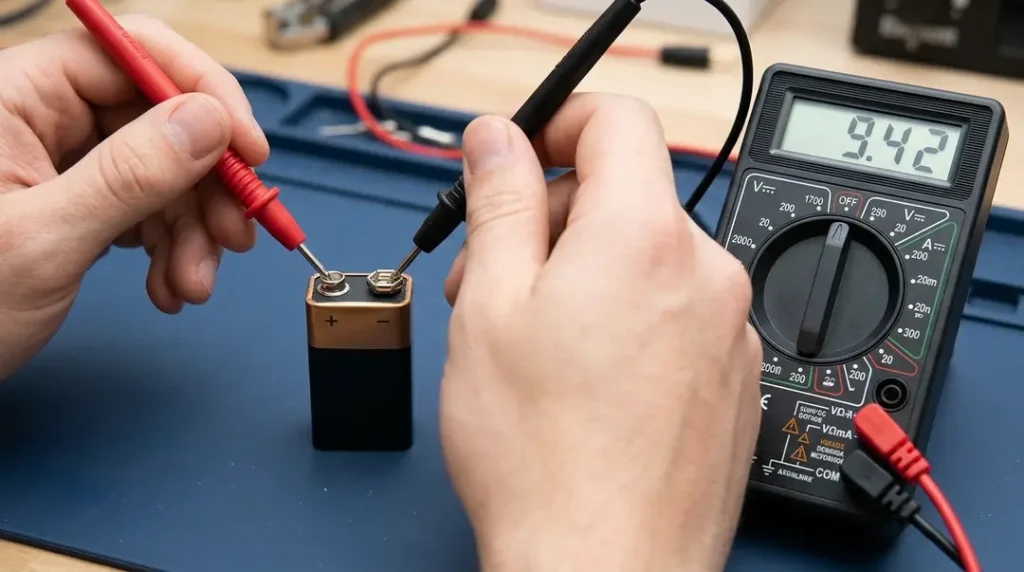
9.42V means this one still has plenty of life left.
Step 4: Read the Display
Compare the number with the voltage chart above for your battery type.
| What the display shows | What it means |
|---|---|
| A number such as 9.43 | The battery’s voltage. Compare it with the chart. |
| A minus sign, such as −9.43 | The probes are reversed. The voltage is still correct. |
| OL | The range is too low. Switch to the 20V range. |
| 0.00 | A dead battery, or the dial is not on DC volts. Check the dial first. |
The Load Test: A Truer 9 Volt Battery Test
The basic check has one weakness. A multimeter draws almost no current, so a worn-out battery can still show a healthy voltage. The moment a real device draws power, its voltage sags.
A load test fixes that. You measure the voltage while the battery powers a small resistor.
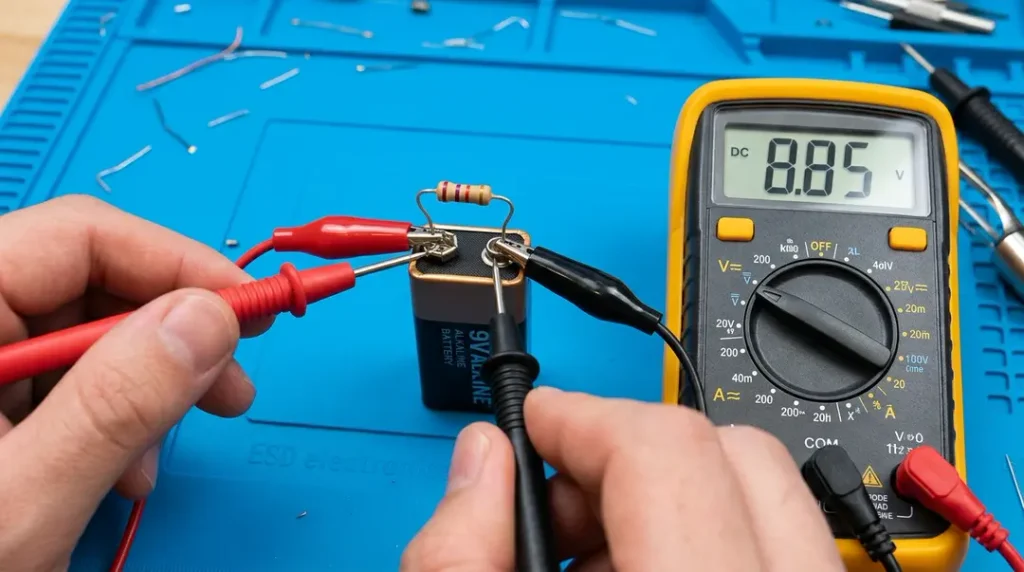
What you need: a 270Ω resistor rated at least 1/2 watt, sold at any electronics store. It draws about 33mA from a 9V battery, a light, realistic load. Energizer uses a 270Ω load in one of its standard 9V tests.
- Measure the battery with no load and write the number down.
- Connect the resistor across the two terminals. Alligator clip leads make this easy.
- Measure the voltage across the terminals while the resistor is connected. Read it after about five seconds.
- Disconnect the resistor. Do not leave it connected, because it slowly drains the battery and gets warm.
| Drop from no-load to loaded reading | What it means |
|---|---|
| A few tenths of a volt | Healthy. The battery can deliver current. |
| About 1V or more | Worn out. The battery cannot keep its voltage under load. |
| The reading keeps sinking while you watch | Nearly empty. Replace it. |
Real World Example: Two Batteries That Look the Same
Say two alkaline batteries from a drawer both read 8.9V with no load. On the chart, both look good.
Under the 270Ω load, battery A reads 8.6V, a drop of 0.3V. Battery B reads 7.4V, a drop of 1.5V. Battery A is healthy. Battery B is worn out, even though its no-load reading matched. Put battery A in the smoke alarm and recycle battery B.
Multimeter vs Battery Tester
Cheap plug-in battery testers sell for a few dollars at US stores. They are handy, but they do less than a multimeter.
| Multimeter | Battery tester | |
|---|---|---|
| What it shows | The exact voltage | Usually good, weak, or replace |
| Load test | With a resistor, as shown above | Many apply a small load automatically |
| Rechargeable 9V batteries | Accurate, if you compare with the label | Often shows a full rechargeable as “weak” |
| Other uses | Outlets, car batteries, wires, and more | Batteries only |
If you already own a multimeter, you do not need a separate tester. If you only ever check batteries, a tester is faster.
9V Battery Safety Tips
A 9V battery is easy to short by accident. Its two terminals sit close together, so a key, coin, or paper clip can bridge them and short the battery. A shorted battery gets hot fast.
- Store them upright in their packaging, or with a plastic cap on the terminals.
- Never toss them loose into a drawer with metal objects.
- Tape the terminals with electrical tape before you recycle a used 9V battery.
⚠️ Safety warning: Never measure a battery’s current by touching the probes across it on the amps setting. That shorts the battery through the meter, which can blow the meter’s fuse and overheat the battery. Current is measured in series with a circuit. See my guide on How to Measure Amps with a Multimeter.
Common Mistakes When Testing a 9V Battery
Testing the battery inside the device. The device draws current and lowers the reading. Take the battery out first.
Using the AC volts setting. A battery is DC. On AC volts, the meter reads 0V or a random number.
Judging a rechargeable by the alkaline chart. A full NiMH rechargeable can read 8.4V, which looks weak on the alkaline chart. Check its label.
Trusting the no-load reading for a smoke alarm. A worn battery can pass the basic check and still fail under load. For safety devices, run the load test or simply fit a new battery.
Using the 2V range. A 9V battery is over the limit, so the meter shows OL. Use the 20V range.
FAQ
How do you test a 9V battery with a multimeter?
Take the battery out of the device and set the multimeter to DC volts on the 20V range. Touch the red probe to the small round terminal and the black probe to the larger six-sided terminal. Compare the reading with the chart: a new alkaline reads 9.2V to 9.6V.
What voltage is a dead 9V battery?
It depends on the device. As a rule, replace an alkaline 9V below about 7.5V, and sooner in a smoke alarm, which can start chirping anywhere from 6.0V to 7.6V. Most devices stop working well before the battery is fully drained.
What should a new 9V battery read?
A new alkaline 9V reads about 9.2V to 9.6V, and a new lithium 9V reads at or a little above 9V. Rechargeable 9V batteries read according to their label, commonly 8.4V or 9.6V for NiMH and 7.4V for lithium-ion.
Why does my new rechargeable 9V battery read only 8.4V?
Most rechargeable 9V batteries are not 9V inside. A common NiMH 9V uses seven 1.2V cells, which gives 8.4V. Check the voltage printed on the label; if the reading matches it, the battery is full.
Is 8 volts OK for a 9V battery?
For an alkaline 9V, 8V means it is weak. It may still run a toy or remote, but replace it in a smoke alarm. For an 8.4V NiMH rechargeable, 8V means it is partly used and should be recharged soon.
Can I test a 9V battery without a multimeter?
Yes. A cheap plug-in battery tester shows whether a 9V is good, weak, or dead, and many apply a small load for a truer result. A multimeter is more precise and also tests outlets, wires, and car batteries.
Conclusion
Testing a 9V battery with a multimeter takes about a minute. Three points get you the right answer:
- Measure on DC volts, 20V range, with the battery out of the device: red to the small round terminal, black to the larger one.
- Read it against the right chart. A new alkaline reads 9.2V to 9.6V and should be replaced below about 7.5V. Rechargeables read their own label voltage, often 8.4V.
- Use the load test for anything that matters, like a smoke alarm. A weak battery can pass the basic check and still sag under load.
New to your meter? My guide on How to Use a Multimeter covers every basic setting. Ready to test a bigger battery? See How to Test a Car Battery with a Multimeter.
Testing AA, AAA, coin cell or 18650 batteries too? Enter your reading in my free Battery Voltage Checker to see if each one is full, weak or dead.