You turn your multimeter to the capacitor setting, and the screen shows “nF.” The capacitor in your hand says “MFD.” The parts list says “µF.” Are these three different things?
Not really. Two of them are the same unit, and the third is the same quantity in a smaller unit. Once you know the microfarad symbol and its common spellings, every capacitor label and meter screen makes sense.
Quick answer: The microfarad symbol is µF. The µ is the Greek letter mu, which means micro (one-millionth), and F stands for farad. So 1µF equals 0.000001 farad. Microfarads are also written as uF, MFD, or mfd, and all of these mean the same unit. On a multimeter, turn the dial to the capacitor symbol; the screen then shows the reading in nF, µF, or mF.
What Is a Microfarad?
A microfarad (µF) is a unit of capacitance equal to one-millionth of a farad.
Capacitance is how much electrical charge a capacitor can store. More capacitance means more stored charge. More stored charge means the capacitor takes longer to fill and empty.
The full farad is a huge unit, so real capacitors use fractions of it. Here is what microfarads look like in everyday parts:
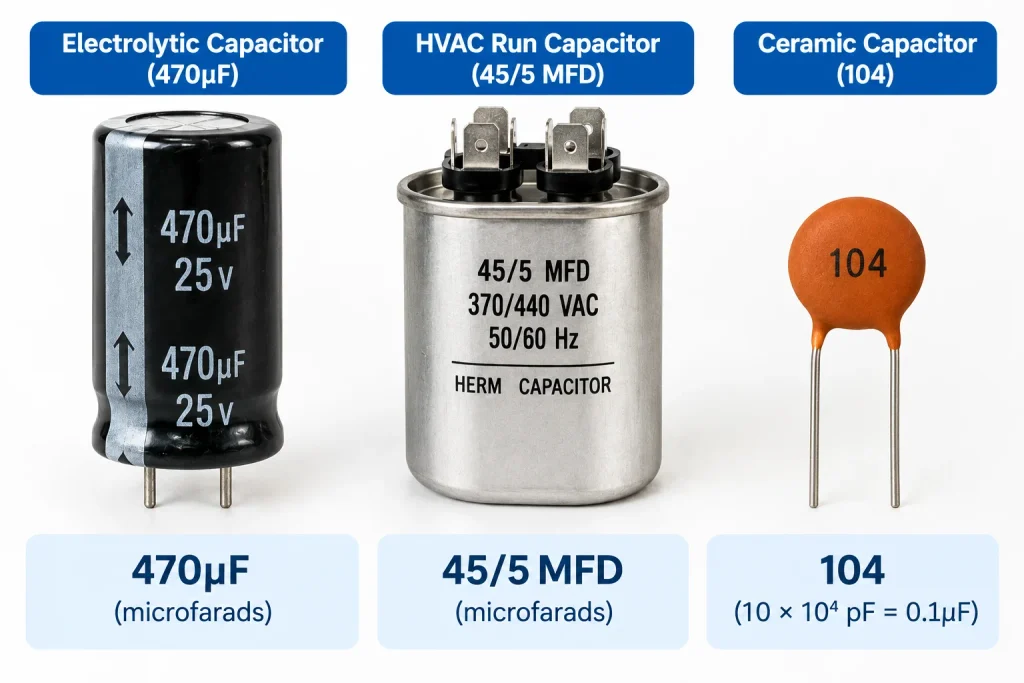
- A small ceramic capacitor on a circuit board might be 0.1µF.
- An air conditioner run capacitor might be 45µF.
- A power supply filter capacitor might be 2,200µF.
It is pronounced “MY-kroh-FAIR-ad.” Technicians sometimes shorten it to “mic” (said like “mike”), as in “a 10-mic cap.” Picofarads get a nickname too: “puff.”
The Farad Symbol (F)
The farad symbol is a capital F. The farad is the SI unit of capacitance, named after English physicist Michael Faraday.
One farad stores one coulomb of charge at one volt. That is far more than most circuits need, which is why you rarely see a capacitor marked in whole farads. Older labels sometimes wrote farad as “f,” “fd,” or “Fd.”
Every Way the Microfarad Symbol Is Written
The same unit shows up in at least four spellings. One look-alike (mF) means something else entirely.
µF: The Official Symbol
µF is the correct SI form. The µ is the micro prefix, meaning one-millionth. You will see it on modern capacitors, datasheets, and multimeter screens.
Computers have two look-alike characters for this: the Greek letter mu (μ) and the older micro sign (µ). In a capacitor value, both mean micro.
uF: The Keyboard Version
Most keyboards have no µ key, so a lowercase u stands in. It looks close enough that it is rarely misread. A listing for a “47uF capacitor” means 47µF.
MFD and mfd: The Older Label Still Used on HVAC Capacitors
Before about 1960, microfarads were usually written “mf” or “MFD.” A 1940 Radio Shack catalog listed every capacitor in “Mfd.”
The habit never left the US motor and HVAC trade. Air conditioner, furnace blower, and pool pump capacitors still say MFD today. A 35 MFD capacitor is a 35µF capacitor.
mF: The Symbol That Causes Mistakes
In the modern metric system, a lowercase m means milli, or one-thousandth. So 1mF is a millifarad, which equals 1,000µF.
The confusion comes from old parts, where “mf” meant microfarad. A capital M is no better, because it officially means mega (one million).
Use this rule:
- On a modern capacitor or meter screen, mF means millifarad.
- On an old capacitor or an HVAC part, mf or MFD means microfarad.
Millifarads are rare on labels. A 4.7mF capacitor is normally sold as 4,700µF.
MMFD and µµF: Old Labels for Picofarads
Vintage radios use the micromicrofarad, written µµF, MMF, or MMFD. One micromicrofarad is one picofarad (pF). So a capacitor marked 100 MMFD is 100pF, not 100µF.
Microfarad Symbol Summary Table
| Symbol | Means | Where you see it | Value in µF |
|---|---|---|---|
| µF or μF | Microfarad | Modern labels, datasheets, meter screens | 1 |
| uF | Microfarad | Online listings, typed text | 1 |
| MFD or mfd | Microfarad | HVAC and motor capacitors, older parts | 1 |
| mf (old parts) | Microfarad | Pre-1960s parts and books | 1 |
| mF (modern) | Millifarad | Large capacitors, some meter screens | 1,000 |
| MMFD or µµF | Picofarad | Vintage radio parts | 0.000001 |
| F | Farad | Supercapacitors | 1,000,000 |
The Microfarad Symbol on a Multimeter
Many people search for “µF” on their meter dial and cannot find it. That is because most meters mark the setting with a different symbol.
The Capacitance Symbol on the Dial
Most meters print the capacitor symbol from circuit diagrams: two short parallel lines with a gap between them, like —||— or —|(—. Some meters print “CAP” instead.
The setting often shares a dial position with another test. On the Klein MM400, for example, capacitance shares a position with diode test, and the SEL button switches between them. If your meter has no capacitor symbol at all, it cannot measure capacitance.
For every other mark on the dial, see my Multimeter Symbols Guide.
What the Display Shows: nF, µF, or mF
The µF symbol usually appears on the screen, not the dial. Most digital meters auto-range, so they choose the unit that fits the capacitor.
The Klein MM400 shows how this works. Its capacitance ranges are 40.00nF, 400.0nF, 4.000µF, 40.00µF, and 200.0µF. A small capacitor reads in nF, and a larger one switches to µF automatically.
That means the unit can change between two capacitors. Always read the unit, not just the number. With the leads apart, the screen should read close to 0 nF.
⚠️ Safety warning: Turn off the power and discharge the capacitor before you measure it. HVAC capacitors can hold a dangerous charge after the power is off.
Real World Example: Reading a 0.1µF Capacitor
Say you test a ceramic capacitor marked 104K, which is 0.1µF with ±10% tolerance. On the Klein MM400, it falls in the 400.0nF range, so the screen shows about 100.0 nF.
That 100.0 nF is the same as 0.1µF. A reading of 96.5 nF is 0.0965µF, which is inside the 90 to 110 nF window for ±10%. The capacitor passes.
Here is a second example. A 45 MFD air conditioner capacitor reads 44.2µF. That is about 1.8% low. Compare it with the tolerance printed on the label to decide.
For the full method, see How to Test a Capacitor with a Multimeter.
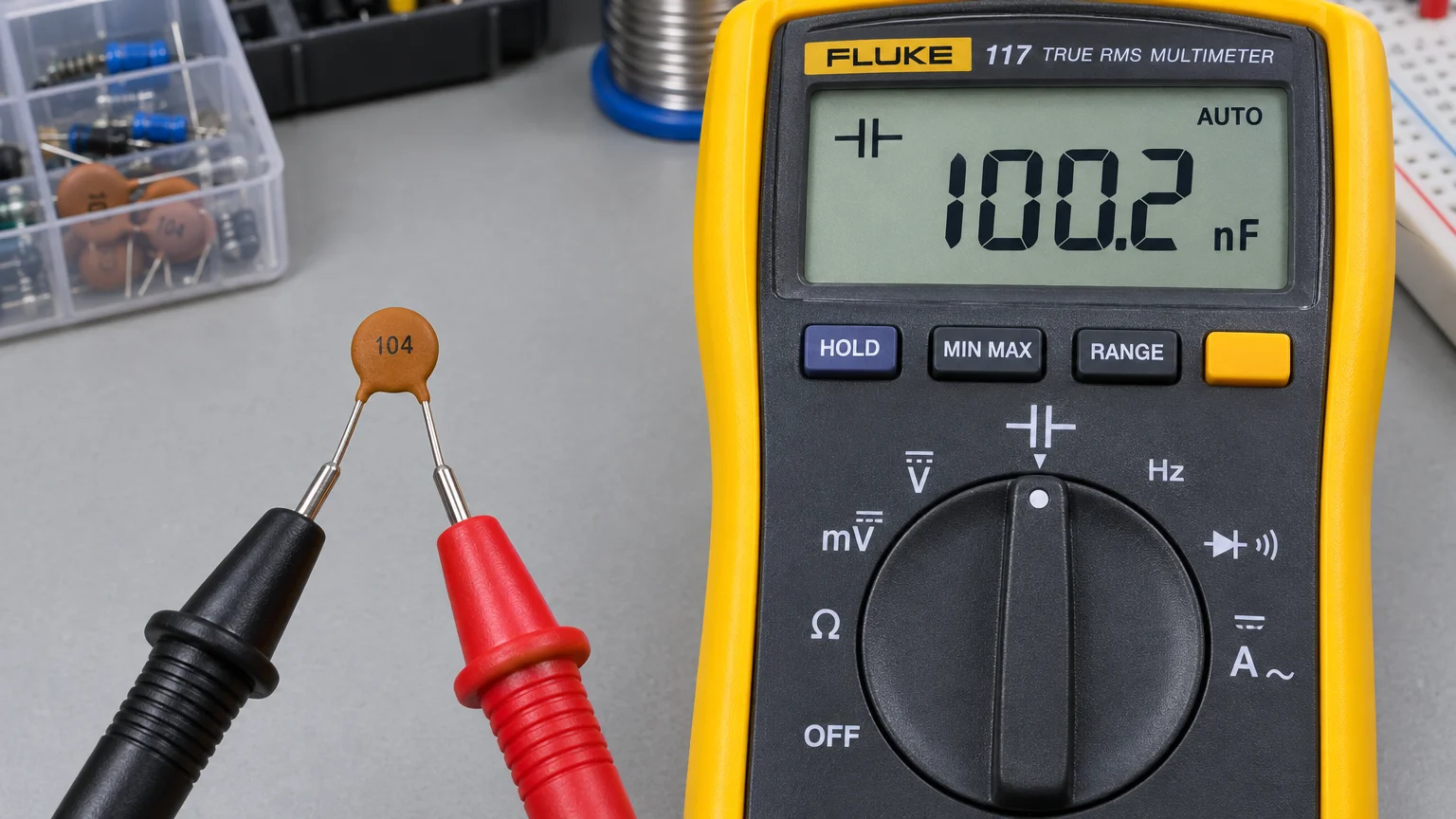
100.2 nF confirms this capacitor is healthy. Always discharge larger
capacitors before testing.
How to Convert pF, nF, µF, and mF
Each unit is 1,000 times bigger than the one before it. 1,000pF makes 1nF. 1,000nF makes 1µF. 1,000µF makes 1mF.
To convert any value instantly, use my free capacitance converter. Type a number, pick its unit, and it shows the value in pF, nF, µF, mF and F.
| Value | In pF | In nF | In µF |
|---|---|---|---|
| 1 pF | 1 | 0.001 | 0.000001 |
| 1 nF | 1,000 | 1 | 0.001 |
| 1 µF | 1,000,000 | 1,000 | 1 |
| 1 mF | 1,000,000,000 | 1,000,000 | 1,000 |
Two rules cover most conversions:
- nF to µF: divide by 1,000. So 470nF is 0.47µF.
- µF to nF: multiply by 1,000. So 0.022µF is 22nF.
US schematics and labels often skip nanofarads and write small values in µF, like 0.022µF. Nanofarads are more common in Europe. If your meter shows 22.0 nF for a part marked 0.022µF, the two agree.
How to Read Microfarads on a Capacitor Label
Small ceramic and film capacitors usually print a code like 104 instead of the value in µF. Decode any code in seconds with my capacitor code calculator, which shows the value in pF, nF and µF.
Capacitors show their value in one of three ways.
Values Printed in µF or MFD
Electrolytic and motor capacitors usually print the value in full. A label reading “470µF 25V” means 470 microfarads, rated for 25 volts. A label reading “35 MFD 370VAC” means 35 microfarads, rated for 370 volts AC.
The voltage rating matters as much as the microfarad value. A replacement should match the µF value and meet or exceed the voltage rating.
Dual Ratings Like 45/5 MFD
A dual run capacitor holds two capacitors in one can. A 45/5 MFD label means a 45µF section for the compressor (HERM terminal) and a 5µF section for the fan (FAN terminal). Both share the C (common) terminal.
Start capacitors often print a range instead, such as 189–227 MFD. That range is the rating itself, not a tolerance problem.
Three-Digit Codes Like 104
Small ceramic and film capacitors are too small for a full label, so they use a code in picofarads. The first two digits are the value. The third digit is how many zeros to add.
So 104 is 10 followed by four zeros: 100,000pF. That equals 100nF, or 0.1µF. Codes below 100 are already in picofarads, so “47” means 47pF.
| Code | pF | nF | µF |
|---|---|---|---|
| 102 | 1,000 | 1 | 0.001 |
| 103 | 10,000 | 10 | 0.01 |
| 473 | 47,000 | 47 | 0.047 |
| 104 | 100,000 | 100 | 0.1 |
| 105 | 1,000,000 | 1,000 | 1 |
A letter after the code shows the tolerance. J means ±5%, K means ±10%, and M means ±20%. So 104K is a 0.1µF capacitor that may measure anywhere from 0.09µF to 0.11µF.
How to Type the Microfarad Symbol
Copy it from here: µF
Or type it yourself:
- Windows: Hold Alt and type 0181 on the numeric keypad, then release Alt.
- Mac: Press Option + M.
- HTML: Use
µorµ. - No keypad or on a phone: Type “uF.” Everyone in electronics reads it as microfarads.
Common Mistakes With Microfarad Symbols
Reading mF as microfarads on a modern part. On a new capacitor or a meter screen, mF means millifarad. Mixing them up makes your value 1,000 times wrong.
Reading MMFD as MFD. A vintage capacitor marked 100 MMFD is 100pF. That is a million times smaller than 100 MFD.
Missing the unit change on the screen. Auto-ranging meters switch between nF and µF on their own. A reading of “47.0” means nothing until you check the unit beside it.
Looking for µF on the dial. Most meters mark the setting with the capacitor symbol or “CAP.” The µF only appears on the screen.
Using a bigger MFD value on an HVAC capacitor. More microfarads is not better. The wrong value can make a motor run hot and fail early. Match the original rating.
Ignoring the voltage rating. Two capacitors with the same µF value are not interchangeable if the replacement has a lower voltage rating.
FAQ
What is the symbol for microfarad?
The symbol for microfarad is µF. The µ means micro, or one-millionth, and F stands for farad. You will also see it written as uF when the µ character is not available, or as MFD on HVAC and older capacitors.
What is the farad symbol?
The farad symbol is a capital F. The farad is the SI unit of capacitance, named after physicist Michael Faraday. One farad equals 1,000,000 microfarads.
What does MFD mean on a capacitor?
MFD means microfarad. A capacitor marked 35 MFD is a 35µF capacitor. The label is common on US air conditioner and motor capacitors, and it does not mean millifarad.
Is µF the same as uF and mF?
µF and uF are the same unit; uF is just easier to type. mF is different on modern parts and meters, where it means millifarad. One millifarad equals 1,000 microfarads.
Where is the microfarad symbol on a multimeter?
The dial usually shows the capacitor symbol (—||—) or “CAP,” not µF. Once you select that setting, the screen shows the reading in nF or µF. Auto-ranging meters switch between the two on their own.
Is it “micro ferrets” or microfarads?
It is microfarads. “Micro ferrets” is a common mishearing of the word, especially in voice searches. The unit is named after Michael Faraday, and its symbol is µF.
Conclusion
The microfarad symbol is µF, and it means one-millionth of a farad. Three points cover almost every label and meter you will see:
- µF, uF, and MFD are the same unit. MFD is still standard on US HVAC and motor capacitors.
- mF on a modern part means millifarad, which is 1,000 times bigger. MMFD on a vintage part means picofarad.
- On a multimeter, find the capacitor symbol on the dial, then read both the number and the unit on the screen.
Ready to put this to work? My guide on How to Use a Multimeter covers every setting, from volts to capacitance.