Searching for the right multimeter online gets you a dozen “2026 best of” articles that all disagree with each other, and more than a few read like they were written by someone who has never held one. Prices shift constantly, models get discontinued, and whatever product tops a ranking list today may not exist on the shelf next year.
This guide takes a different approach. Instead of telling you which specific model to buy, it teaches you the criteria that actually separate a good multimeter from a bad one, so you can evaluate any meter you find, at any store, in any year, and know with confidence whether it fits your needs.
💡 Looking for specific product recommendations instead? This page is purely educational. Once you understand the criteria below, check out our Best Multimeters guide for specific picks by category and budget.
What to Look For in a Multimeter
Digital vs Analog
For nearly everyone, digital is the right answer. A digital multimeter (DMM) gives you a clear numeric readout, higher accuracy, and better durability against overload than an analog meter with a moving needle.
Analog meters retain one narrow advantage: a moving needle can make it easier to catch a rapidly changing value in real time, since some technicians find needle deflection reveals subtle, fast fluctuations that a digital display smooths over between refreshes. This is a niche use case. Unless you have a specific reason to want a needle display, buy digital.
Handheld vs Benchtop
Virtually everyone shopping for a multimeter wants a handheld model: compact, battery-powered, and portable enough to carry in a toolbox or glovebox. Benchtop and lab-grade multimeters used in electronics manufacturing, calibration labs, and R&D are a completely different category, built for stationary precision work and often costing anywhere from several hundred to tens of thousands of dollars. Unless you specifically work in a lab or calibration environment, a handheld meter is what you need.
Auto-Ranging vs Manual Ranging
An auto-ranging multimeter automatically detects the correct measurement range and displays the result. You select voltage, current, or resistance, and the meter does the rest.
A manual-ranging multimeter requires you to select the specific range yourself, for example, choosing between 200mV, 2V, 20V, and 200V ranges when measuring DC voltage. This takes more knowledge to use correctly but can be faster in the hands of an experienced technician who already knows the expected value.
For beginners: Always choose auto-ranging. It removes an entire category of mistakes.
For experienced users: A meter with both auto-ranging and a manual override button gives you the best of both.
Input Impedance Explained
Input impedance is the internal resistance of the multimeter’s own measuring circuit. The higher it is, the less the meter itself interferes with the circuit you are testing.
Look for at least 10MΩ (megohms) input impedance, which is standard on virtually all modern digital meters. This matters most when testing sensitive electronic circuits, where a low-impedance meter can pull down a voltage reading and give you a false result by acting as an unintended parallel path for current.
True RMS vs. Average-Responding
This is one of the most misunderstood specs on a multimeter box.
Average-responding meters calculate AC voltage assuming a perfect sine wave. This works fine for a standard wall outlet, but gives inaccurate readings on modern electronics like variable frequency drives, LED drivers, and many appliance motors, which produce distorted, non-sinusoidal waveforms.
True RMS meters calculate the actual effective value of any waveform, sine or not, giving accurate readings regardless of shape.
| Your Situation | Do You Need True RMS? |
|---|---|
| Testing wall outlets, car batteries, basic home wiring | No, average responding is fine |
| Working on HVAC systems, motors, or variable-speed drives | Yes, True RMS is important |
| Professional electrical or industrial work | Yes, considered standard for this work |
Display Quality and Refresh Rate
A higher count rating means finer resolution. A 2,000-count display shows fewer decimal points than a 6,000-count display for the same range. For most home and automotive work, 6,000 counts is more than enough. Look for a backlit display if you will ever work in dim spaces like under a dashboard or inside an electrical panel.
Refresh rate matters more than most buyers realize. A slow-updating display makes it hard to catch a fluctuating reading. Budget meters with a very low refresh rate can feel frustrating during continuity or resistance checks.
Battery Life and Access
Cheap multimeters can burn through batteries surprisingly fast. Look for a stated battery life of at least 200 hours (without backlight use), and check whether the battery compartment is separate from the main case screws. Meters that require you to open the entire case just to change a battery wear out their screw threads over time.
An auto shut-off feature is a small but genuinely useful detail that saves battery life if you forget to turn the meter off.
Understanding CAT Safety Ratings
CAT stands for Category. It is a safety rating that tells you how much electrical energy a multimeter is designed to safely withstand in a given environment. This is not a marketing spec. It is a real safety measure that protects you from arc flash and internal component failure during a voltage transient.
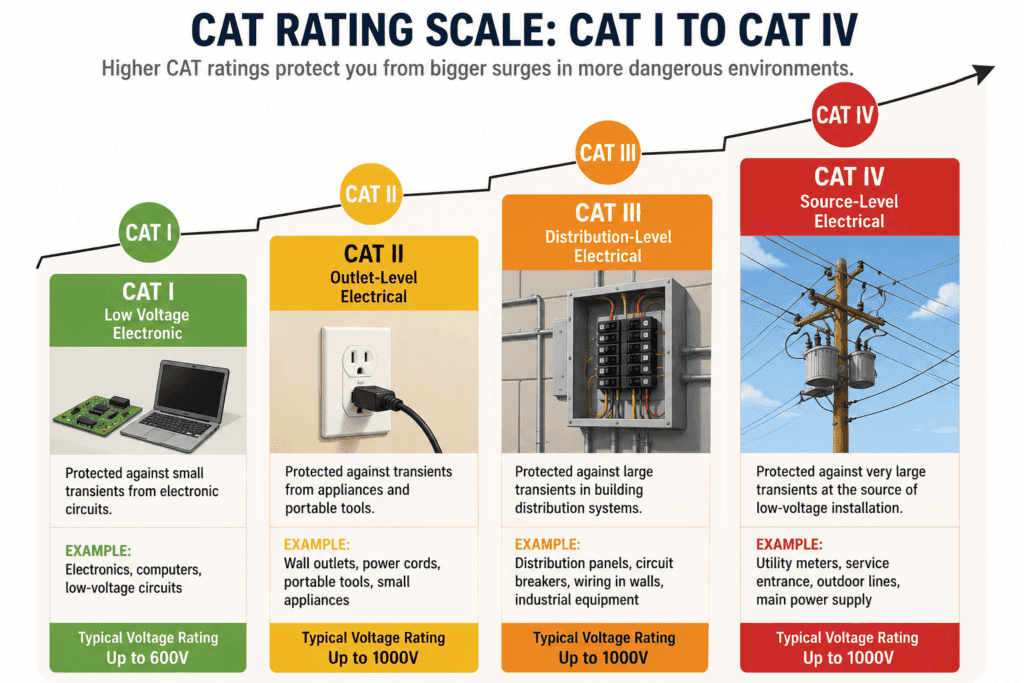
CAT Rating Comparison Table
| CAT Rating | Environment | Typical Use |
|---|---|---|
| CAT I | Low-energy electronics | Circuit boards, battery-powered devices, signal circuits |
| CAT II | Household outlets and appliances | Wall sockets, extension cords, plug-in devices |
| CAT III | Fixed building wiring | Consumer units, distribution panels, hard-wired circuits |
| CAT IV | Utility and industrial supply | Electricity meters, outdoor supply lines, industrial feeds |
Which CAT Rating Do You Actually Need?
Home DIY, automotive work, and basic electronics: A CAT II or CAT III rated meter covers everything you will realistically encounter.
Working at a breaker panel or on fixed building wiring: Do not go below CAT III.
Industrial, utility, or commercial electrical work: You need CAT IV.
If you are unsure which category applies to your work, choose the higher rating. The cost difference between CAT II and CAT III meters is usually small, and the safety margin is worth it.
Must-Have vs Nice-to-Have Features
Essential Features for Every Buyer
- DC and AC voltage measurement to at least 600V
- DC current measurement, ideally with separate, individually fused ports for mA and 10A ranges
- Resistance measurement
- Continuity beeper with a reasonably fast response
- Auto-ranging
- CAT II rating at an absolute minimum
⚠️ Why separate current ports matter: some very cheap multimeters route voltage and current measurement through the same physical port to cut manufacturing cost. If you forget to switch modes and accidentally test a live voltage source while the dial is still set to current, the meter creates a direct short circuit through itself. This is one of the most common ways low quality multimeters fail catastrophically, and it is not a rare or theoretical risk. Always confirm separate, individually fused ports before buying.
Features Only Electricians and Technicians Typically Need
- True RMS
- Frequency measurement
- Duty cycle measurement
- Micro-amp (μA) range
- CAT III or CAT IV rating
Features Most Hobbyists Can Skip
- Capacitance measurement, unless doing electronics or HVAC work
- Transistor gain (hFE) testing
- High-precision resolution beyond what a standard 6,000-count display offers
Do not pay extra for a feature list you will never use. A meter loaded with capacitance ranges, frequency counters, and transistor testers is wasted money if you only ever check batteries and outlets.
Multimeter Price Tiers Explained
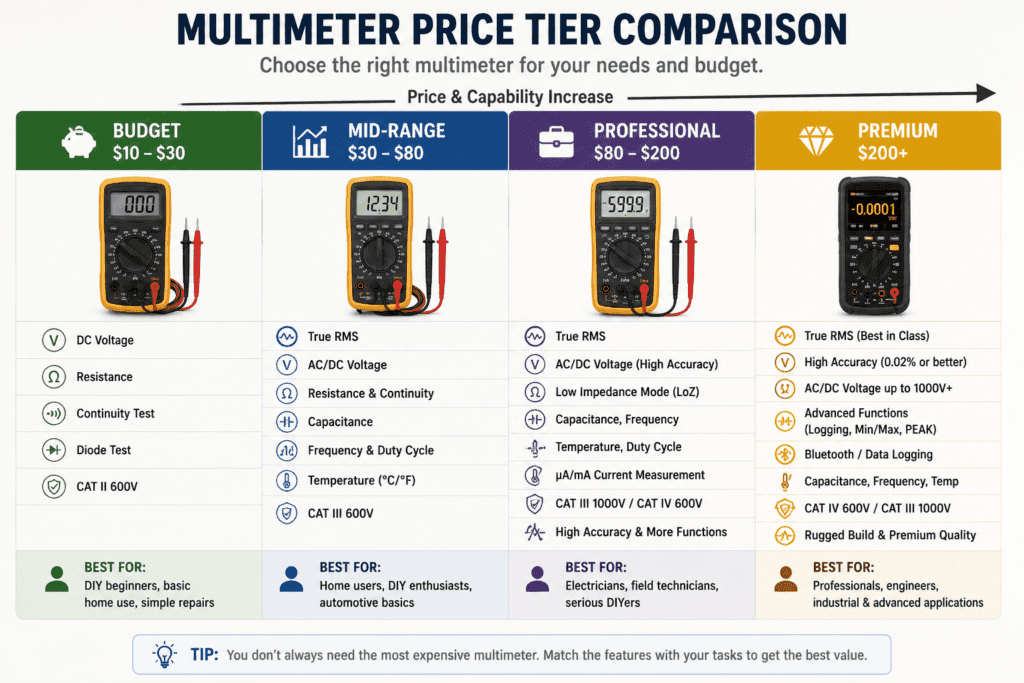
| Price Tier | Typical Range | What You Get |
|---|---|---|
| Budget | Under $30 | Basic voltage, current, resistance, continuity. Auto-ranging on most modern models. Build quality varies. |
| Midrange | $30 to $80 | Better build quality, often True RMS, more complete feature set, better probes |
| Professional | $80 to $250 | CAT III/IV rating, True RMS standard, faster response times, rugged construction |
| Premium | $250+ | Top-tier accuracy, best-in-class safety ratings, advanced features like data logging |
Most home and automotive users get everything they genuinely need from the midrange tier. Professionals working daily with electrical systems justify the professional and premium tiers through durability and safety margin, not just extra features.
Multimeter Brands: What Each Is Generally Known For
Brand reputation is not marketing fluff in this category. It correlates directly with input protection quality, calibration accuracy, and how the meter behaves when you accidentally overload a range, which happens to everyone eventually.
| Brand | Known For | Typical Price Range |
|---|---|---|
| Fluke | Premium accuracy, industry-standard reliability, excellent input protection | $80 to $400+ |
| Klein Tools | Durable build quality, strong mid-to-professional lineup, popular with electricians | $40 to $150 |
| Amprobe | Wide range selection, strong clamp meter heritage, solid mid-range value | $30 to $150 |
| Extech | Reliable US-designed instruments, good feature-to-price ratio | $30 to $100 |
| AstroAI | Popular budget-to-midrange option, good value for hobbyists and DIYers | $15 to $60 |
💡 Just how dominant is Fluke? According to calibration industry data tracking the meters that pass through professional calibration services, Fluke accounts for roughly 75% of all multimeters seen, with Keysight a distant second at around 11%. This reflects one industry data point rather than a full market study, but it is a strong real-world signal of how dominant Fluke’s reputation is among working professionals. That reputation is exactly why Fluke meters typically carry a price premium over lesser-known brands with similar specs on paper.
💡 A note on pricing: Prices fluctuate constantly with sales, supply, and new model releases. Treat the ranges above as general positioning rather than exact current prices, and always check current listings before buying.
Multimeter vs Clamp Meter: Do You Need Both?
A standard multimeter measures current by breaking the circuit and placing the meter in series with it, which works well for small currents but becomes impractical and genuinely dangerous for large currents.
A clamp meter measures current differently. Its jaws clamp around a single wire and read the current through the magnetic field the wire generates, without ever touching bare conductors or breaking the circuit. This makes it the safer and faster choice for measuring high current loads like HVAC compressors, motors, and main electrical panels.
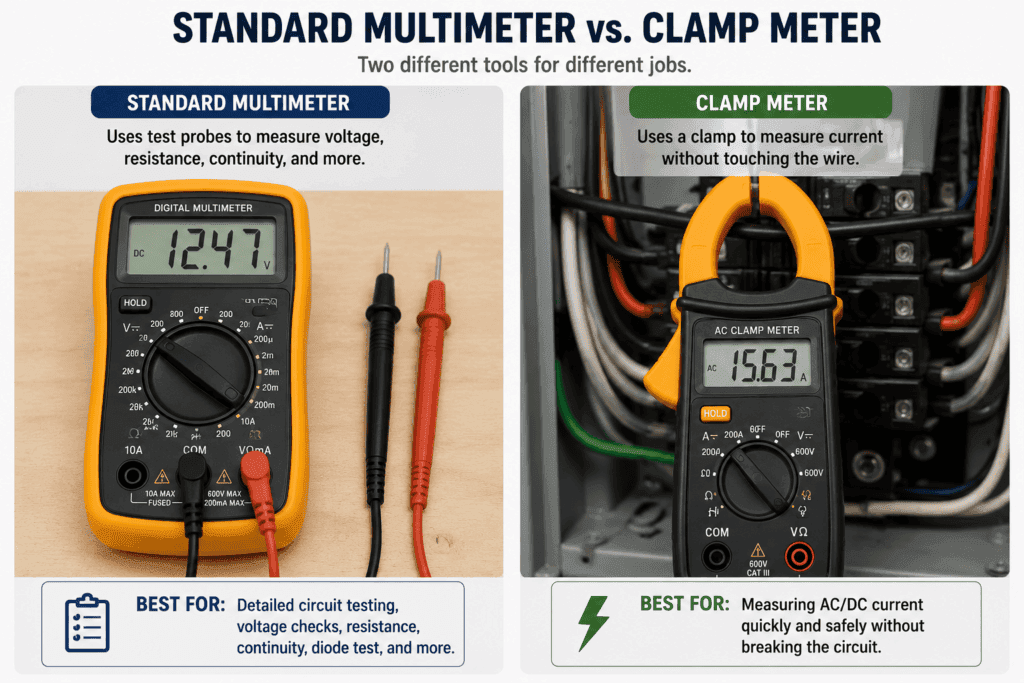
| Task | Best Tool |
|---|---|
| Testing a car battery, checking outlets, tracing wires | Multimeter |
| Measuring current on an HVAC compressor or motor | Clamp meter |
| General home DIY and electronics | Multimeter |
| Electrical panel or high-current industrial work | Clamp meter, or a combo unit |
Many manufacturers, including Fluke, Klein Tools, and Amprobe, sell combination clamp meters that include full multimeter functionality alongside a current clamp. If you expect to measure high currents regularly, a clamp meter and multimeter combo unit is worth the modest price premium over a standard multimeter alone.
💡 For a deeper dive into current measurement techniques, see our How to Measure Amps with a Multimeter guide.
Choosing the Right Multimeter for Your Use Case
Different projects call for different priorities. Use this section to identify which criteria above matter most for what you actually plan to do.
For Automotive Diagnostics
Prioritize a CAT III rating, DC voltage testing down to at least 20V with good resolution, a dedicated diode test mode, and durable probes that can reach into a cramped engine bay comfortably. True RMS is not essential for basic DC automotive work but becomes useful for diagnosing alternator ripple or hybrid and EV systems.
💡 See our How to Test a Car Battery with a Multimeter guide for the exact testing process once you have your meter.
For Home Electrical and General DIY
Prioritize CAT III rating since you may be working near a breaker panel, a fast and reliable continuity beeper for tracing wires and fuses, and auto-ranging so you are not fumbling with range selection mid-project.
For HVAC Diagnostics
Prioritize True RMS, since HVAC systems commonly include variable-speed motors and electronic controls, a temperature probe input, capacitance measurement for testing start and run capacitors, and a CAT III rating.
For Electronics and Circuit Board Work
Prioritize a diode test mode with a clear forward voltage display, a capacitance range extending down to nanofarads, an hFE socket if you work with discrete transistors, and fine-tipped probes for reaching small solder joints. CAT rating matters less here since you are typically working at low voltages, but do not go below CAT I.
For Solar Panel Testing
Prioritize a DC voltage range comfortably covering 0 to 50V for panel VOC testing, a DC current range up to 10A with a properly fused input for ISC testing, and CAT III rating for safety margin.
Common Buying Mistakes to Avoid
Overpaying for features you will never use. A meter with frequency measurement, duty cycle, and micro-amp ranges is wasted money if you only ever check batteries, outlets, and fuses.
Buying a CAT-rated meter too low for the job. A CAT I meter is fine for a circuit board on your workbench. It is not fine for testing a breaker panel.
Ignoring input impedance. Confirm at least 10MΩ before buying, especially for electronics work.
Choosing manual ranging as a beginner. Manual ranging is faster in experienced hands but genuinely frustrating for a first-time user.
Ignoring how current is measured. A standard multimeter measuring current must be placed in series, breaking the circuit. For high currents, this is where a clamp meter becomes the safer choice instead.
Assuming shared ports are fine. A meter that uses the same physical port for voltage and current measurement carries a real risk of an accidental short circuit if you forget to switch modes. Confirm separate, individually fused ports before buying.
FAQ
What is the most important feature to look for in a multimeter?
Safety rating (CAT category) and input protection matter most, since these directly affect whether the meter, and you, survive an accidental overload. Beyond safety, auto-ranging is the single feature that most improves ease of use for beginners and reduces measurement errors for everyone.
Do I need a True RMS multimeter?
Only if you regularly work with non-sinusoidal AC waveforms, which includes HVAC systems with variable-speed motors, LED lighting drivers, inverters, and industrial equipment. For basic home electrical work, car battery testing, and general DIY, a standard average-responding multimeter gives accurate enough results.
What CAT rating do I need for home use?
A CAT II or CAT III rated multimeter covers standard home DIY work. CAT II handles wall outlets and plug-in appliances. CAT III is needed if you plan to test at a breaker panel or work on fixed building wiring. Never use a CAT I meter on mains voltage circuits.
Is auto-ranging worth paying extra for?
Yes, especially for beginners. Auto-ranging eliminates the most common setup mistake, which is selecting the wrong range and getting a confusing or inaccurate reading. Most modern multimeters at every price tier now include it, so it is rarely a significant price premium anymore.
What is the difference between a cheap and expensive multimeter?
Expensive multimeters generally offer better input protection against overload, more accurate calibration, faster display refresh rates, higher CAT safety ratings, and more durable build quality. For occasional home use, a budget or midrange meter is usually sufficient. For daily professional use, the extra durability and protection of a higher-tier meter pays for itself over time.
Do I need a clamp meter instead of, or in addition to, a multimeter?
A standard multimeter covers the vast majority of home, automotive, and general electronics needs. A clamp meter becomes worth adding when you regularly measure high current loads, such as HVAC compressors, motors, or electrical panels, since it measures current safely without breaking the circuit. Many brands sell combination units that include both functions in one device.
Can one multimeter handle both automotive and household testing?
Yes. A single CAT III-rated, auto-ranging digital multimeter with standard DC and AC voltage, current, resistance, and continuity functions comfortably covers both automotive diagnostics and household electrical checks. You only need separate specialized tools if you move into HVAC, industrial, or precision electronics work.
Conclusion
The multimeter that ranks “best” on any single article changes every year as new models replace old ones and prices shift with sales and supply. What does not change are the fundamentals in this guide: auto-ranging for ease of use, adequate input impedance, separate fused ports for current and voltage, the right CAT rating for your work, and a feature set that actually matches your projects rather than an impressive spec sheet you will never fully use.
Use the criteria in this guide to evaluate whatever multimeter is currently on the shelf, at whatever store you are shopping, from whichever brand you are considering. If it checks the boxes for your specific use case, it is the right meter for you.
Ready for specific recommendations by category and budget? Check out our Best Multimeters guide next. Once you have your multimeter in hand, our How to Use a Multimeter guide gets you testing confidently in minutes, and our Multimeter Symbols Guide makes sure you never guess at a dial setting again.
5 thoughts on “The Multimeter Buying Guide: Everything You Need to Know Before You Buy”