
What Multimeter Fuses Do
Multimeter fuses protect the current inputs, so a measuring mistake blows a cheap fuse instead of the meter, or you.
The voltage input does not need a fuse. It has a very high resistance, so little current can flow through it. The current inputs are the opposite. Inside, they pass through a shunt of about 0.01Ω. Add the test leads, and the whole path is close to a dead short.
Here is the classic mistake. You measure current, then forget to move the red lead out of the amps jack. You touch the probes across an outlet. Near-zero resistance means a huge current. The fuse blows in a fraction of a second.
Most meters have two current fuses:
| Fuse | Protects | Example ratings |
|---|---|---|
| Low-current fuse | The mA and µA jack | 440mA 1000V on many Fluke meters; 500mA 600V on the Klein MM400 |
| High-current fuse | The 10A jack | 11A 1000V on many Fluke meters; 10A 600V on the Klein MM400 |
How to Read a Fuse Rating
A meter fuse carries more information than an amp number. Every one of these must match:
| Marking | Example | What it means |
|---|---|---|
| Current | 11A or 440mA | The current at which the fuse opens |
| Voltage | 1000V | The highest voltage it can safely break. It must be at least the meter’s maximum. |
| Interrupt rating | 10kA, 17kA, or 20kA | The largest fault current it can break without bursting |
| Speed | F (fast-acting) | Meter fuses blow fast to limit damage |
| Size | 10.3 × 38mm | Diameter × length. It must fit the holder exactly. |
Why a Glass Fuse Is Dangerous
A cheap glass fuse may fit the holder and carry the right amp number. It still is not safe.
Fluke gives a simple example. With the leads in the amps jacks, the path through the meter is about 0.1Ω. Touch them across a 1,000V source, and Ohm’s law gives 1,000 ÷ 0.1 = 10,000 amps. The fuse has to break that current instantly.
A proper meter fuse is a ceramic tube filled with sand. When it blows, the heat melts the sand into glass, which smothers the arc. Fluke uses fuses with minimum interrupt ratings of 10,000 and 17,000 amps. A small glass fuse is not built for that. It can burst and release a fireball near your hands.
Fluke calls a meter with the wrong fuse, or a wire bridged across the fuse holder, a “thermal hand grenade.” The risk is greatest on CAT III and CAT IV circuits, such as breaker panels, where the available fault current is highest.
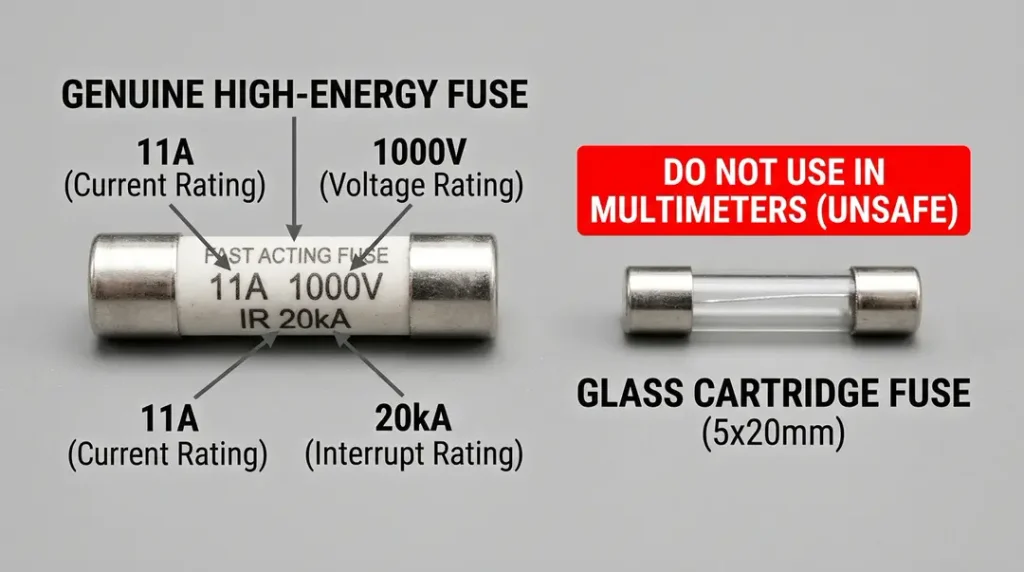
high-energy fuse is built to stop a 20,000-amp fault, like testing an
outlet with the leads in the amps jack.
Signs Your Multimeter Fuse Is Blown
A blown fuse only affects the current range it protects. Voltage, resistance, and continuity keep working.
| Symptom | Likely cause |
|---|---|
| mA range reads zero, but voltage works | Blown mA fuse |
| 10A range reads zero, but the mA range works | Blown 10A fuse |
| Both current ranges read zero, voltage and ohms work | Both fuses blown, or one shared fuse |
| The meter shows a fuse or lead warning | Some meters detect a blown fuse and warn you |
| Voltage and resistance are dead too | Not a fuse problem. Check the battery first. |
How to Test a Multimeter Fuse
Method 1: The 10-Second Self-Test
Many meters can test their own fuses without opening the case. Fluke describes this method in its manuals.
- Remove both test leads.
- Turn the dial to ohms (Ω).
- Plug one test lead into the VΩ jack.
- Touch that lead’s probe tip into the 10A jack.
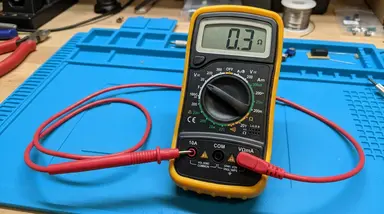
touch its tip into the 10A jack. Near 0 Ω means the fuse is good; OL
means it’s blown.
| Reading | What it means |
|---|---|
| Under about 0.5Ω | The 10A fuse is good |
| OL | The 10A fuse is blown. Replace it. |
Repeat with the probe tip in the mA jack. On some meters, that jack reads a higher value, sometimes thousands of ohms, because of a built-in protection resistor. Your manual lists the expected value. OL still means the fuse is blown.
Method 2: Remove and Test the Fuse
If your meter does not support the self-test, open the case (see the steps below) and lift the fuse out. Set the meter, or a second meter, to continuity and touch one probe to each metal end cap.
A good fuse beeps and reads under 1Ω. A blown fuse reads OL. Do not rely on looks. Most meter fuses are ceramic, so you cannot see the element inside. For more on reading these results, see How to Test Continuity with a Multimeter.
Multimeter Fuse Replacement: Step by Step
Multimeter fuse replacement takes about 10 minutes and a small screwdriver. Have the correct fuse in hand before you start (the next section shows how to find it).
- Turn the meter off and remove both test leads. Fluke’s manuals warn to remove the leads and any input before opening the case.
- Remove the rubber holster if your meter has one.
- Open the case. On some meters, the fuses sit under the battery door. On others, you remove several screws and lift off the whole back. Check your manual.
- Take a photo of the fuse layout, and note which fuse is the mA fuse and which is the 10A fuse.
- Lift out the blown fuse. Use your fingers or a plastic tool. Do not pry hard on the metal clips; bent clips cause a loose contact.
- Press the new fuse into the clips until it sits firmly. A loose fuse adds resistance and can make current readings wrong.
- Close the case completely and refit every screw before you use the meter.
- Test it. Run the self-test from Method 1. The new fuse should read under about 0.5Ω on the 10A jack.
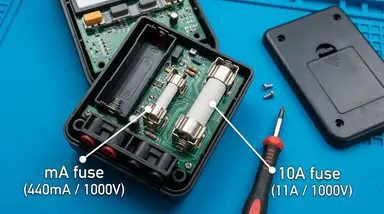
don’t blow it. When replacing either fuse, match its current, voltage
and interrupt ratings exactly.
If the new fuse blows the moment you take a current reading that should be well within range, stop. The meter may have internal damage and needs the maker’s repair service.
How to Find the Correct Replacement Fuse
Where to Find the Fuse Rating
- On the meter: many meters print the fuse ratings on the back, near the battery or fuse door.
- Inside the case: the rating is often printed next to the fuse holder.
- In the manual: look in the maintenance section. It lists every rating and often the maker’s part number.
The Matching Rules
| Rating | Rule |
|---|---|
| Current | Exactly the same. Never higher, which removes protection, and never lower, which blows constantly. |
| Voltage | The same or higher |
| Interrupt rating | The same or higher |
| Speed | The same, usually fast-acting |
| Size | Exactly the same |
Example Fuse Ratings
| Meter | Low-current fuse | High-current fuse |
|---|---|---|
| Fluke 20, 70, and 80 Series III meters | 440mA, 1000V | 11A, 1000V |
| Fluke 21 and 75 | 630mA, 250V, 1,500A interrupt rating | 11A, 1000V, 17kA interrupt rating |
| Klein Tools MM400 | 500mA, 600V, fast-blow | 10A, 600V, fast-blow |
These are examples only. Always confirm against your own meter’s manual.
Where to Buy
The safest source is the meter’s maker or one of its authorized distributors. Fluke, for example, lists its 440mA 1000V fuse at $14.42 and its 11A 1000V fuse at $21.63. Major fuse makers such as Eaton Bussmann and Littelfuse also sell fuses built for meters.
Be careful with cheap marketplace listings. Fluke publishes a counterfeit warning, and a fake fuse may carry the right numbers without the interrupt rating to back them up.
How to Stop Blowing Multimeter Fuses
Most blown meter fuses come from a few habits. Fix those, and the fuses last for years.
- Move the red lead back to VΩ after every current test. This single habit prevents the classic mistake of measuring voltage with the leads in the amps jack.
- Set up before you connect. Turn off the circuit, choose the current range, connect the meter in series, then turn the power back on. My guide on How to Measure Amps with a Multimeter walks through it.
- Start on the 10A jack when you are unsure. Move to the mA jack only once you know the current is small enough.
- Never touch current leads across a voltage source. Current is measured in series, inside the circuit, not across it.
- Use a clamp meter for large or unknown currents. It measures without breaking the circuit, so there is no fuse to blow. See my Clamp Meter Guide.
Some meters help you avoid the mistake altogether. Fluke’s Input Alert, for example, warns you if a lead is in an amps jack while the dial is set to measure voltage.
Common Mistakes with Multimeter Fuses
Fitting a higher-amp fuse so it stops blowing. That removes the protection. Fix the measuring habit instead.
Using a glass, automotive, or household fuse because it fits. The size and amp number can match while the interrupt rating does not. That is the dangerous part.
Bridging the fuse holder with wire or foil. This turns the meter into what Fluke calls a thermal hand grenade on high-energy circuits.
Matching only the amps. Check the voltage, interrupt rating, speed, and size too.
Skipping the fuse check before industrial current work. Fluke’s manuals advise checking the fuses before measuring current-transformer secondary or motor winding current, because an open fuse there can let a dangerous voltage build up.
FAQ
What do multimeter fuses do?
Multimeter fuses protect the current inputs, the mA and 10A jacks. If you accidentally connect those jacks across a voltage, the fuse blows in a fraction of a second. That protects you and the meter from a dangerous short circuit.
How do I know if my multimeter fuse is blown?
The current range reads zero while voltage and resistance still work. To confirm, set the meter to ohms, plug one lead into the VΩ jack, and touch its tip inside the 10A jack. Under about 0.5Ω means the fuse is good, and OL means it is blown.
Can I replace a multimeter fuse with a higher-amp fuse?
No. A higher-amp fuse lets too much current through before it blows, which removes the protection. Always fit the exact current rating, with the same or higher voltage and interrupt rating, listed in your meter’s manual.
Can I use a glass fuse in my multimeter?
No, unless the manual specifies one. Most meters need a ceramic, sand-filled fuse with a high interrupt rating, often 10,000 amps or more. A glass fuse can burst on a high-energy circuit even if its amp rating matches.
Why does my multimeter still read voltage with a blown fuse?
The voltage input is not fused. It has a very high resistance and its own overvoltage protection. Only the current ranges stop working when a fuse blows.
How much does a multimeter fuse cost?
Genuine fuses cost more than generic ones because of their high interrupt rating. Fluke, for example, lists its 440mA 1000V fuse at $14.42 and its 11A 1000V fuse at $21.63. Prices change, so check current listings.
Conclusion
A blown fuse is the most common reason a multimeter stops reading current, and it is an easy fix when you do it right.
- Test it first. On ohms, one lead from the VΩ jack into the amps jack: under about 0.5Ω is good, and OL is blown.
- Replace it exactly. Match the current, voltage, interrupt rating, speed, and size from the manual. Never use glass fuses, higher-amp fuses, or wire.
- Fix the habit. Move the red lead back to VΩ after every current test, and you will rarely blow a fuse again.
Ready to measure current safely with your newly fused meter? My guide on How to Use a Multimeter covers every setting step by step.