You need a current reading without cutting a wire, and someone just told you to grab “the amp clamp.” This guide covers exactly what that tool is, the real difference between an AC-only clamp and a DC amp clamp, a genuine trick for getting an accurate low-current amp clamp reading, and what a Fluke clamp meter actually costs across its lineup.
If you want the full technical breakdown of how clamp meters work, including Hall effect versus current transformer sensing and load versus leakage current, see our complete Clamp Meter Guide first. This article builds on that with the angles most buying guides skip entirely.
What Is an Amp Clamp?
An amp clamp is a current-sensing tool whose jaws open and close around a wire, measuring the current flowing through it via the magnetic field the current produces, without breaking the circuit.
Amp Clamp vs Standard Clamp Meter (Same Thing, Different Name)
Amp clamp, amperage clamp, and clamp meter all refer to the same category of instrument in everyday conversation. “Amp clamp” is simply the more casual, shortened way people describe it on the job.
Electronic Clamp Meter: What Makes It “Electronic”
An electronic clamp meter uses a built-in sensor and digital display to convert the detected magnetic field directly into a numeric current reading, replacing the older analog needle displays some vintage clamp instruments used. Nearly every clamp meter sold today falls into this category.
DC Amp Clamp vs AC Amp Clamp
How a DC Clamp Detects Direct Current
A dc amp clamp uses Hall effect sensor technology, which directly reads magnetic flux rather than relying on an induced signal. This is the only sensing method that can detect a steady, unchanging DC.
Why Not Every Amp Clamp Can Read DC
A standard current transformer clamp meter, the most common and often most affordable type, can only measure AC current, since it depends on a constantly changing magnetic field to generate a reading. If you need to measure a car battery, a solar panel, or any other DC source, confirm your clamp is a Hall effect or combined AC/DC model before relying on it.
💡 See our Clamp Meter Guide for the complete explanation of how each sensing technology works internally.
Low Current Amp Clamp: Measuring Small Currents Accurately
This is the technique most clamp meter guides never mention, and it solves a real, common problem.
Why Standard Clamps Lose Accuracy at Low Current
A general-purpose amp clamp is built to cover a wide range, often up to hundreds of amps. That wide range comes at a cost: precision at the low end, below roughly 1 amp, suffers, and small currents can be difficult to read reliably or may not register clearly at all.
The Multiple-Wrap Technique for Better Low Current Readings
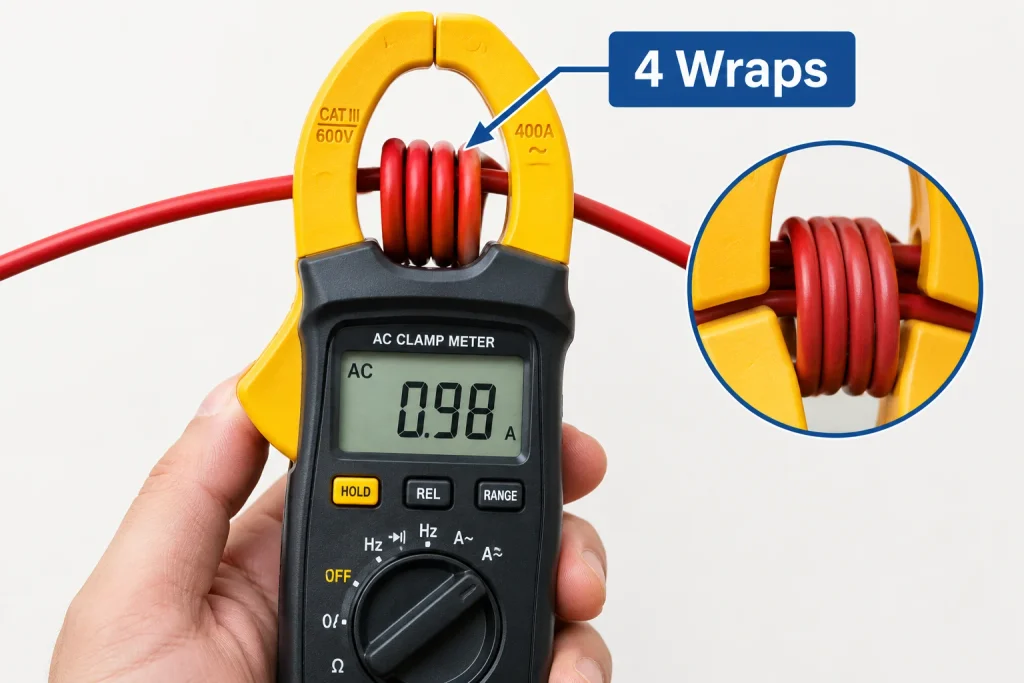
You do not necessarily need to buy a dedicated low-amp clamp meter to solve this. Instead, wrap the wire you are testing through the clamp jaws multiple times before closing them, then divide your reading by the number of wraps.
Example: Wrap the wire through the jaws 10 times, and the display reads 2.5A. Divide 2.5 by 10, and your actual current draw is 0.25A. Each additional wrap effectively multiplies the magnetic field the clamp detects, making a small current large enough to read with confidence.
When to Use a Dedicated Low Amp Clamp Meter Instead
If you regularly measure very small currents, control circuits, sensor wiring, or milliamp-range signals, a dedicated low-amp clamp meter built specifically for that range is worth owning rather than relying on the wrap technique every time.
HVAC Clamp Meters: What Technicians Actually Need
Common HVAC Amperage Readings
| Component | Typical Amperage |
|---|---|
| Residential compressor, running | 10A to 30A |
| Compressor inrush (startup) | 3 to 5 times running amperage, briefly |
| Blower motor | 3A to 10A |
| Condenser fan motor | 1A to 3A |
Inrush Current Capture for Compressor Startup
An HVAC clamp meter’s purchase decision often comes down to one feature: inrush current capture. Compressor startup current spikes and settles within a fraction of a second, too fast to catch on a standard reading, so a clamp meter with a dedicated inrush mode is genuinely useful for this specific diagnostic.
Amp Clamps for Automotive Use
Automotive DC Current Clamp Meter Applications
An automotive DC current clamp meter is essential for testing parasitic battery drain, alternator output current, and starter draw, all of which are DC measurements requiring Hall effect sensing rather than a standard AC-only clamp.
Choosing an Amp Clamp for Automotive Diagnostics
For amp clamps for automotive work specifically, prioritize DC capability first, since this rules out a large share of budget clamp meters that only handle AC. A current range comfortably covering both small parasitic drains (well under 1A) and starter cranking current (100A or more) gives you the widest usable coverage in one tool.
💡 See our Car Electrical Diagnostic guide for the complete process of finding a parasitic drain once you have the right clamp.
Fluke Clamp Meter Price: What to Expect
Why Fluke Commands a Price Premium
Fluke consistently earns a reputation for accurate calibration, strong input protection, and reliable performance across years of daily use, the same qualities that drive brand loyalty across their entire multimeter and clamp meter lineup. That reputation is reflected directly in Fluke clamp meter price positioning relative to lesser-known brands.
Fluke Clamp Multimeter Price by Tier
| Tier | General Positioning |
|---|---|
| Entry-level Fluke clamp meters | Priced above most budget-brand alternatives, but the most accessible point in the Fluke lineup |
| Mid-range Fluke clamp meters | Adds True RMS and broader function coverage |
| Professional Fluke clamp meters | Highest accuracy, widest current range, and additional features like inrush capture |
Fluke clamp meter price, and ac dc fluke clamp meter price specifically for combined AC/DC models, changes with new releases and retailer promotions. Check current listings directly before budgeting for a specific model.
Is a Fluke Clamp Meter Worth the Price?
For daily professional use, the durability and calibration accuracy generally justify the premium. For occasional home or hobbyist use, a reputable mid-tier brand often covers the same practical needs at a lower price. See our Multimeter Buying Guide for the full breakdown of price tiers and what you actually need to pay for.
How to Choose the Best Amp Clamp
Jaw Size and What It Can Fit Around
Confirm the jaw opening comfortably fits the largest cable or bundle you expect to test, whether that is a thin control wire or a thick service entrance conductor.
AC Only vs AC/DC Combo
If your work ever touches automotive, solar, or battery systems, choose an AC/DC combo model over an AC-only clamp, since the small price difference buys genuine flexibility.
True RMS Accuracy
True RMS matters for accurate readings on modern equipment with variable speed drives and electronic controls, which produce non-sinusoidal current that a standard average-responding clamp can misread significantly.
CAT Safety Rating
Match the CAT rating to your work environment: CAT III at minimum for most home and light commercial use, CAT IV for utility-level work.
How to Use an Amp Clamp Correctly
Step-by-Step Current Measurement
- Select AC or DC mode to match the circuit you are testing
- Choose the appropriate range, or confirm auto-ranging is active
- Open the jaws and clamp around a single conductor only
- Center the wire in the jaws for the most accurate reading
- Read the current on the display
Common Mistakes
Clamping around two or more wires at once cancels the magnetic fields and gives a false, near-zero reading. Using an AC-only clamp on a DC circuit gives no usable reading at all, not because anything is broken, but because that sensing technology cannot detect steady current. And skipping the wrap technique on a genuinely low current reading often leaves you with an unreliable number when a dedicated low-range clamp or the multiple-wrap trick would have solved it.
FAQ
What is an amp clamp used for?
An amp clamp measures electric current by clamping around a single wire and reading the magnetic field the current produces, without needing to break the circuit or disconnect anything. It is used across home electrical work, HVAC servicing, automotive diagnostics, and industrial motor testing.
Can an amp clamp measure DC current?
Only if it uses Hall effect sensor technology. A standard AC-only clamp meter relies on current transformer sensing, which requires a constantly changing magnetic field and cannot detect steady DC. Look specifically for a DC amp clamp or a combined AC/DC model for battery, solar, or automotive work.
How do I measure very low current with a clamp meter?
Wrap the wire through the clamp jaws multiple times, then divide the displayed reading by the number of wraps to get the actual current. This multiplies the magnetic field enough for a standard clamp to register a small current accurately, without needing a dedicated low-amp clamp meter.
How much does a Fluke clamp meter cost?
Fluke clamp meter price varies by tier, from an accessible entry-level option up through professional-grade models with True RMS and inrush current capture. Fluke commands a premium over lesser-known brands due to its reputation for calibration accuracy and input protection. Check current listings directly, since pricing shifts with new releases and promotions.
What is the best amp clamp for automotive use?
The best amp clamp for automotive diagnostics is a Hall effect or combined AC/DC model, since parasitic drain testing, alternator output, and starter current are all DC measurements. Prioritize a current range that covers both small parasitic drains under 1A and starter cranking current well over 100A.
What is the difference between an amp clamp and an electronic clamp meter?
There is no real difference for nearly every clamp meter sold today. “Amp clamp” is a casual, shortened way of referring to the same instrument, while “electronic clamp meter” describes the digital sensing and display technology used inside nearly all modern clamp meters, as opposed to older analog needle-based designs.
Conclusion
An amp clamp measures current without ever breaking a circuit, but not every model handles every job. Confirm DC capability before automotive or solar work, use the multiple-wrap technique when a reading is too small to trust, and match your CAT rating to your actual working environment.
For Fluke specifically, the price premium buys real calibration accuracy and durability, worthwhile for daily professional use and less essential for occasional home projects.
Ready to go deeper? Check out our complete Clamp Meter Guide for the full technical breakdown, and our Car Electrical Diagnostic guide for automotive-specific current testing.