Have you ever had an appliance stop working and had no idea why? Or wondered if a wire is broken, a fuse has blown, or a battery is still good?
A multimeter gives you the answer in seconds. It is the one tool that every homeowner, student, and technician should have in their toolkit. Whether you are fixing a car, troubleshooting a circuit, or just checking a battery, a multimeter tells you exactly what is going on with electricity.
In this guide, you will learn what a multimeter is, what its parts are, how it works, and how to read one. Everything is explained in simple language so complete beginners can follow along.
What Is a Multimeter?
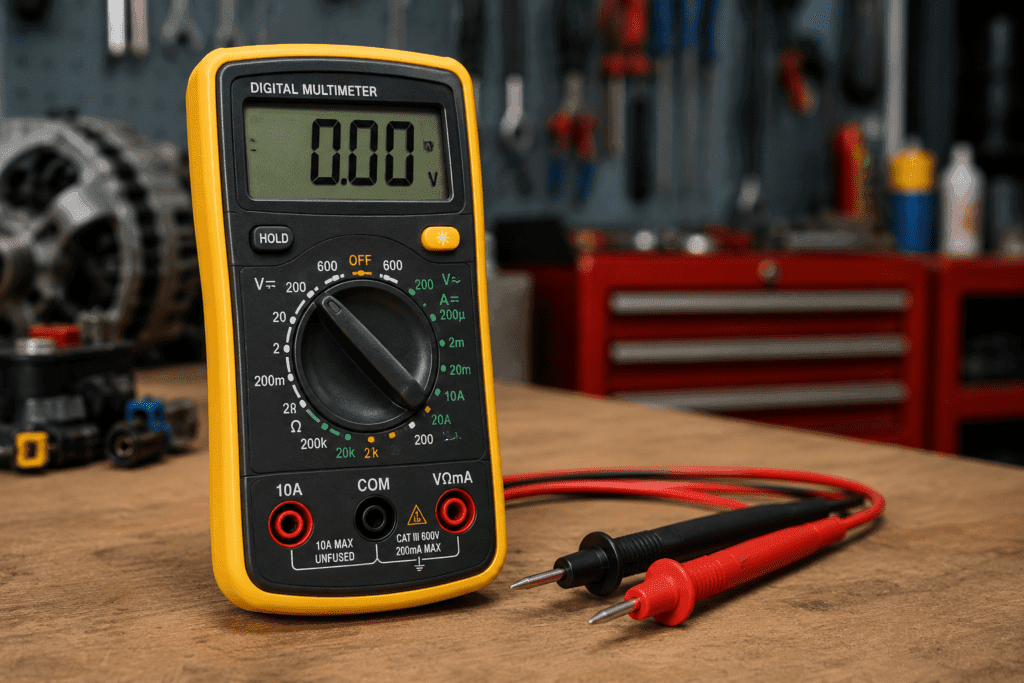
A multimeter is a handheld electrical testing tool that measures voltage, current, and resistance in a single device. Electricians, engineers, students, and DIY enthusiasts use it to diagnose and fix problems in electrical circuits, appliances, and wiring.
The name “multimeter” comes from its ability to perform multiple measurements. Before multimeters existed, technicians needed three separate tools: a voltmeter, an ammeter, and an ohmmeter. A multimeter combines all three into one affordable, portable device.
You will find multimeters used in homes, workshops, cars, factories, and electronics labs. If a device stops working and you want to know why, a multimeter is usually the first tool you reach for.
💡 Tip: Ready to use one? Check out our guide on How to Use a Multimeter for step-by-step instructions.
What Can a Multimeter Measure?
A multimeter measures several electrical properties. Here is what each one means in simple terms:
Voltage (V) Voltage is the force that pushes electricity through a circuit. You measure voltage to check if a battery is charged, a power outlet is live, or a component is receiving the correct power supply.
Current (A) Current is the flow of electricity through a wire or component. It is measured in amperes (amps). Measuring current helps you check if a circuit is drawing too much power.
Resistance (Ω) Resistance is how much a component slows down the flow of electricity. It is measured in ohms (Ω). Testing resistance helps you check if a component is damaged or working correctly.
Continuity: Continuity testing checks if there is a complete, unbroken path between two points. Your multimeter beeps when it detects continuity. This is useful for checking wires, fuses, and switches.
Additional Functions on Advanced Multimeters
Some multimeters can also measure:
- Capacitance (storage capacity of capacitors)
- Frequency (speed of AC signals)
- Temperature (using a thermocouple probe)
- Diode testing (checking semiconductor health)
💡 Tip: Not sure what continuity testing is? Read our guide on How to Test Continuity with a Multimeter.
Parts of a Multimeter (Labeled Diagram)
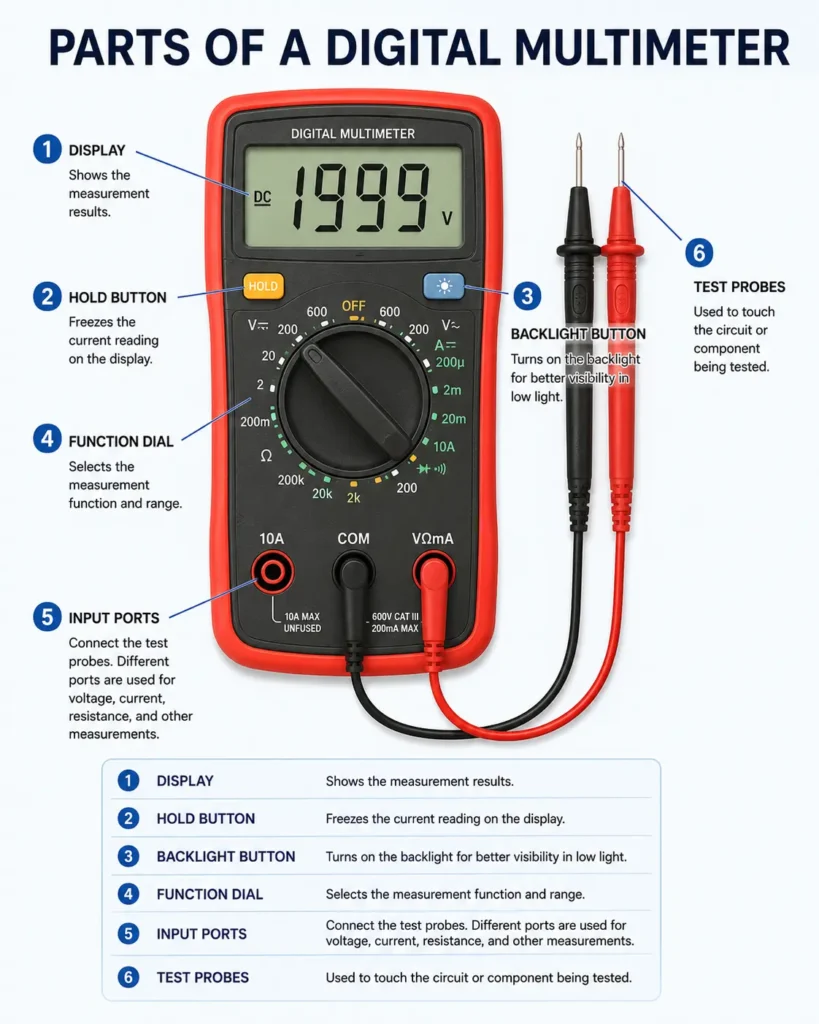
Understanding the parts of a multimeter helps you use it correctly and safely. Here are the main components every multimeter has.
Display
The display is the screen on the front of the multimeter. It shows your measurement as a number. Most digital multimeters have an LCD screen that shows up to 4 digits. The display also shows the unit of measurement, such as V for volts, A for amps, or Ω for ohms.
Selection Dial (Rotary Knob)
The selection dial is the large rotating knob in the center of the multimeter. You turn it to choose what you want to measure. Each position on the dial has a symbol representing a different function, such as DC voltage, AC voltage, resistance, or continuity.
Ports (Input Jacks)
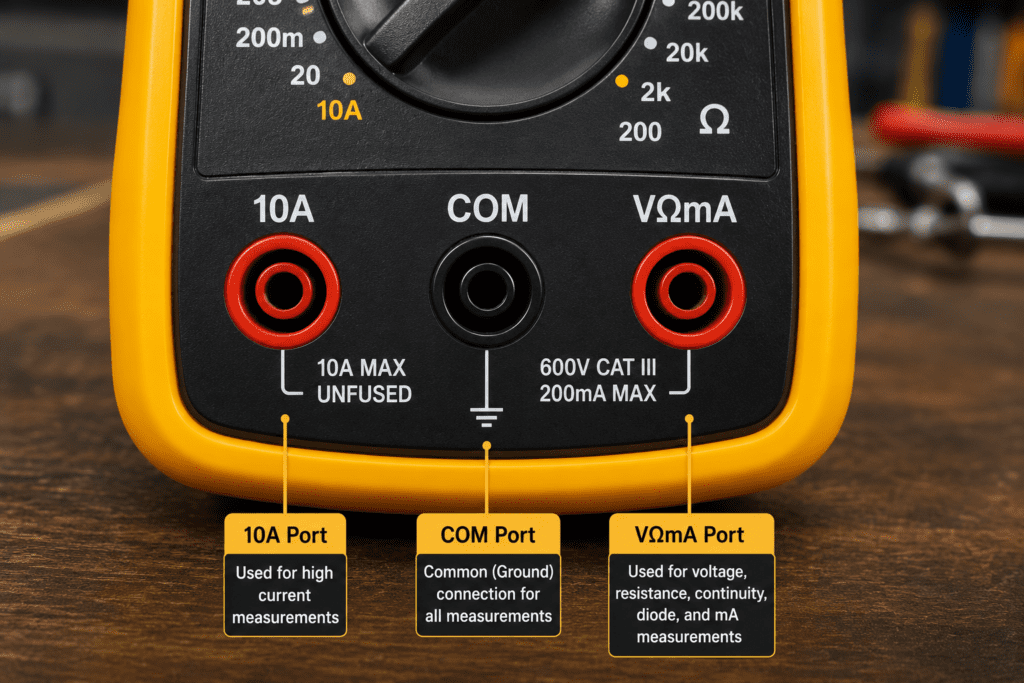
Most multimeters have 3 to 4 ports where you plug in the test leads. Here is what each port is for:
| Port Label | What It Is For |
|---|---|
| COM | Common port. Always plug the black lead here |
| VΩmA | Used for voltage, resistance, and small current measurements |
| 10A | Used for measuring large currents above 200mA |
Test Leads (Probes)
Test leads are the two wires that come with your multimeter. One is red, and one is black.
- Red lead: Connects to the positive terminal or measurement port
- Black lead: Always connects to the COM port
The tip of each lead is a pointed metal probe that you touch to the circuit or component you are testing.
⚠️ Safety Note: Always hold the probes by their insulated handles. Never touch the metal probe tips while testing a live circuit.
Function Button
Some multimeters have a function button near the dial. This button lets you switch between related settings on the same dial position. For example, the same dial position may cover both AC and DC voltage, and you press the function button to switch between them.
Types of Multimeters
There are two main types of multimeters. Each has its own strengths depending on what you need.
Digital Multimeters (DMM)
A digital multimeter shows measurements as numbers on an LCD screen. It is the most common type used today by beginners and professionals alike.
Why most people choose digital multimeters:
- Easy to read — numbers are clear and precise
- More accurate than analog models
- Auto-ranging models select the correct range automatically
- Compact and affordable
Analog Multimeters
An analog multimeter uses a moving needle on a printed scale to show measurements. The needle moves left or right depending on the reading.
When analog multimeters are useful:
- Detecting rapid changes in a circuit (the needle movement is easier to track)
- Low-cost testing when high precision is not needed
- Some older technicians prefer the needle for certain applications
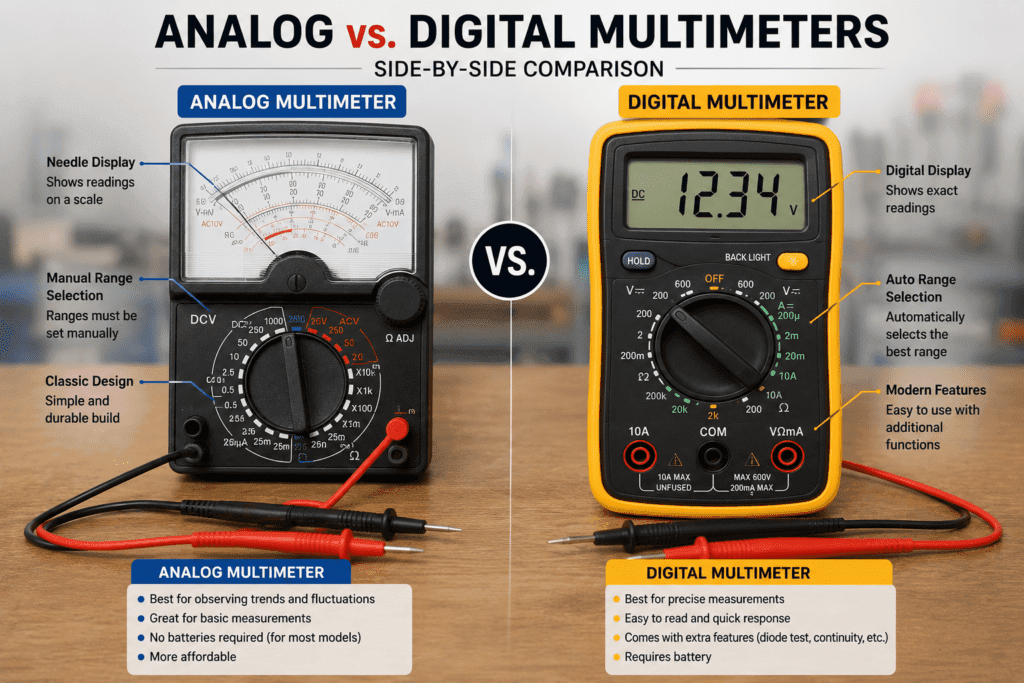
Digital vs Analog Multimeter: Which One Should You Choose?
| Feature | Digital Multimeter | Analog Multimeter |
|---|---|---|
| Display | LCD number display | Moving needle on a scale |
| Accuracy | High precision | Lower precision |
| Ease of use | Very easy for beginners | Requires practice to read |
| Price | Affordable to expensive | Usually cheaper |
| Best for | Most everyday tasks | Detecting fast-changing signals |
| Auto-ranging | Available on most models | Not available |
For most beginners, a digital multimeter is the right choice. It is easier to read, more accurate, and widely available at any hardware store.
How Does a Multimeter Work?
A multimeter works by sending a small amount of electrical current through the component being tested and then measuring what happens to that current.
Here is a simple breakdown of how each measurement works:
Voltage Measurement: The multimeter measures the difference in electrical potential between two points. It connects across a component (in parallel) and reads the voltage without interrupting the circuit.
Current Measurement: To measure current, the multimeter must be connected in series with the circuit. This means you break the circuit and insert the multimeter so the current flows through it. The multimeter then measures how much current is passing through.
Resistance Measurement The multimeter applies a small known voltage to the component and measures how much current flows. Using Ohm’s Law (V = IR), it calculates the resistance and displays the result in ohms.
Continuity Testing: The multimeter sends a tiny current between the two probes. If the current flows freely (very low resistance), the multimeter triggers an audible beep. No beep means the circuit is broken.
💡 Internal Note: Ohm’s Law (V = IR) is the foundation of how every multimeter works. Voltage equals Current multiplied by Resistance.
How to Read a Multimeter
Reading a multimeter display is simple once you know what the numbers and symbols mean.
Reading Voltage
The display shows a number followed by V. For example:
- 12.6V means 12.6 volts DC
- 230V means 230 volts AC (typical household outlet)
Reading Resistance
The display shows a number followed by Ω, kΩ, or MΩ:
- Ω = ohms
- kΩ = kilohms (1,000 ohms)
- MΩ = megohms (1,000,000 ohms)
Reading Current
The display shows a number followed by A or mA:
- A = amperes
- mA = milliamperes (one thousandth of an amp)
What Does OL Mean on a Multimeter?
OL means “overload.” The reading is beyond the range your multimeter can measure. This happens when:
- The value is higher than your selected range
- A component has failed completely (open circuit)
If you see OL during resistance testing, the component is broken. If you see OL during voltage testing, switch to a higher range setting.
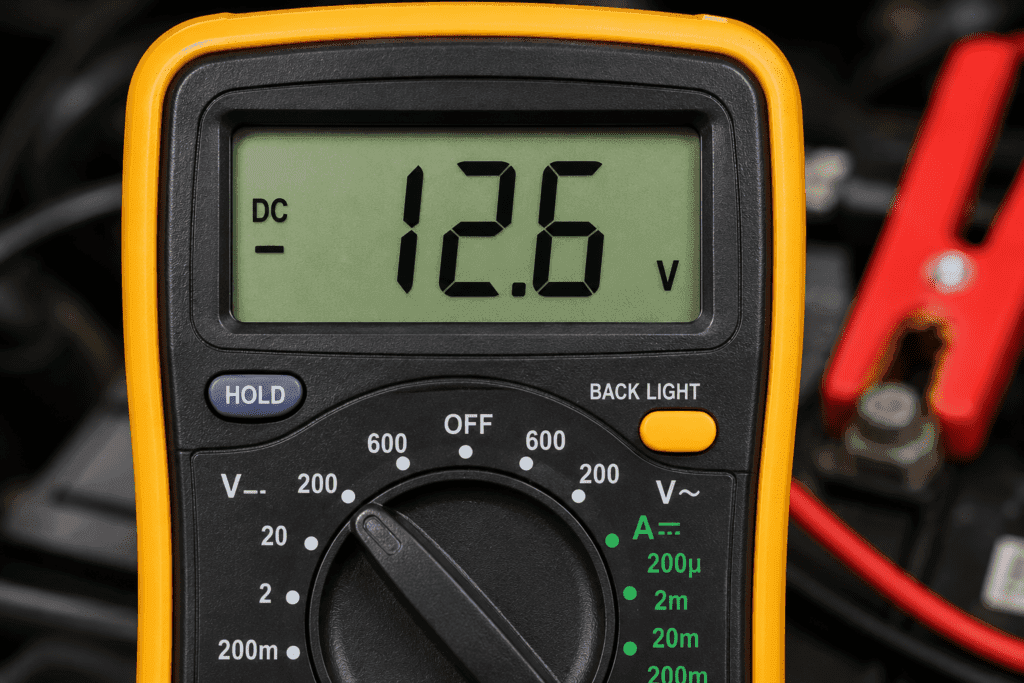
Multimeter Uses and Functions: Real World Examples
A multimeter is useful in more situations than most people realize. Here are the most common real-world uses:
Testing a Car Battery: Set the multimeter to DC voltage and touch the probes to the battery terminals. A healthy 12V car battery should read between 12.4V and 12.7V when fully charged.
Checking a Household Fuse Set the multimeter to continuity mode. Touch each probe to one end of the fuse. A beep means the fuse is good. No beep means it has blown and needs replacing.
Testing a Power Outlet: Set the multimeter to AC voltage. Insert the probes into the outlet slots. A working outlet should read around 120V in the US or 230V in the UK and Europe.
Finding a Broken Wire: Set the multimeter to continuity mode. Touch the probes to each end of the wire. A beep means the wire is intact. No beep means there is a break inside the wire.
Checking a Resistor Value: Set the multimeter to resistance mode. Touch the probes to each end of the resistor. The display shows its resistance value, which you can compare to its color code rating.
What is a multimeter used for?
A multimeter is used to measure voltage, current, and resistance in electrical circuits. It helps diagnose problems in appliances, cars, wiring, and electronic devices. It is the most common electrical testing tool used by technicians, engineers, and DIY enthusiasts worldwide.
How does a multimeter work?
A multimeter works by sending a small electrical current through a component and measuring the result. For voltage, it reads the difference between two points. For resistance, it uses Ohm’s Law to calculate how much the component resists current flow. For continuity, it beeps when current flows freely between two points.
What are the parts of a multimeter?
The main parts of a multimeter are the display, the selection dial, the test leads (probes), and the input ports. The display shows the reading. The dial selects the measurement mode. The probes connect to the circuit. The ports are where you plug in the probes.
What is the difference between a digital and an analog multimeter?
A digital multimeter shows readings as numbers on an LCD screen and is more accurate and easier to read. An analog multimeter uses a moving needle on a printed scale. Digital multimeters are better for most everyday tasks, while analog models are sometimes preferred for detecting rapidly changing values.
How do I read a multimeter display?
The display shows a number followed by a unit. For voltage, you will see V, for resistance you will see Ω or kΩ, and for current you will see A or mA. If the display shows OL, the reading is beyond the selected range, and you need to switch to a higher setting.
Can a beginner use a multimeter?
Yes. A digital multimeter is very beginner-friendly. You simply turn the dial to the measurement you need, plug in the probes, and read the number on the screen. Always start with the power turned off and follow basic safety steps.
Conclusion
A multimeter is one of the most useful tools you can own for anything related to electricity.
It measures voltage, current, and resistance, tests continuity, and helps you diagnose problems in everything from car batteries to household appliances. Understanding its parts, knowing which type to choose, and learning how to read the display puts you in full control of any basic electrical task.
Digital multimeters are the best choice for most beginners. They are accurate, affordable, and easy to read.
Now that you know what a multimeter is and how it works, the next step is learning how to use one. Check out our complete guide on How to Use a Multimeter for step-by-step instructions on every measurement.
6 thoughts on “What Is a Multimeter? Parts, Types & How It Works”