You need to measure electricity. You search online and find two tools: a voltmeter and a multimeter. Both measure voltage. Both use probes. Both display readings on a screen.
So what is actually different between them?
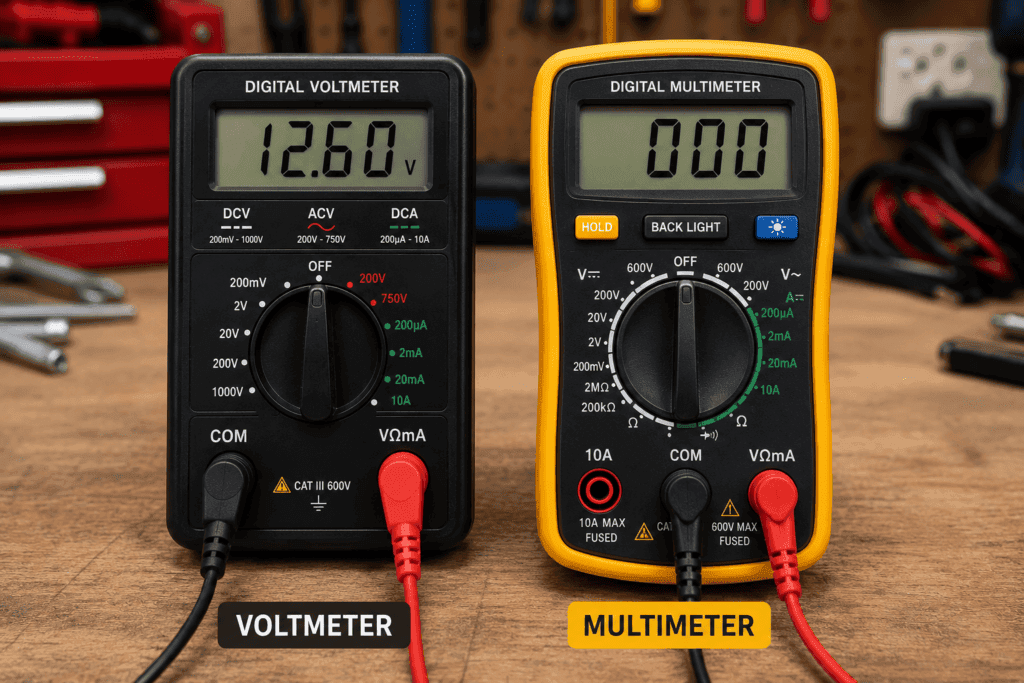
The short answer is this. A voltmeter measures voltage only. A multimeter measures voltage, current, resistance, and much more. For most people, a multimeter is the better choice. But there are situations where a voltmeter is the right tool.
This guide explains both tools clearly so you can make the right decision.
What Is a Voltmeter?
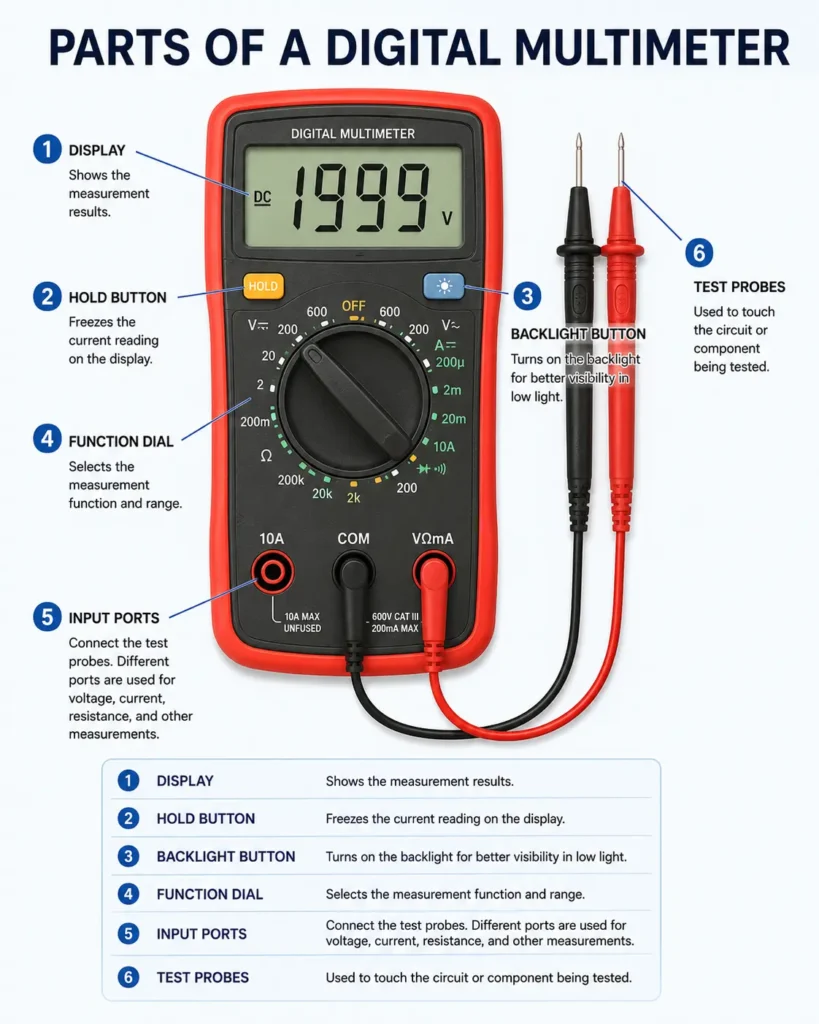
A voltmeter is a specialized electrical instrument that measures the voltage between two points in a circuit. It connects in parallel across a component and reads the electrical potential difference in volts.
Voltmeters are designed to do one job and do it very well. Because they focus only on voltage measurement, they can be built with extremely high input impedance. This makes them very accurate for voltage readings in sensitive circuits.
How Does a Voltmeter Work?
A voltmeter connects across two points in a circuit. It measures the difference in electrical potential between those two points and displays the result in volts.
Inside an analog voltmeter, a fine wire coil sits inside a magnetic field. When current flows through the coil, it creates a force that moves a needle across a printed scale. The position of the needle shows the voltage reading.
A digital voltmeter converts the analog voltage signal into a digital number using an analog-to-digital converter. It displays the result as a number on an LCD screen. Digital voltmeters are more accurate and easier to read than analog models.
Types of Voltmeters
Analog voltmeter: Uses a moving needle on a printed scale. Best for detecting rapidly changing voltages where needle movement gives a visual indication of change.
Digital voltmeter: Shows the reading as a number on an LCD or LED display. More accurate and easier to read than analog models.
Potentiometer voltmeter: Compares the measured voltage against a known reference voltage. Used in laboratory settings where very high precision is needed.
Electrostatic voltmeter: Uses electrostatic force instead of current. Measures high voltages without loading the circuit. Used in specialized scientific applications.
What Is a Voltmeter Used For?
Voltmeters are used when precise voltage measurement is the only requirement. Common applications include calibrating electrical systems in laboratories, testing high-voltage equipment where loading the circuit would affect the reading, quality control in electronics manufacturing, and verifying precise voltage levels in sensitive circuits.
Advantages and Disadvantages of a Voltmeter
Advantages: Extremely accurate for voltage measurement. High input impedance means it does not affect the circuit being measured. Simple to use — just connect and read.
Disadvantages: Measures voltage only. Cannot test current, resistance, continuity, or other parameters. Less versatile than a multimeter.
What Is a Multimeter?
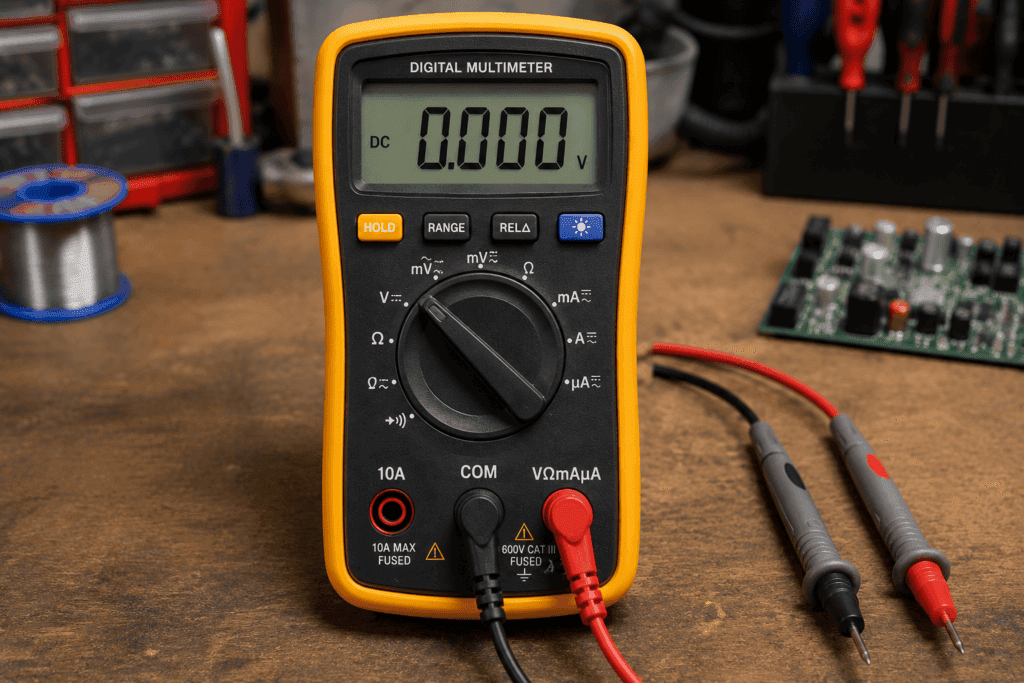
A multimeter is a multi-function electrical testing tool that measures voltage, current, resistance, and continuity in a single device. It combines the functions of a voltmeter, ammeter, and ohmmeter into one affordable, portable instrument.
The name comes from its ability to perform multiple measurements. Most modern digital multimeters also measure capacitance, frequency, temperature, and diode function.
How Does a Multimeter Work?
A multimeter works by sending a small known signal through the component being tested and measuring the result. For voltage, it reads the difference between two points. For resistance, it applies a known voltage and measures the resulting current. For continuity, it sends a tiny current and beeps when it flows freely.
The user selects the measurement type using a rotary dial. The result appears on a digital LCD in the correct unit: volts, ohms, amps, or another measurement.
What Is a Digital Multimeter?
A digital multimeter (DMM) is the most common type of multimeter used today. It displays measurements as numbers on an LCD screen rather than using a moving needle like an analog multimeter.
Digital multimeters are more accurate, easier to read, and more durable than analog models. Most modern digital multimeters include auto-ranging, which automatically selects the correct measurement range so you do not have to guess.
What Can a Multimeter Measure?
| Measurement | Unit | What It Tests |
|---|---|---|
| Voltage | Volts (V) | Battery charge, outlet voltage, circuit power |
| Current | Amps (A) or mA | Current draw, parasitic drain, motor load |
| Resistance | Ohms (Ω) | Component health, wire resistance |
| Continuity | Beep | Broken wires, blown fuses, switch function |
| Capacitance | Farads (µF) | Capacitor health |
| Frequency | Hertz (Hz) | AC signal frequency |
| Temperature | Celsius or Fahrenheit | Component temperature with probe |
| Diode test | Volts | Semiconductor health |
Advantages and Disadvantages of a Multimeter
Advantages: Measures multiple electrical quantities with one tool. Affordable and widely available. Suitable for home, automotive, and professional use. Auto-ranging models are very easy to use.
Disadvantages: Slightly less specialized than a dedicated voltmeter for pure voltage precision. Can be confusing for beginners if they use the wrong port or setting.
Voltmeter vs Multimeter: Key Differences
Side by Side Comparison Table
| Feature | Voltmeter | Multimeter |
|---|---|---|
| Measures voltage | ✅ Yes | ✅ Yes |
| Measures current | ❌ No | ✅ Yes |
| Measures resistance | ❌ No | ✅ Yes |
| Tests continuity | ❌ No | ✅ Yes |
| Tests capacitance | ❌ No | ✅ Yes (most models) |
| Input impedance | Very high | High |
| Voltage accuracy | Extremely precise | Very accurate |
| Ease of use | Simple | Simple to moderate |
| Price | Affordable to expensive | Affordable to expensive |
| Best for | Lab and precision work | General electrical testing |
| Portability | Portable | Portable |
| Replaces other tools | No | Yes |
Accuracy Comparison
For pure voltage measurement, a dedicated voltmeter is slightly more accurate than a multimeter. This is because the voltmeter is designed and optimized for one function only.
However, for everyday use testing car batteries, checking outlets, diagnosing appliances, or testing circuits — a digital multimeter provides more than enough accuracy. The difference is only meaningful in laboratory or precision calibration settings.
Price Comparison
Basic analog voltmeters start at around $5 to $15. Digital voltmeters range from $20 to several hundred dollars for precision laboratory models.
Basic digital multimeters start at around $10 to $20 for budget models. A reliable mid-range multimeter costs between $30 and $80. Professional-grade multimeters cost $100 to $500 or more.
For most users, a $30 to $50 digital multimeter gives better overall value than a standalone voltmeter because it performs multiple tests.
Ease of Use Comparison
Both tools are easy to use for voltage testing. You connect the probes and read the display.
The multimeter requires one extra step: selecting the correct measurement mode on the dial. This takes a few seconds but is straightforward once you have done it once.
Clamp Meter vs Multimeter: What Is the Difference?
What Is a Clamp Meter?
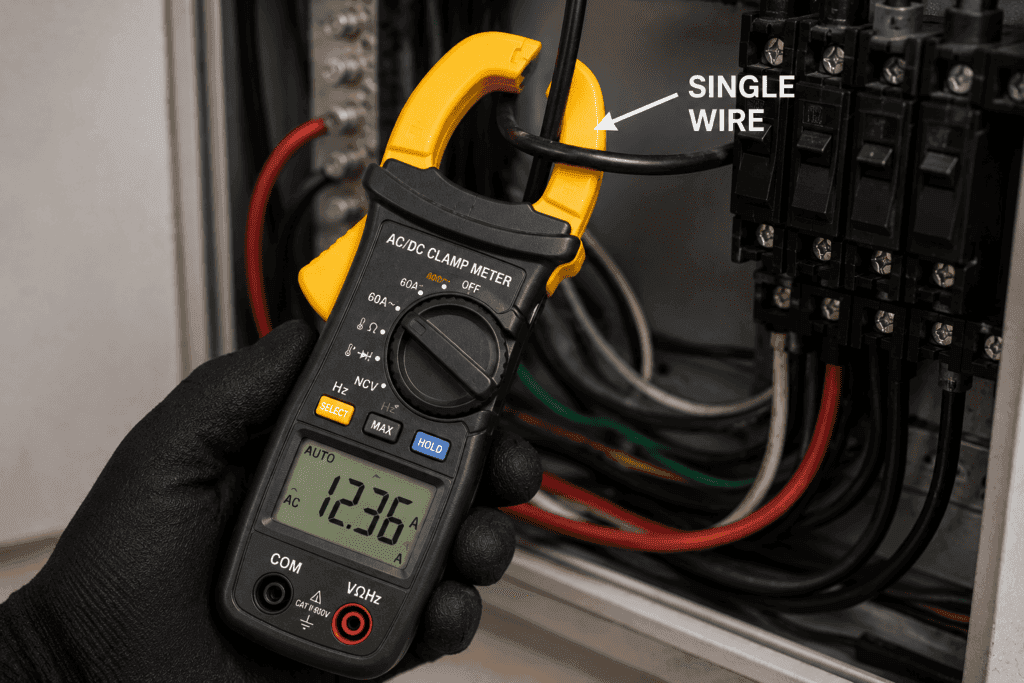
A clamp meter is a specialized tool that measures electrical current without breaking the circuit. It works by clamping its jaws around a single wire and detecting the magnetic field created by current flowing through it.
Unlike a standard multimeter, a clamp meter does not need to be connected in series to measure current. You simply clamp around the wire and read the display.
Clamp Meter vs Multimeter Comparison Table
| Feature | Clamp Meter | Multimeter |
|---|---|---|
| Measures voltage | ✅ Yes (most models) | ✅ Yes |
| Measures current | ✅ Yes — without breaking the circuit | ✅ Yes — must break circuit |
| Measures resistance | ✅ Yes (most models) | ✅ Yes |
| Maximum current range | Up to 1000A | Usually up to 10A |
| Safe for high current | ✅ Yes | ❌ Risky above 10A |
| Best for small currents (mA) | ❌ Less accurate | ✅ More accurate |
| Price | Slightly higher | More affordable |
| Best use case | High current AC/DC testing | General electrical testing |
When to Use a Clamp Meter Instead of a Multimeter
Use a clamp meter when you need to measure large currents above 10A without breaking the circuit. It is the right tool for testing motors, HVAC systems, industrial equipment, and high-draw appliances.
Use a multimeter for small current measurements, parasitic draw testing, voltage testing, and resistance testing.
Types of Multimeters
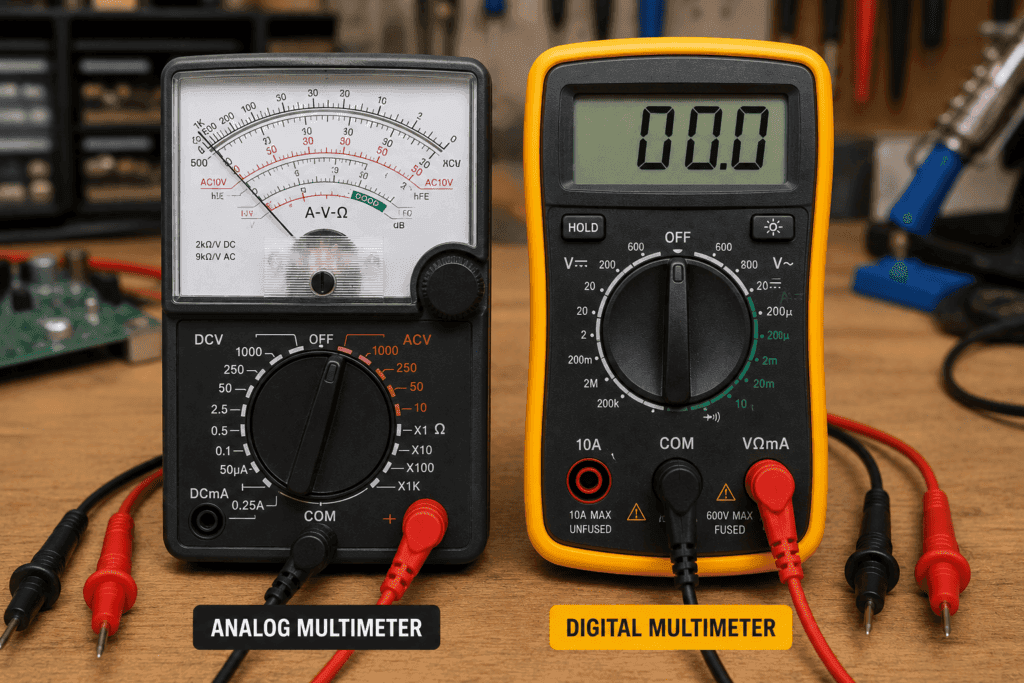
Analog multimeter: Uses a moving needle on a printed scale. Less accurate but useful for detecting rapidly changing values.
Digital multimeter (DMM): Shows readings as numbers on an LCD screen. The most common type for everyday use.
Auto-ranging multimeter: Automatically selects the correct measurement range. Best choice for beginners.
Clamp multimeter: Combines a standard multimeter with a built-in current clamp. Measures current without breaking the circuit.
True RMS multimeter: Accurately measures non-sinusoidal AC waveforms. Essential for testing variable frequency drives, motors, and modern electronic equipment.
Real World Use Cases: Which Tool Should You Use?
Use a Voltmeter When
You need extremely precise voltage readings in a laboratory setting. You are calibrating sensitive electronic equipment. You only ever need to measure voltage and nothing else.
Use a Multimeter When
You want one tool for home, automotive, and electrical testing. You need to test voltage, current, resistance, and continuity. You are a DIY enthusiast, student, electrician, or technician. You want the best value for money.
Use a Clamp Meter When
You need to measure current above 10A safely. You do not want to break the circuit to measure current. You are testing motors, HVAC systems, or industrial equipment.
Use Case Chart
| Situation | Best Tool |
|---|---|
| Testing a car battery voltage | Multimeter |
| Checking a household outlet | Multimeter |
| Testing a blown fuse | Multimeter |
| Measuring motor current draw | Clamp meter |
| Calibrating laboratory equipment | Voltmeter |
| Testing a capacitor | Multimeter |
| Checking for parasitic car battery drain | Multimeter |
| Measuring high current appliances | Clamp meter |
| Testing continuity of a wire | Multimeter |
| Precision voltage in sensitive circuits | Voltmeter |
Which Should You Buy? Voltmeter or Multimeter?
Buy a Voltmeter If
You work in a laboratory or calibration environment where extreme voltage precision is required. You only ever measure voltage and will never need to test current, resistance, or continuity.
Buy a Multimeter If
You are a homeowner, DIY enthusiast, student, electrician, or automotive technician. You want one tool that does everything — voltage, current, resistance, continuity, and more. This covers the vast majority of users.
Our Recommendation for Beginners
For most people, a digital multimeter is the right choice. It does everything a voltmeter does for voltage testing and adds current, resistance, continuity, and more. A reliable digital multimeter in the $30 to $50 range gives you everything you need for home and automotive testing.
Check out our guide to the Best Multimeters to find the right model for your budget.
How to Choose a Multimeter
Key Features to Look For
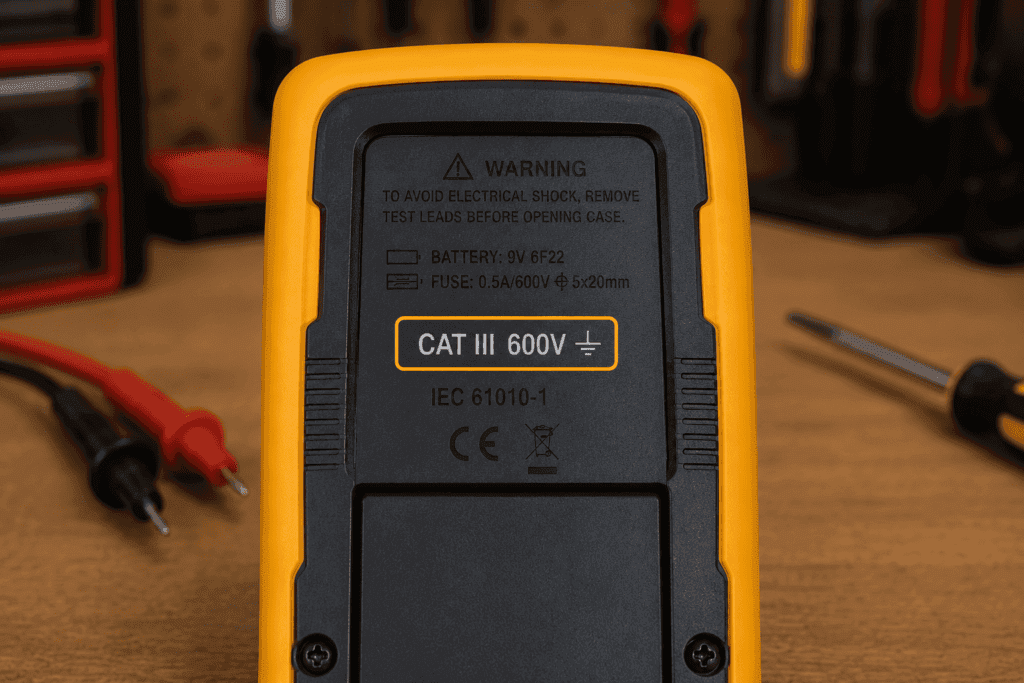
Auto-ranging automatically selects the correct range. CAT III or CAT IV safety rating for outlet and panel testing. True RMS for accurate AC measurements. Backlit display for working in dark spaces. Built-in continuity beeper. Fused current inputs for protection against overload.
Safety Rating: What CAT Rating Do You Need?
| CAT Rating | Use Case |
|---|---|
| CAT I | Electronic equipment and low voltage circuits |
| CAT II | Household outlets and appliances |
| CAT III | Fixed wiring, distribution panels, and outlets |
| CAT IV | Utility service entrance and outdoor wiring |
For most home and automotive use, a CAT III rated multimeter is the right choice.
Auto-Ranging vs Manual Ranging
Auto-ranging multimeters automatically select the correct measurement range. This is the best choice for beginners. Manual ranging multimeters require you to select the range yourself before measuring. They are preferred by experienced technicians who want faster readings.
Budget vs Professional Multimeters
| Type | Price Range | Best For |
|---|---|---|
| Budget | $10 to $30 | Basic home use and occasional testing |
| Mid-range | $30 to $80 | DIY enthusiasts and automotive testing |
| Professional | $100 to $500+ | Electricians, engineers, and technicians |
FAQ
Is a voltmeter the same as a multimeter?
No. A voltmeter measures voltage only. A multimeter measures voltage, current, resistance, continuity, and more. A multimeter can do everything a voltmeter does, plus much more.
Can a multimeter replace a voltmeter?
Yes. A digital multimeter can replace a voltmeter for almost every practical application. The only exception is laboratory or precision calibration work where a dedicated voltmeter provides marginally higher accuracy.
What is the main difference between a voltmeter and a multimeter?
A voltmeter measures only one electrical quantity — voltage. A multimeter measures multiple electrical quantities including voltage, current, resistance, and continuity. A multimeter is more versatile and suitable for most users.
What is a clamp meter used for?
A clamp meter measures electrical current without breaking the circuit. You clamp its jaws around a single wire and it reads the current passing through that wire. It is ideal for measuring large currents in motors, appliances, and industrial equipment safely.
What is a digital multimeter?
A digital multimeter (DMM) is a handheld electrical testing tool that measures voltage, current, resistance, and continuity. It displays readings as numbers on an LCD screen. It is the most common electrical testing tool used by electricians, engineers, students, and DIY enthusiasts worldwide.
Which is more accurate — a voltmeter or a multimeter?
For pure voltage measurement, a dedicated voltmeter is marginally more accurate. However, for everyday practical use, a good digital multimeter provides more than enough accuracy. The difference only matters in laboratory or precision calibration settings.
Conclusion
The difference between a voltmeter and a multimeter comes down to one thing: versatility.
A voltmeter does one job extremely well — measuring voltage with precision. A multimeter does that job and five more. For most homeowners, students, DIY enthusiasts, and technicians, a digital multimeter is the better investment.
If you are buying your first electrical testing tool, choose a multimeter. It gives you everything a voltmeter does and much more.